
Simulating Star Formation: From Giant Molecular Clouds to Protostellar Clusters
Overview
The origin of star clusters and the high mass stars that form within them remains one of the most fundamental unsolved problems in astrophysics. Moreover, many low mass stars are born in clusters containing high mass stars, and Hubble Space Telescope observations show that gaseous disks around these massive stars are destroyed by intense radiation from the stars themselves. The formation of stellar clusters and massive stars lies at the center of the web of physical processes that shaped the universe as we know it—yet the processes involved in their formation remain elusive.
Tackling such a challenge requires complex simulations that must include a large range of physical processes, including: gravity; supersonic turbulence; hydrodynamics; outflows; radiation (ionizing and non-ionizing); magnetic fields; and chemistry. However, the high degree of non-linear coupling and feedback mechanisms among these processes, along with the very large dynamic range in time and spatial scales, make such simulations difficult to produce. Our simulation work is closely connected to NASA's goals to determine the origin of stars and planets.
Project Details
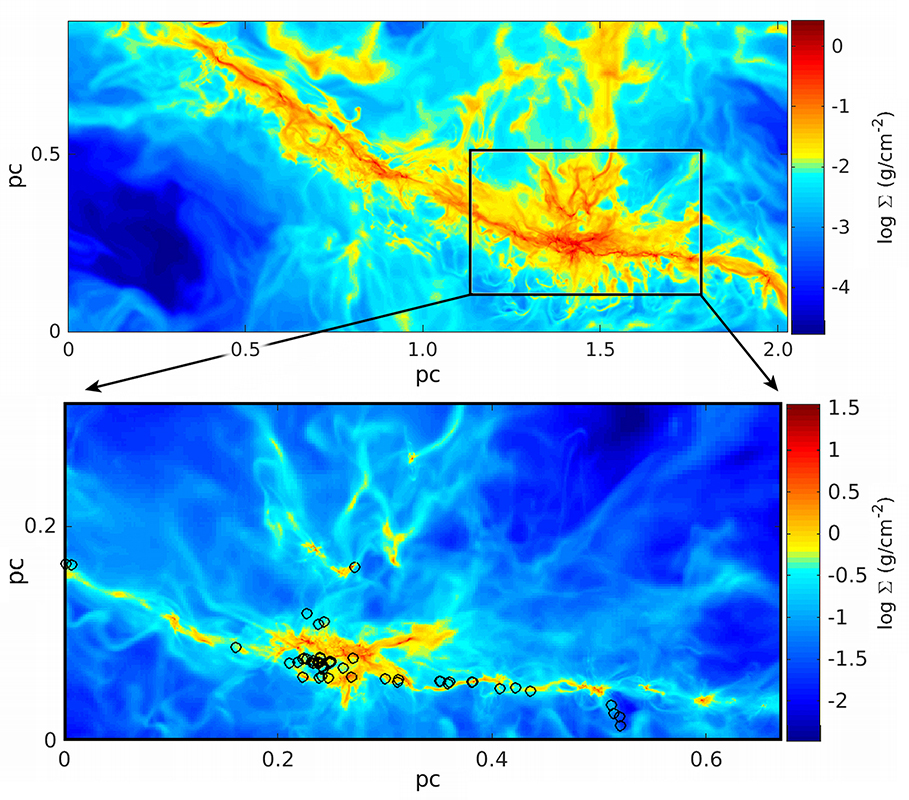
We use our advanced, 3D adaptive mesh refinement (AMR) code, ORION2, to produce large-scale simulations that include magnetic fields, radiation transport, turbulence, and highly energetic protostellar outflows. These simulations follow the gravitational collapse (over a spatial dynamic range of over 32,000) of a highly magnetized, massive molecular cloud through to the formation of multiple turbulent clumps inside these clouds, which then gravitationally collapse and result in the creation of star-forming cores. Finally, the magnetized turbulent cores are further evolved to form stellar clusters via AMR zoom-in simulations. The large dynamic range of the simulations is equivalent to 30 trillion volumetric cells.
Results and Impact
The ORION2 simulations reveal that massive, infrared dark cloud filaments (IRDCs) form by gravitational collapse in a strongly magnetized, highly supersonic, turbulent environment with a column density that has a lognormal-like probability distribution function at the early stages of collapse, evolving into a power law later. Protostars inside dense cores have a protostellar mass function that is well explained by the theoretical two-component turbulent core model at all times. At the end of the simulation (700,000 years), the distribution matches very well with the observed stellar initial mass function; and the multiplicity of binary, triple, and quadruple protostellar systems formed in the simulation match well with observations.
Why HPC Matters
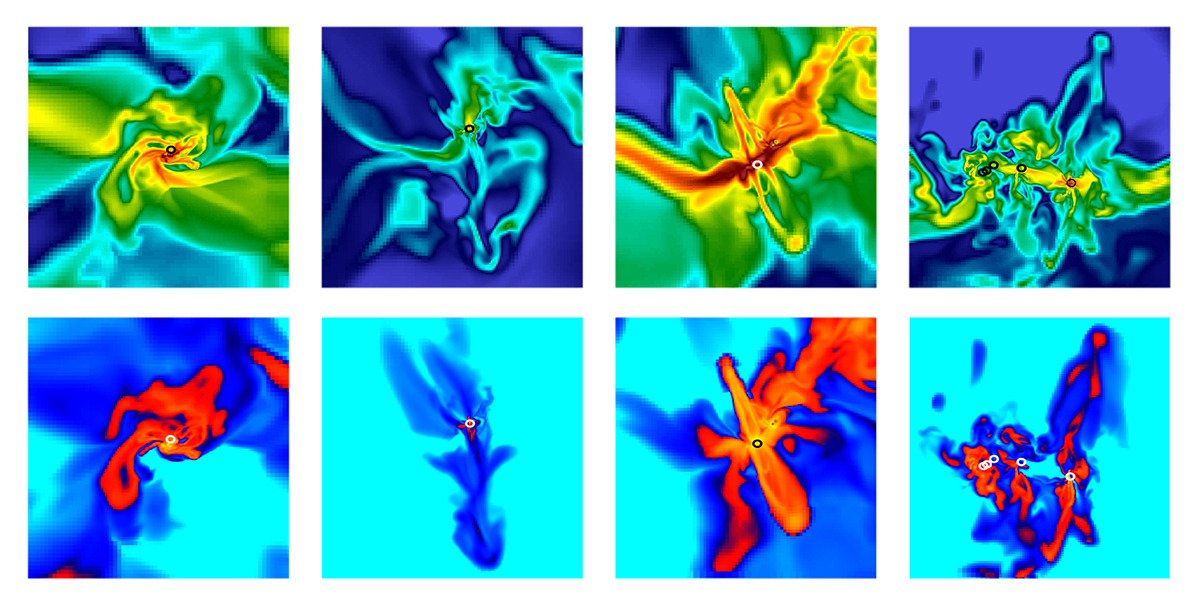
Our simulations performed on NASA's Pleiades supercomputer required 1,000–4,000 processors each, consumed over 6 million processor hours over several months, and produced about 100 terabytes of data. Simulations of such an enormous range of time and space scales and physical processes—along with accompanying data visualization—would not be possible without NASA's vast computational resources.
More Media
See additional images/videos related to this demo in our media gallery.
rklein@astron.berkeley.edu