
Designing a New Spacecraft for Deep Space Exploration
Overview
NASA is designing a new spacecraft that will enable astronauts to explore numerous destinations in our solar system. The Orion multi-purpose crew vehicle is a highly flexible and robust capsule that will usher in a new era of deep space exploration. Combined with the Space Launch System (SLS), Orion will transport astronauts to asteroids, Mars, or other celestial bodies and return them safely back to Earth. In designing the multi-purpose vehicle, engineers needed to analyze a wide range of entry conditions and verify that the spacecraft will protect its crew from the harsh environment of an atmospheric entry. Hundreds of high-fidelity computer simulations were performed to assist engineers in the design of Orion's thermal protection system (TPS) and other key components of the spacecraft.
Project Details
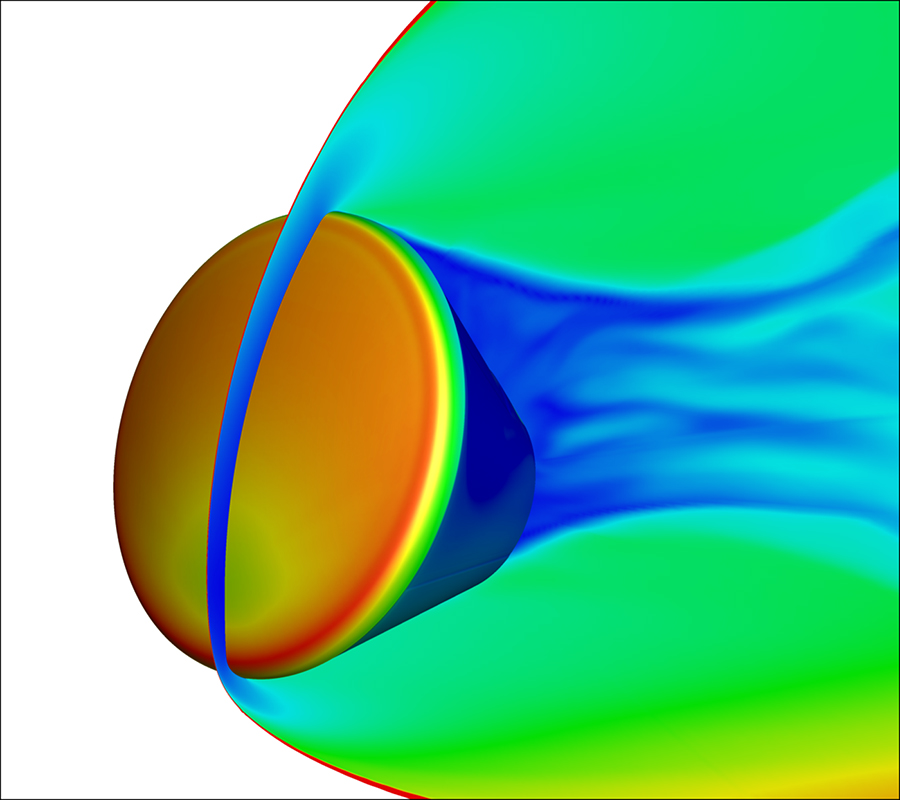
We performed computational fluid dynamics (CFD) simulations to estimate the exchange of energy between the Orion capsule and its environment at different flight conditions, such as entry speed, altitude, and orientation of the vehicle. In addition, we used computer simulations to model scenarios where high heating can occur during entry, such as the interaction of the spacecraft's reaction control system (RCS) jets with incoming flow, or enhanced heating downstream of a compression pad. The numerical simulations were computed at both flight and wind tunnel conditions and compared with experimental data. Spacecraft designers then used the computational results and test data to select and size the TPS materials for Orion.
Results and Impact
Comparisons are underway to verify the accuracy of CFD simulations with Exploration Flight Test (EFT-1) measurements and wind tunnel data, and initial assessments indicate good agreement between the numerical results and the experimental data. The comparisons will help engineers validate and refine their aerothermal models and reduce error margins in their designs. These improvements will then aid in optimizing the spacecraft design for NASA's upcoming Exploration Missions: EM-1, an uncrewed flight that will send Orion around the moon, and EM-2, scheduled to be the first crewed mission of Orion on the SLS.
Why HPC Matters
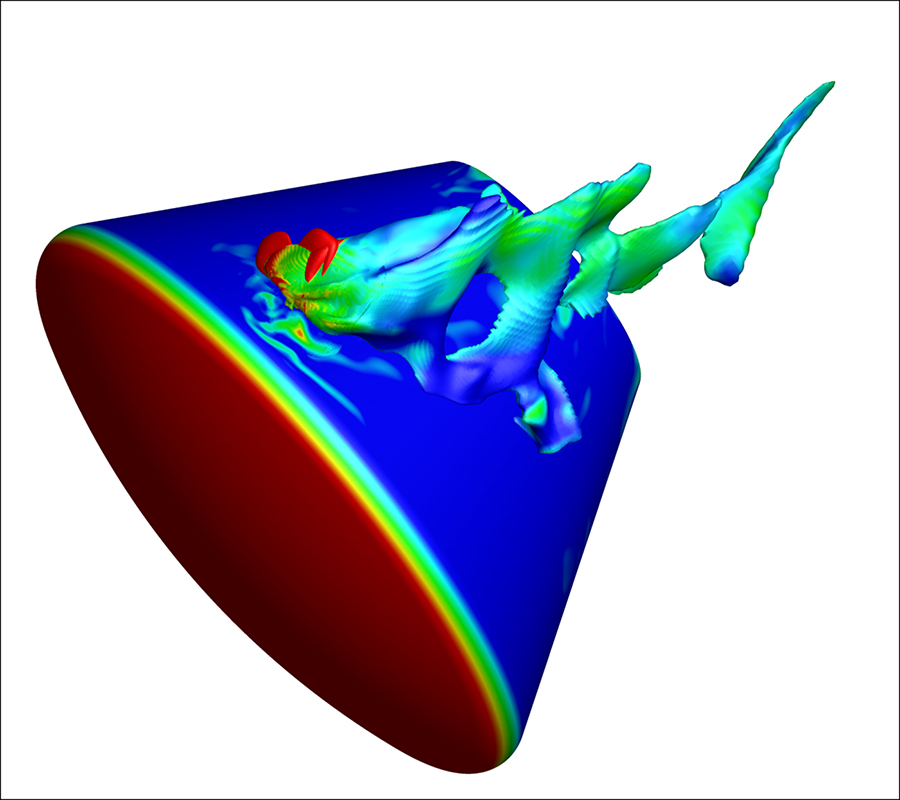
Typically, each Orion computer simulation required 300 – 400 processors and two to three days of computing time on the Pleiades supercomputer at the NASA Advanced Supercomputing (NAS) facility. The ability to rapidly turnaround solutions is critical to maintaining the ambitious schedule outlined for the Orion/SLS program—and thanks to the vast capabilities offered by the NAS facility, we were able to complete hundreds of these simulations in just one month. NAS supercomputers also enabled engineers to run detailed simulations of RCS jets and compression pads on large grids with up to 400 million grid points. Finally, high-speed networks made it possible to transfer large datasets among NASA's Ames Research Center, Johnson Space Center, and Langley Research Center.
More Media
See additional images/videos related to this demo in our media gallery.
chun.y.tang@nasa.gov Joseph Olejniczak, NASA Ames Research Center
joseph.olejniczak@nasa.gov