
Simulating the SLS Ignition Over-Pressure/Sound Suppression Water System
Overview

NASA's next-generation Space Launch System (SLS) for deep space exploration consists of four RS-25 liquid rocket engines and two five-segment solid rocket boosters (SRBs). At ignition, the SRBs create a significant over-pressure event, known as the Ignition Over-Pressure (IOP) event. The IOP event experienced in the first space shuttle flight (STS-1) in 1981 damaged the space shuttle orbiter and motivated significant design changes to the launch pad at NASA's Kennedy Space Center. The RS-25 liquid rocket engines aboard the SLS, along with the SRBs, also create a very significant acoustic environment that, if not mitigated, can harm the SLS launch vehicle. An Ignition Over-Pressure/Sound Suppression (IOP/SS) water system was developed to reduce the amplitude of both the IOP event and the acoustic environment caused by the firing of the RS-25 engines and the SRBs.
Mitigation of the IOP and acoustic environment relies on proper design of the IOP/SS system. One of several important aspects of the design is the placement of the water spray so that it reduces pressure and sound within the launch environment while not interfering with the nominal operation of other subsystems in the vicinity of the water system, such as the RS-25 engines, the SRBs, and Hydrogen Burn-off Igniter (HBOI) systems. The volume of fluid (VOF) model recently developed using the Loci-STREAM computational fluid dynamics (CFD) software program provides the ability to simulate the placement of water within the IOP/SS system.
Project Details
We constructed a detailed CFD model of the launch pad, including the IOP/SS water system and the lower portions of the SLS launch vehicle, consisting of 82 million volume cells. The Loci-STREAM-VOF CFD program was then used to perform an unsteady simulation of the IOP/SS water system. This CFD simulation—the first of its kind—was used to determine the optimal placement of the water for reducing IOP and acoustic amplitudes and maintaining operation of the other subsystems.
Results and Impact
Our CFD simulations of the initial designs identified water projection patterns that adversely interacted with both the SRBs and the HBOI subsystems. Based on the simulation results, the design of the IOP/SS system was significantly altered to avoid these problems while still performing its intended mitigation function. The CFD simulations also determined that the IOP/SS system was creating an air entrainment effect, or waterfall effect, which interfered with the intended operation of the HBOI subsystem. In this case, an HBOI system design change was devised that accommodated the waterfall effect. As a result of our work, the IOP/SS and HBOI systems are expected to operate as intended during an SLS launch—avoiding expensive redesigns and schedule delays that would have occurred if these problems had been detected much later during full-scale testing activities.
Why HPC Matters
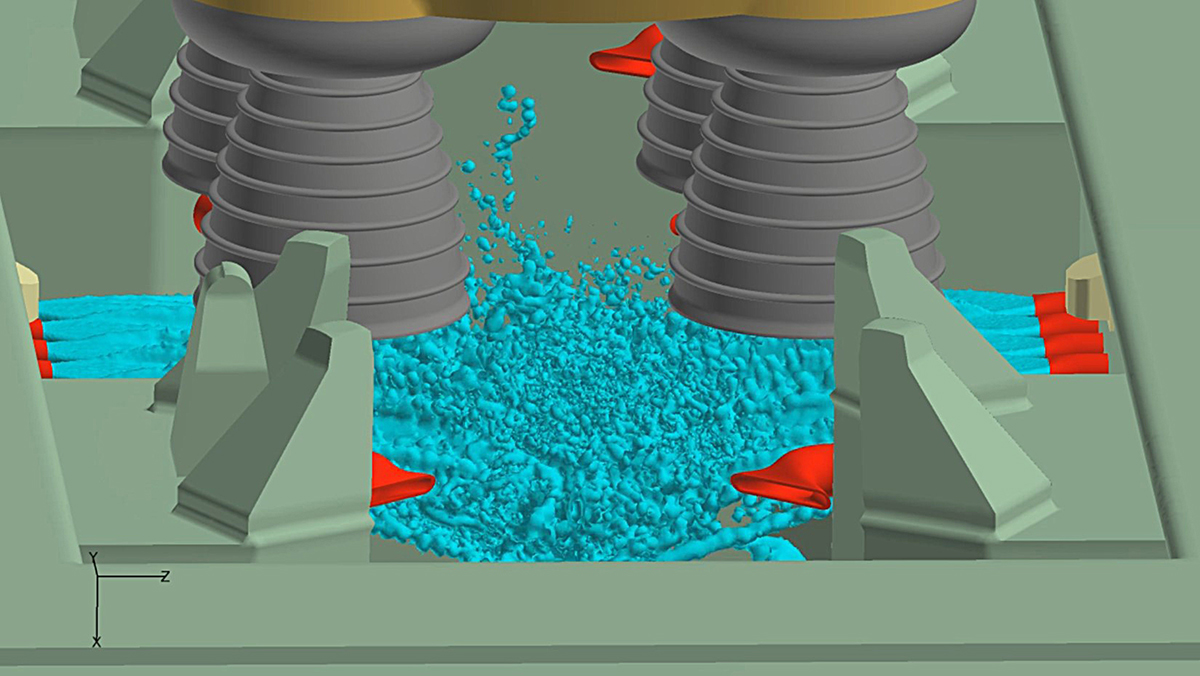
The Loci-STREAM-VOF program was developed for use at NASA's Marshall Space Flight Center to enable the use of high-performance computing for the volume of fluid algorithm. Parallel computing on NASA's Pleiades supercomputer, using the VOF algorithm for unstructured meshes, was limited to approximately 32 cores. Our work to simulate the SLS IOP/SS system with Loci-STREAM-VOF required using over 4,000 cores concurrently. An assessment of this kind would have not been possible without the NASA high-performance computing hardware and the software written to exploit it.
What's Next
The current CFD simulations are being used to analyze the placement of water by the IOP/SS system before ignition of the liquid engines and solid rocket boosters. The next steps will include combining the VOF water simulation with that of the solid rocket motor IOP event, in order to quantitatively predict the mitigation of the Ignition Over-Pressure event.
Jeff West, NASA Marshall Space Flight Centerjeffrey.s.west@nasa.gov