
Analyzing the Space Launch System Debris Environment
Overview
Following the space shuttle Columbia tragedy in 2003, NASA has made a concerted effort to identify all expected sources of debris, such as ice and foam from the propellant tanks, and to quantify the impact energy the debris may impart to the launch vehicle. This process is now being applied during the design phase of NASA's next-generation Space Launch System (SLS). Once the debris and potential impacts are fully characterized, the SLS vehicle designers can assess whether their hardware is capable of surviving this environment, or try to eliminate the sources of debris. However, an overly conservative analysis of the debris environment may drive expensive design changes that can ultimately reduce the launch capacity of the SLS vehicle. Therefore, NASA uses high-fidelity computational fluid dynamics (CFD) simulations to understand the fluid flow features that may act as transport mechanisms for debris. At liftoff, these features include solid rocket booster (SRB) ignition overpressure, rocket plume entrainment and impingement, and ambient winds. The CFD simulation data is then coupled with models of typical debris to predict the resulting trajectories and identify the affected components of the vehicle.
Project Details
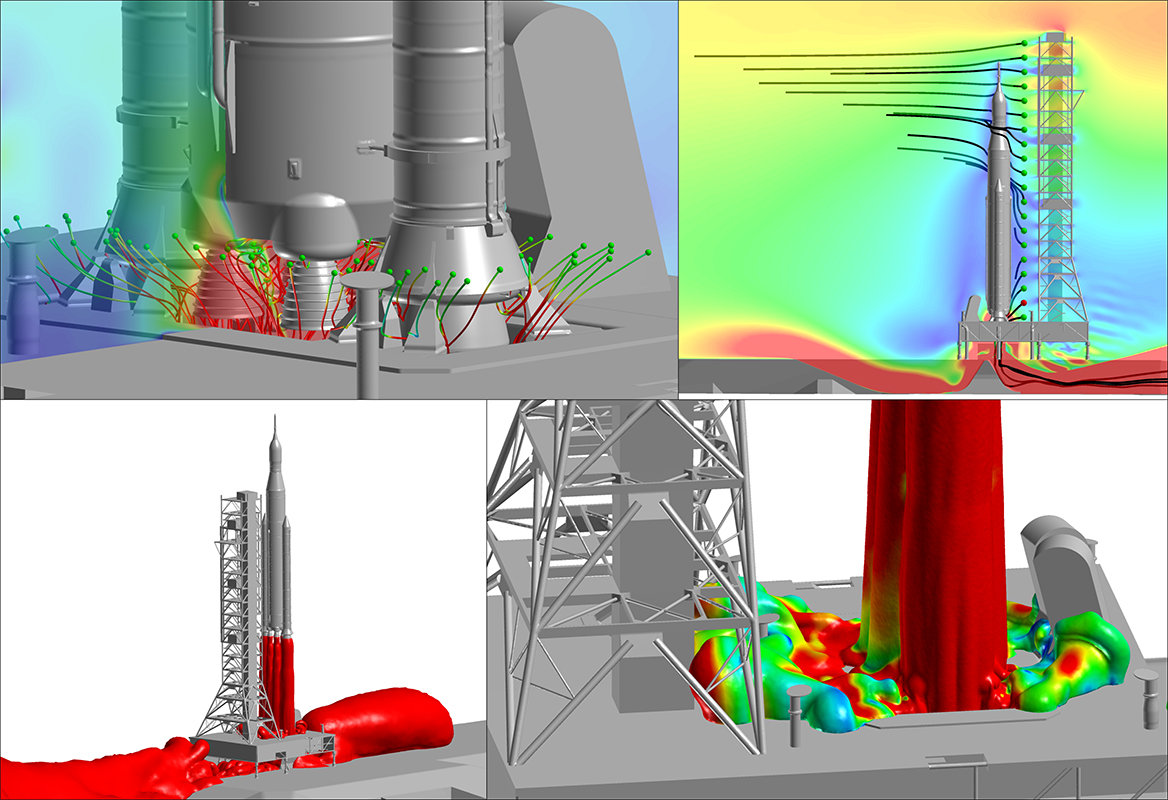
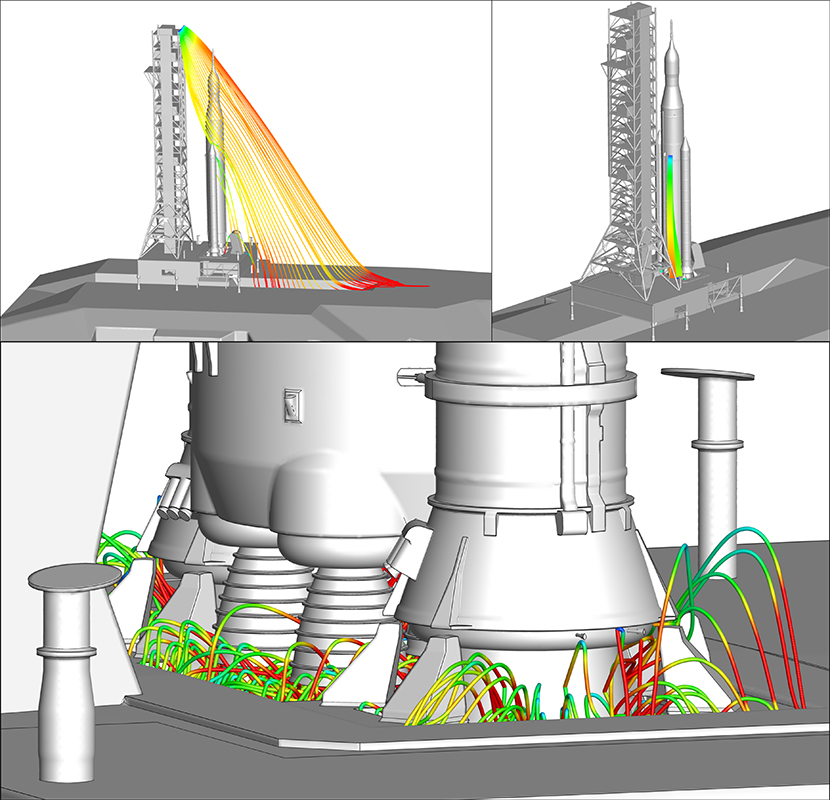
Analysis of the SLS debris environment required a two-pronged approach to address the various fluid flow aspects at liftoff. First, we conducted a series of static vehicle CFD simulations to vary the wind speed and direction, and the on/off state of the rocket plumes. Depending on the debris type and source location, different wind speed/direction combinations may result in maximum impact conditions at different parts of the vehicle. Additionally, the entrainment from the liquid engine plumes and/or the solid rocket plumes can significantly alter the course of some types of debris near the aft end of the vehicle.
Second, we used a dynamic CFD simulation of the SLS vehicle moving on a launch trajectory to investigate plume-driven flow features during the first few seconds of flight. Plume-driven flow (including SRB ignition overpressure, plume impingement, and recirculation) is especially important because it has the potential to accelerate debris near the aft end of the vehicle and the launch platform deck to much greater speeds than wind or gravity alone. These flow features are transient as the vehicle lifts off the launch pad, and cannot be captured with static CFD simulations.
Results and Impact
Our high-fidelity models and simulations reduced the uncertainty and conservatism inherent in earlier debris environment analyses that used simpler engineering models. For example, we analyzed the dynamic SLS launch simulation for high-speed upward flow resulting from plume impingement and recirculation on the launch deck—a major factor in previous debris analyses—but no significant upward flow was identified. The delivery of the updated debris environment was important to the completion of the SLS critical design review earlier this year.
Why HPC Matters
NASA supercomputing resources are instrumental to completing this type of analysis. The computational model of the SLS vehicle and launch pad requires nearly 250 million mesh cells to adequately represent the effects of the rocket plumes and the ambient winds. Each of the 25 static simulations in this work consumed approximately 75,000 processor-hours on the Pleiades supercomputer at the NASA Advanced Supercomputing (NAS) facility. The dynamic simulation of the SLS launch used nearly 4 million processor-hours, which would have been an intractable problem even ten years ago during the Space Shuttle Program. Now, we can leverage advancements in NASA's high-performance computing resources to field these high-fidelity simulations during the SLS design process.
Brandon Williams, NASA Marshall Space Flight Centerbrandon.williams@nasa.gov