
Advanced Data Analytics Platform at the NASA Center for Climate Simulation
Overview
The Advanced Data Analytics Platform (ADAPT) is a Platform-as-a-Service, managed Virtual Machine (VM) environment providing compute, storage, and data management as well as user data publication services. Its charter is to streamline the process of putting flexible computational tools at the disposal of NASA scientists, thus allowing them to focus on Earth science rather than computer science. Currently a system administration-intensive framework, ADAPT is evolving into a more cloud-like venture operating under OpenStack.
Project Details
ADAPT's feature set includes:
- A mix of physical and virtualized high-performance computing (HPC), storage, and network assets linked by QDR/FDR InfiniBand (IB) networks.
- VMs customized for data-intensive science applications and flexible enough for various loads, applications, and operating systems (Linux and Windows).
- The Integrated Rule-Oriented Data System (iRODS), RAMADDA, and ArcGIS for distributed data management.
Results and Impact

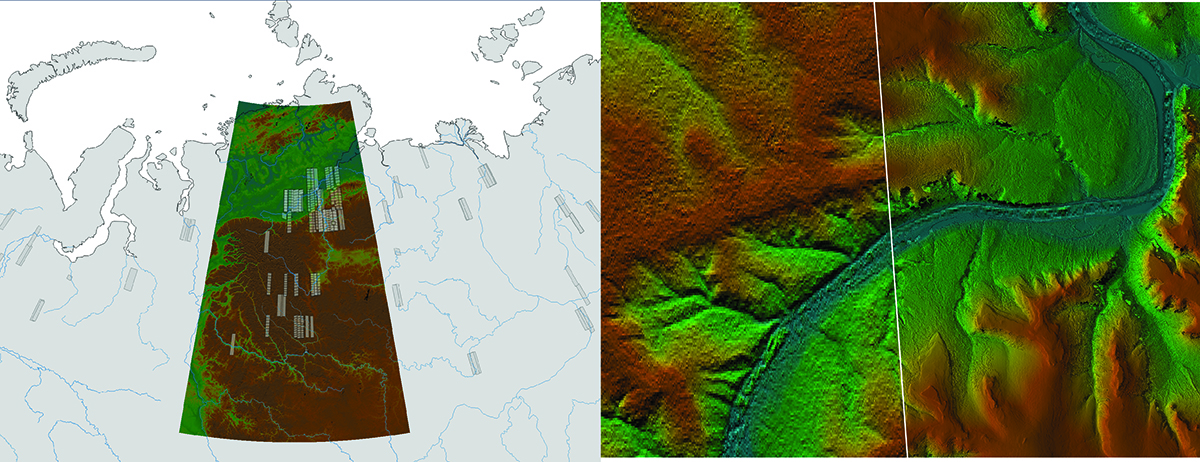
ADAPT is currently being leveraged to better understand the impacts of a rapidly changing climate in Alaska and western Canada. In partnership with NASA's Terrestrial Ecology Program, the NASA Center for Climate Simulation is supporting the Arctic-Boreal Vulnerability Experiment (ABoVE) field campaign. ABoVE will challenge scientists to take measurements in the field, study remote observations, and then run computational models to verify and project trends.
ADAPT has also been used in engineering applications such as simulating near-Earth object (NEO) discovery to assess options for improving system fidelity and rapid chip design simulations for the Laser Communications Relay Demonstration.
Why HPC Matters
At the center of the ADAPT architecture is a multi-petabyte, open-source Gluster storage environment. Surrounding the storage with multi-core, large-memory, IB-interconnected HPC nodes facilitates:
- Ephemeral VMs for "as needed" processing and persistent VMs for ongoing data delivery services.
- Highly available databases.
- Server-side graphical processing and data rendering.
- Leveraging of large, shared datasets.
Scientists interact with the ADAPT team to provision resources and launch ephemeral VMs. The data-centric, virtual system approach significantly lowers the barriers and risks to organizations that require on-demand access to HPC solutions. As OpenStack is introduced into the environment, scientists will become more self-sufficient in deploying VMs.
What's Next
Continued ADAPT evolution will concentrate on broadening the application and user footprint while augmenting both computational and storage resources. OpenStack will bring a new level of functionality and flexibility to the platform.
Dan'l Pierce, NASA Goddard Space Flight Centerdaniel.l.pierce@nasa.gov Jonathan Mills, NASA Goddard Space Flight Center
jonathan.mills@nasa.gov Hoot Thompson, NASA Goddard Space Flight Center
john.h.thompson@nasa.gov