
Numerical Simulation of Slat Noise to Support Environmentally Responsible Aviation
Overview
During takeoff and landing, the noise generated by high-lift devices on aircraft, such as the slats located at the front of the wings, cause large-amplitude broadband sound waves. These waves propagate down to communities near airports, causing disruption and annoyance. As part of NASA’s Environmentally Responsible Aviation (ERA) project, researchers are investigating noise-reduction concepts for airplanes—one of the key ERA areas for next-generation commercial aircraft. In order to reduce noise from high-lift devices, the underlying physics of the noise generation must first be understood. Toward this end, NASA teams performed both numerical simulation and experimental testing of a conventional high-lift slat device installed at high angle of attack in an open jet facility.
Project Details
We used the Launch Ascent and Vehicle Aerodynamics (LAVA) solver framework, developed at NASA’s Ames Research Center, for the high fidelity, time-accurate, near-field computational fluid dynamics (CFD) analysis of the slat noise, which was then propagated to the far-field using the LAVA Ffowcs Williams-Hawkings (FWH) acoustic module. An experimental test was also performed in the Quiet Flow Facility (QFF) at NASA’s Langley Research Center to validate the computed results of the acoustic simulation. Time-averaged surface pressure coefficient (Cp) and both near- and far-field power spectral density (PSD) spectra were used for the validation.
Results and Impact
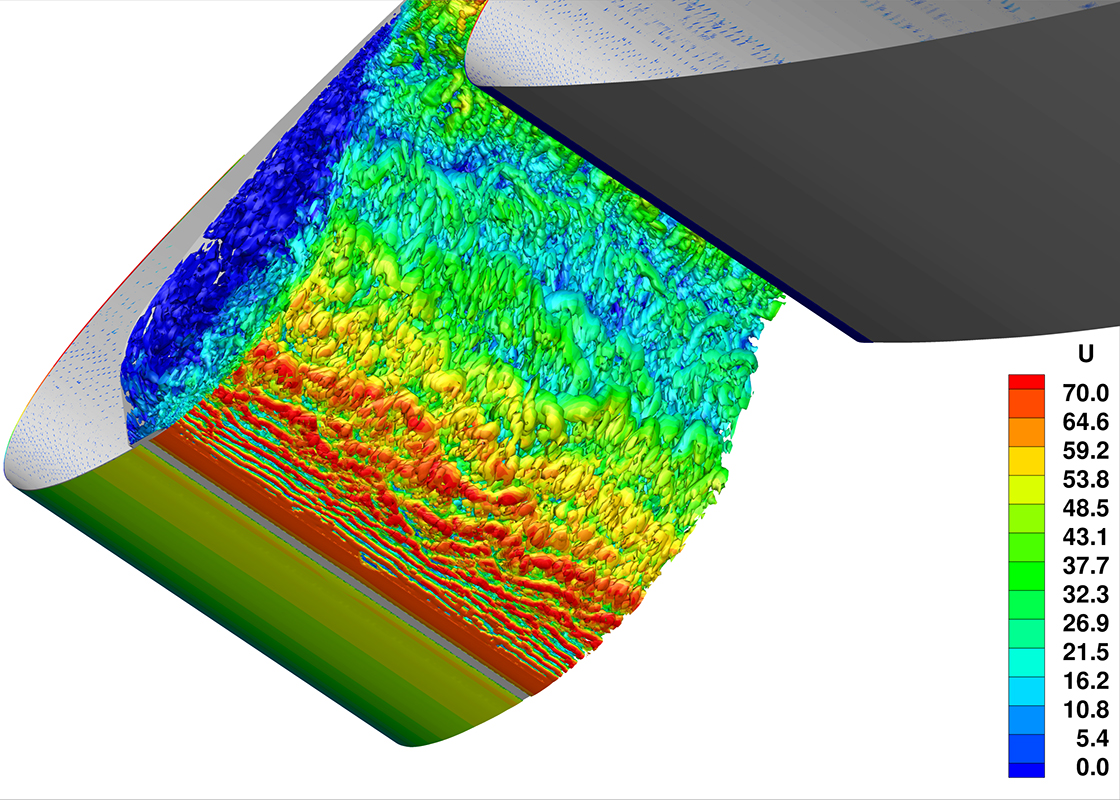
Prior to the experimental test, LAVA CFD analysis was used exclusively to help design the experiment at the QFF. Both steady and time-accurate Reynolds-averaged Navier-Stokes (RANS) calculations were performed in both free-air and installed configurations for several angles of attack. During the experimental run, the centerline Cp on the slat and main element of the wing were compared to the existing CFD results, with excellent agreement.
To simulate the slat noise, we developed a higher-order accurate, finite-difference scheme for general non-orthogonal curvilinear coordinates within LAVA, along with advanced hybrid RANS/Large Eddy Simulation (LES) models. The increased accuracy in both the numerical discretization and the turbulence model allows fine-scale structures to be modeled on relatively coarser meshes, reducing the computation resource requirements. The impact of this work on ERA includes:
- Validation of the LAVA solver framework for predicting noise generation and sound propagation from high-lift devices.
- A successful experimental test resulting from strong cross-center collaboration between NASA Ames and NASA Langley.
- A high-fidelity dataset to explore the noise-generating mechanisms, to gain a deeper understanding of slat noise.
Why HPC Matters
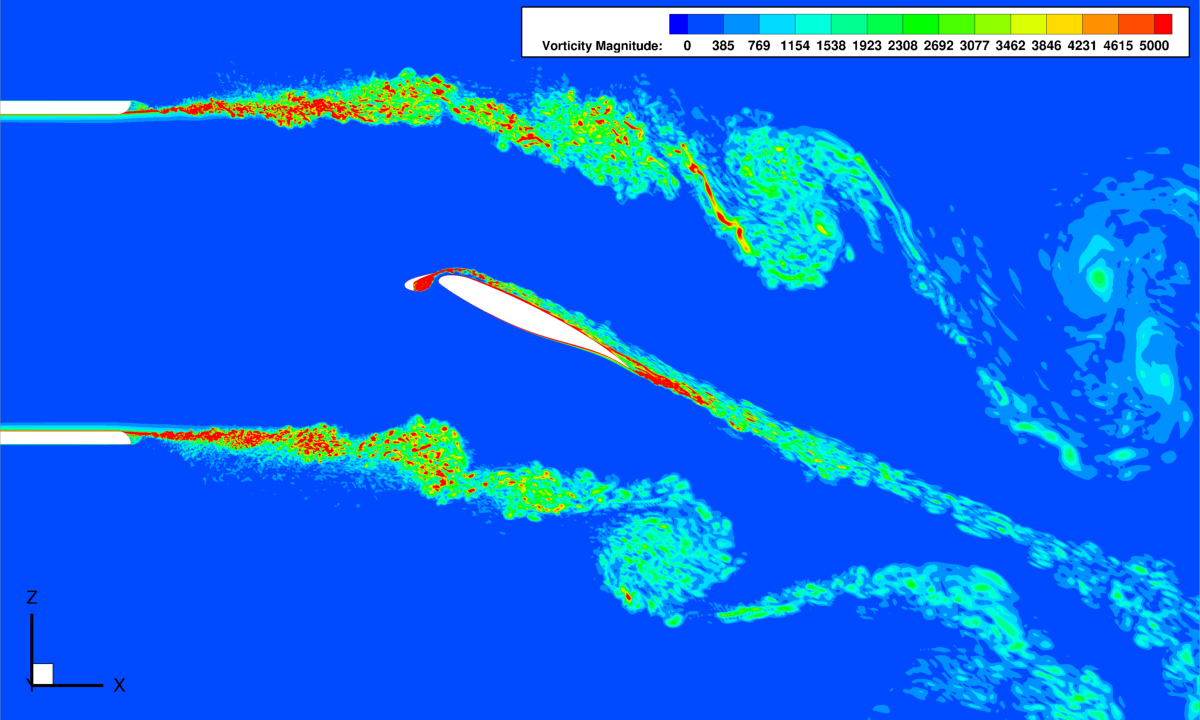
The high-fidelity, time-accurate, near-field CFD analysis was performed on the Pleiades supercomputer at the NASA Advanced Supercomputing (NAS) facility using 500 cores and 62,000 core-hours. For the acoustic propagation, the Fast-Fourier transform of the long-duration time series on both solid and permeable surfaces requires large amounts of memory—we used up to 256 gigabytes of memory to efficiently perform this part of the FWH procedure.
What’s Next
In addition to the conventional slat, a leading edge (LE) Krueger flap that was designed using the LAVA CFD analysis tools, is currently being tested in the QFF tunnel. Acoustic simulations of the LE Krueger flap will be validated with the experimental data, and differences in the noise-generation mechanisms between the slat and Krueger will be explored.
More Media
See additional images/videos related to this demo in our media gallery.
jeffrey.a.housman@nasa.gov Cetin Kiris, NASA Ames Research Center
cetin.c.kiris@nasa.gov