
Data Assimilation and Image Registration Using Quantum Annealing
Overview
Yuri Manin, Richard Feynman, and David Deutsch first conceptualized the idea of a quantum computer in the early 1980s. Quantum computers leverage quantum mechanical effects, such as superposition and entanglement, to efficiently solve computational problems. Jeffrey Fahri and co-authors first proposed the idea of quantum adiabatic computing in 2000. Central to this idea is adiabatic evolution—gradually changing conditions to allow the system to adapt its configuration. Quantum adiabatic computing is particularly well suited to solving optimization problems, a task required in many scientific fields, including Earth sciences.
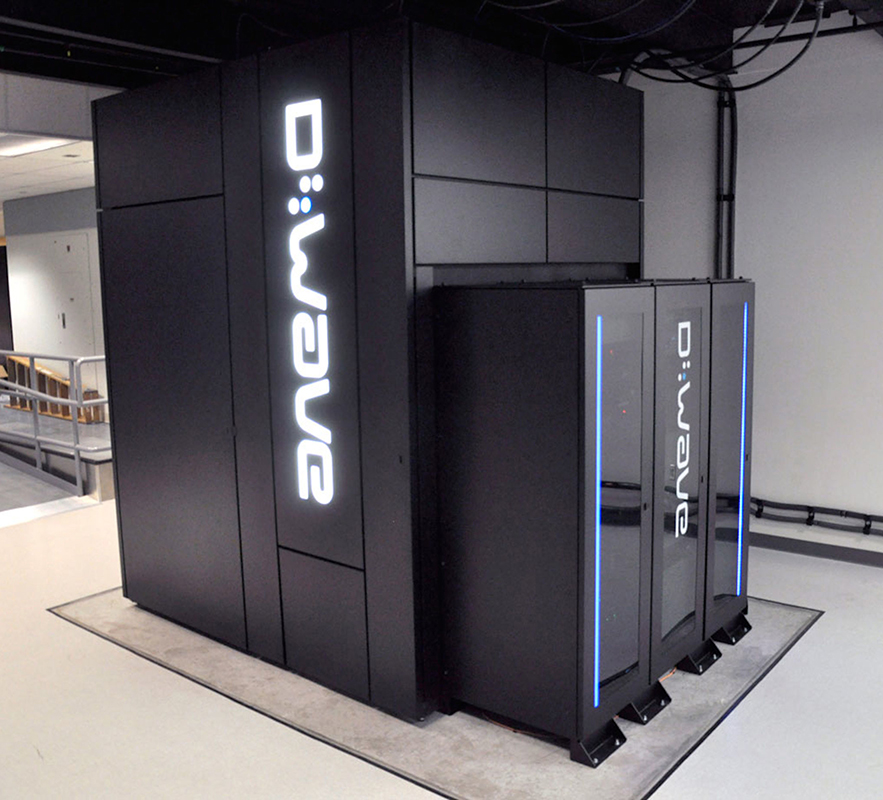
D-Wave Systems, Inc. made available the first commercial quantum adiabatic computing system in 2013. In the past year, NASA's Quantum Artificial Intelligence Laboratory, located at the NASA Advanced Supercomputing facility at Ames Research Center, upgraded its system to a D-Wave 2X computer with 1,000+ qubits (quantum bits). Research is actively being carried out on this new system. The D-Wave computer is a physical Ising system and is capable of solving quadratic binary unconstrained optimization (QUBO) problems. To learn and assess the feasibility of quantum adiabatic computing for Earth science areas, we are investigating its applicability in performing data assimilation and image registration to generate satellite data products.
Project Details
Remote sensing instruments such as the Orbiting Carbon Observatory-2, the Atmospheric Infrared Sounder, and the Cross-track Infrared Sounder can infer concentrations of carbon dioxide (CO2) in atmospheric profiles. However, they lack the near-surface sensitivity to provide direct estimates of sources and sinks. To access information about these terrestrial CO2 fluxes, NASA and other organizations must run inversion algorithms through data assimilation.
Collecting the multi-temporal data necessary to perform the assimilation is only possible through accurate calibration using image registration. Both image registration and data assimilation require minimization of real-valued objective functions. In this project, we investigate different approaches of casting these objective functions into a QUBO and solving them using the D-Wave quantum adiabatic computing system.
Results and Impact
Currently at the beginning of this two-year project, we are investigating two methods for data assimilation: A polynomial approximation cast into a QUBO, and regression using a Hopfield Neural Network (HNN). In the first method, real-valued parameters are cast into binary form using fixed precision, and higher-order terms are reduced by introducing ancilla variables. In the second method, the training of the HNN is performed on the D-Wave system. To train the HNN requires the minimization of a QUBO for each datum in the training set. In the case of image registration, we are investigating the two methods: the construction of a conflict graph between selected features of the two images being registered, and regression using an HNN.
Why HPC Matters
Earth science applications require large computational resources. Areas such as weather prediction have a strict time-to-solution requirement, and the available high-performance computing (HPC) resources, in part, determine the prediction accuracy. Quantum computing offers a drastically different approach to HPC and has the potential to play an important role in the Earth sciences.
Craig Pelissier, NASA Goddard Space Flight Centercraig.s.pelissier@nasa.gov Milton Halem, University of Maryland, Baltimore County
halem@umbc.edu