
Sensitivity Analysis for Chaotic Fluid Simulations
Overview
Formal sensitivity analysis methods play a critical role in computational science, enabling fields such as design optimization, uncertainty quantification, and error estimation. These methods provide a rigorous measure of how simulation outputs vary with changes in simulation inputs. For example, in the field of computational fluid dynamics (CFD), an aircraft designer can benefit greatly from knowing how vehicle performance varies with wing shape or how noise in the vicinity of an airport is affected by a specific landing gear configuration.
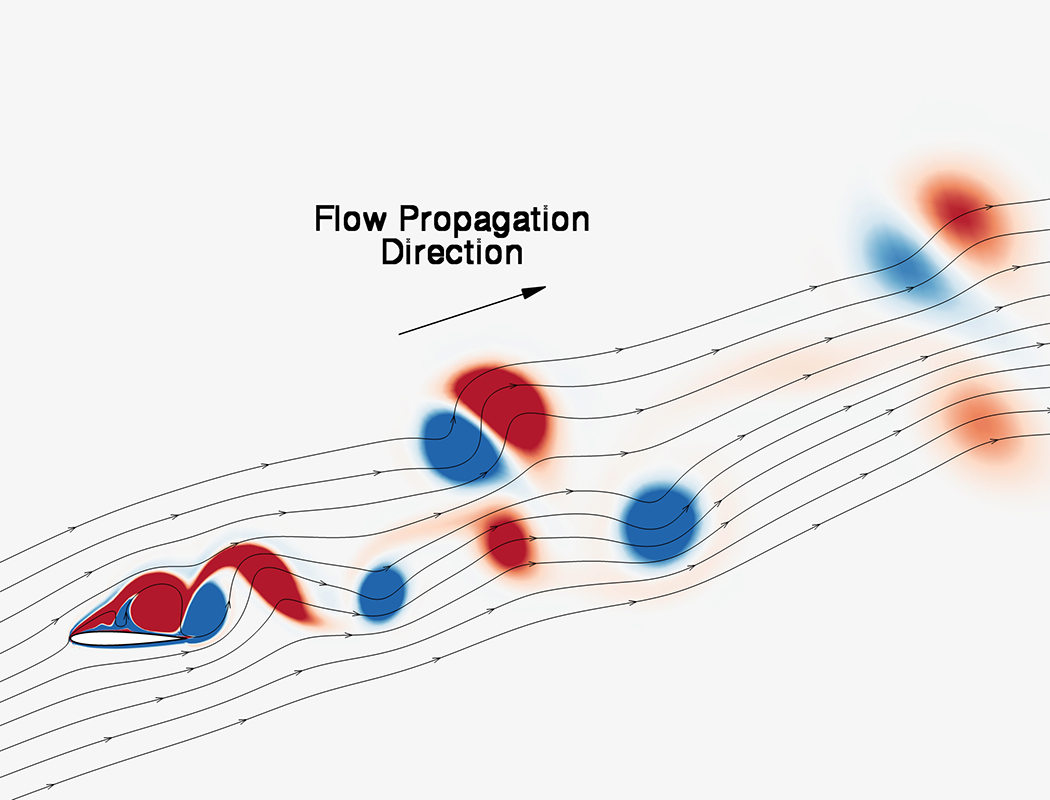
Traditional approaches to sensitivity analysis are routinely used for sensitivities of time-averaged quantities in flows governed by the unsteady Reynolds-Averaged Navier-Stokes (RANS) equations. However, as today's leading-edge simulations begin to adopt higher-fidelity, eddy-resolving techniques such as large eddy simulations (LES), hybrid RANS-LES approaches, and direct numerical simulations (DNS), classical sensitivity analysis methodologies break down, whether applied in forward or reverse (adjoint) mode. In these applications, where turbulent fluctuations are being directly simulated, the flow fields and associated outputs such as lift and drag are chaotic in nature. Traditional sensitivity analysis procedures fail to provide useful information here because of the well-known "butterfly effect" where, in chaotic dynamical systems, simulation outputs are highly sensitive to initial conditions.
Project Details
In this effort, the FUN3D development team at NASA's Langley Research Center is partnering with researchers at the Massachusetts Institute of Technology (MIT) and the National Institute of Aerospace to implement and evaluate a new approach for the sensitivity analysis of chaotic simulations, known as Least Squares Shadowing (LSS). Developed at MIT, LSS computes sensitivities using the shadow trajectory—a phase space trajectory for which perturbations to the flow field do not grow exponentially in time. To efficiently compute multiple sensitivities for one objective function, we use an adjoint version of LSS.
Results and Impact
We evaluated the LSS approach for flow over a two-dimensional NACA 0012 airfoil—a standard wing shape used in aircraft design—at a high angle of attack, in which chaotic shedding from the upper surface of the wing occurs. Using the time-averaged lift as a representative output function, the solution of the traditional unsteady discrete adjoint equations grows exponentially in time. To overcome this barrier, we were able to—for the first time—successfully apply the LSS methodology to compute a bounded discrete adjoint solution for such a flow.
If the LSS approach can be successfully extended to large-scale three-dimensional simulations, a long-standing barrier for the sensitivity analysis community will be removed. The methodology would then have a broad impact on fluid simulations of relevance to NASA aerospace work across the speed range. And since chaotic dynamics can occur in other disciplines, such as aeroelasticity, the potential benefits of the approach reach far beyond just the CFD community.
Why HPC Matters
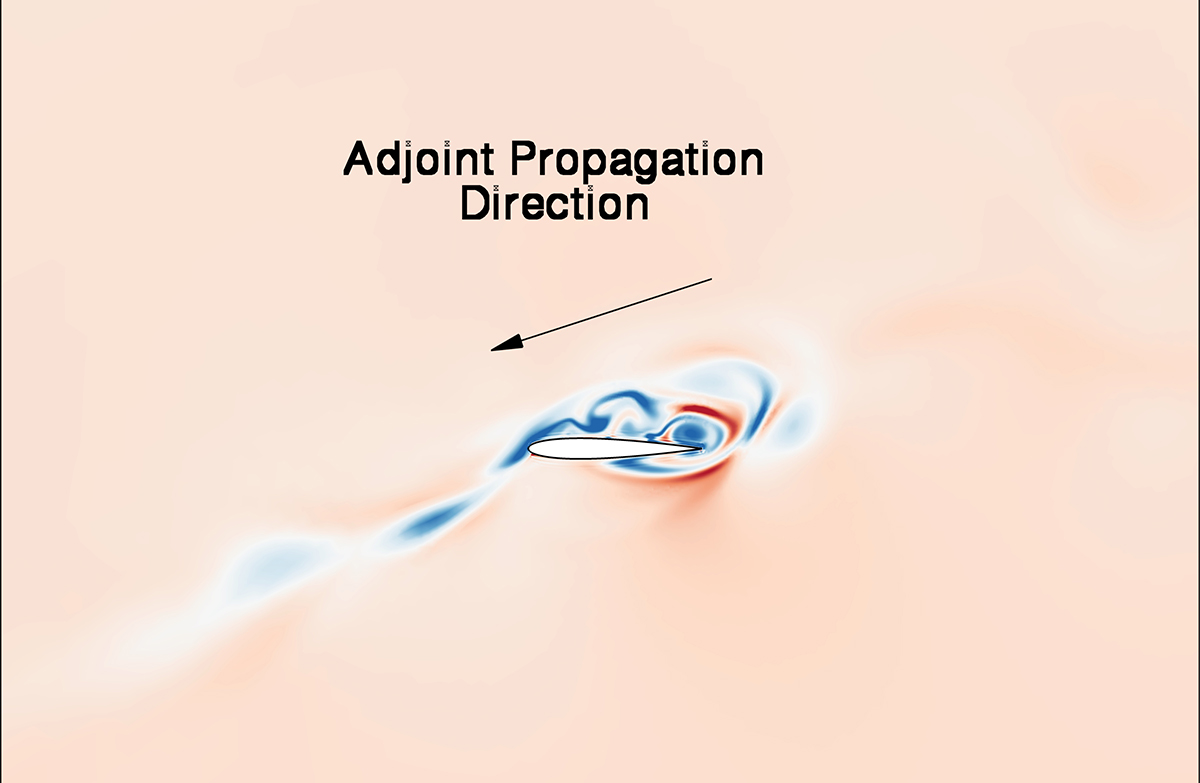
The challenge in applying LSS lies in its extreme computational requirements. Instead of the initial value problem that is solved in traditional CFD, the LSS formulation requires the solution of a globally coupled space-time system of equations. For the simple airfoil test case described above, a coarse spatial grid consisting of just 100,000 grid points is used, with 15,000 time steps. While the traditional CFD simulation for this problem could be solved in minutes on a desktop computer, the LSS formulation results in billions of coupled equations that require a parallel decomposition in time across 15,000 processors, with many terabytes of input data generated by FUN3D.
Simulations currently being performed on NASA's Pleiades supercomputer are at least six orders of magnitude larger than the baseline problem presented here. Clearly, the LSS methodology is an ideal candidate for leveraging the next generation of exascale-class hardware.
Eric Nielsen, NASA/Langleyeric.j.nielsen@nasa.gov Qiqi Wang, Massachusetts Institute of Technology
qiqi@mit.edu