
Projecting Sea Level Rise by Modeling the Evolution of Ice Sheets
Overview
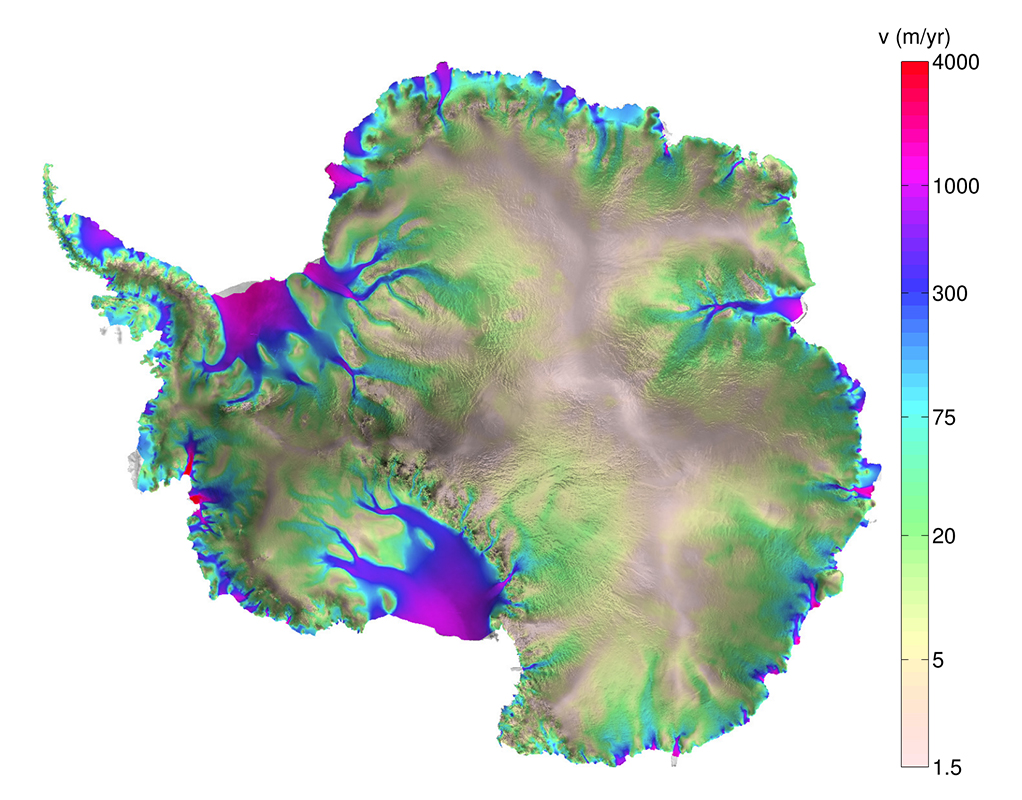
The ability to accurately project sea level rise (SLR) in a changing climate is of paramount importance to mitigate its socio-economic impacts. One of the most significant contributions to SLR comes from freshwater fluxes (evaporation and precipitation) originating in the melting polar ice sheets of Greenland and Antarctica. Understanding and projecting the evolution of these ice caps is a priority for the global science community.
A team at NASA's Jet Propulsion Laboratory (JPL) and the University of California at Irvine (UCI) has developed the open-source Ice Sheet System Model (ISSM) software to assimilate remote sensing data into projections of the water mass for both Greenland and Antarctica. The ISSM team aims to accurately assess the future contribution of freshwater fluxes to the ocean, and understand how this contribution will impact SLR in the coming decades.
Project Details
Accurately modeling the evolution of ice sheets involves complex physical processes that are still not fully understood, and requires a significant amount of computing power. Furthermore, large amounts of input data (coming from various sources, such as regional climate models) need to be processed. To address these issues, we use ISSM, a state-of-the-art finite element model, which takes full advantage of a wide range of high performance computing (HPC) environments. The HPC element is essential for dealing with the degrees of freedom that arise as a result of the huge problem domain and complex equations that govern ice flow.
Results and Impact
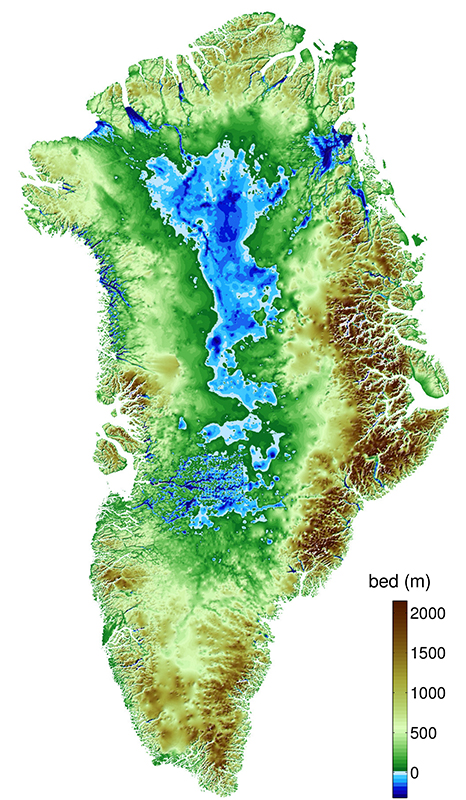
The ISSM team's results have had a widespread impact on the cryosphere scientific community. Among the team’s most significant contributions are the new capabilities to automatically differentiate the ISSM code base in order to assimilate NASA's remote sensing data, and to perform uncertainty quantification. Moreover, optimization procedures utilizing NASA's Operation IceBridge data have produced an accurate and physically consistent bedrock topography of the Greenland ice sheet. The ISSM team and users continuously push the envelope, improving the modeling of physical processes such as calving front dynamics, ice/ocean interactions, hydrology at the ice/bed interface, and paleo reconstructions of polar ice caps spanning thousands of years—with the goal of improving model spin-ups.
Why HPC Matters
Access to NASA supercomputing resources is indispensable to the ISSM team. By leveraging these resources, scientists using ISSM can complete jobs in a matter of hours, compared to weeks on conventional computing resources. For large simulation runs involving thousands of computational nodes with lots of inter-process communication, there is no other viable alternative. Of particular importance to us is the Pleiades supercomputer at NASA's Ames Research Center, which we use extensively on a regular basis.
Gilberto Perez, University of California, Irvinegilberp@uci.edu Eric Larour, Jet Propulsion Laboratory
eric.larour@jpl.nasa.gov