
Using Distributed Flaps to Optimize Flexible Wings During Flight
Overview
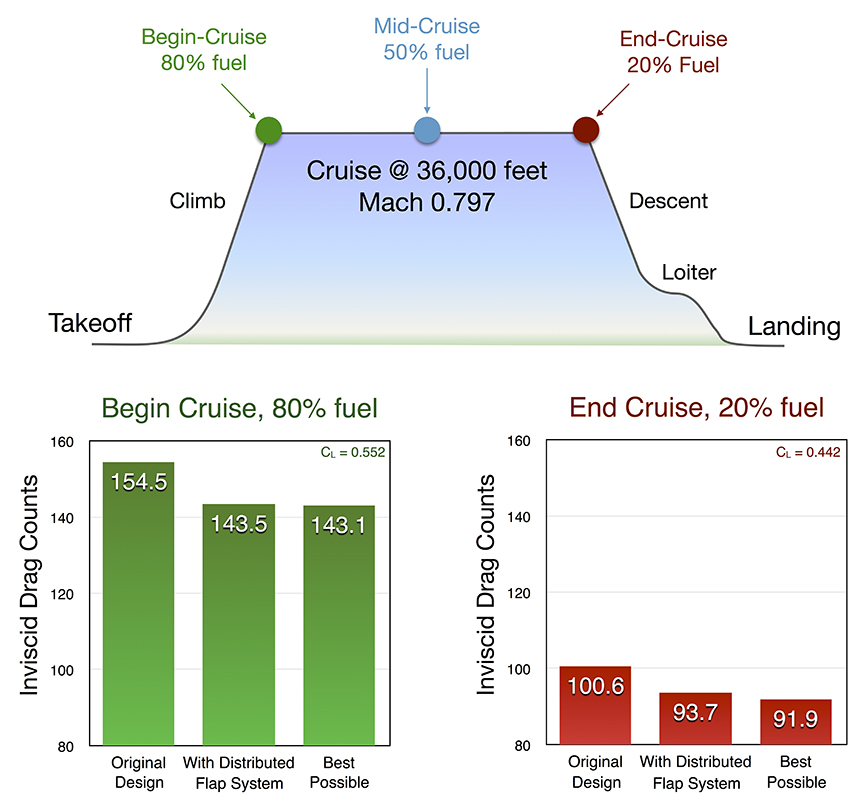
An aircraft's weight varies greatly as fuel burns throughout cruise, putting its wings "off-design" for the majority of the flight. This effect is exacerbated in newer aircraft with composite, highly flexible wings, as the weight change alters the shape of these "soft" wings more significantly in response to the changing load. In this project, we examined the potential of a full-span distributed flap system to adaptively reshape an aircraft wing in order to recover lost performance and keep the wing operating near peak efficiency throughout the aircraft's mission.
Project Details

This work involves a nested, adjoint-driven process that combines aerodynamic shape optimization with structural modeling. It optimizes deflections of an array of 48 distributed flaps to reduce lift-induced drag at multiple operating conditions during flight. Since the flaps alter lift distribution over the wing, this method deforms the flexible wing in each candidate design in response to the varying load. The aerostatic computation of the wing shape is done through an iterative aerostructural computation for the bending and twisting of the wing. The structural analysis includes varying fuel loads, structural and engine weights, engine thrust, and other important factors.
Results and Impact
We developed a fast and powerful methodology for aerostructural shape optimization for highly flexible wings that is many times more computationally efficient than traditional approaches, and is fully automated. We employed this approach to examine the potential benefit of actively managing the load distribution of highly flexible wings through adaptive deflection of a full-span flap system. Results showed:
- The full-span flap system is able to manage the wing's lift distribution to achieve near-optimal performance throughout the entire mission profile.
- The system also shows great promise for reducing performance penalties from the strong wing shock when the aircraft is operating at off-design conditions.
Why HPC Matters
While the new approach is roughly five times more computationally efficient than typical coupled aerostructural analysis methods, high-fidelity aerodynamic shape optimization is very compute intensive. A typical design cycle may examine dozens to hundreds of candidate designs before finding the optimal wing—a process that severely taxes most large computers. The extreme computational power made available by the NASA Advanced Supercomputing facility made it possible to perform these design exercises, as well as to quantify the benefits through comparison with baseline configurations, conventional stiff-wing aircraft, best-possible reference configurations, and other key reference points. We performed about two dozen full aerostructural optimizations on the Pleiades supercomputer, equating to thousands of individual computational fluid dynamics simulations.
What's Next
The ability of the distributed flap system to actively alleviate wave drag was an unexpected discovery in this work. We are now investigating the degree to which the flap system can reduce drag in so-called "dash cruise" cases, where the aircraft is intentionally flown faster than its design Mach number.
More Media
See additional images/videos related to this demo in our media gallery.
michael.aftosmis@nasa.gov David L. Rodriguez, NASA Ames Research Center
david.l.rodriguez@nasa.gov