
Test-Driving the "Sun in a Box" with NASA's IRIS Solar Observatory
Overview
The Sun is the closest star to Earth, and it impacts us in a variety of ways, many of which are not well understood. The radiation from the Sun plays a role in Earth's climate, and its violent plasma storms directly impact the space environment around our planet, which can lead to significant disruptions to our technology-dependent society (GPS reception, power grid stability). To better understand how the Sun's atmosphere is shaped and heated, and how it impacts Earth, our team is simulating a small piece of the Sun in a computational box that could hold the Earth six times over, and comparing our results with high-resolution observations of the Sun from NASA's recently launched Interface Region Imaging Spectrograph (IRIS) Mission.
Project Details
This project uses advanced multi-dimensional radiative magnetohydrodynamic simulations to take into account the complex physical processes that power the Sun's atmosphere. We perform detailed comparisons of our simulations with high-resolution observations of the low solar atmosphere from NASA's IRIS solar observatory. This combination of numerical modeling and observations is focused on revealing:
- How the outer solar atmosphere is heated to much greater temperatures than those at the Sun's surface through the dissipation of magnetic field energy.
- How the complex interactions of magnetic fields, hydrodynamics, and radiation fields shape the Sun's atmosphere.
Results and Impact
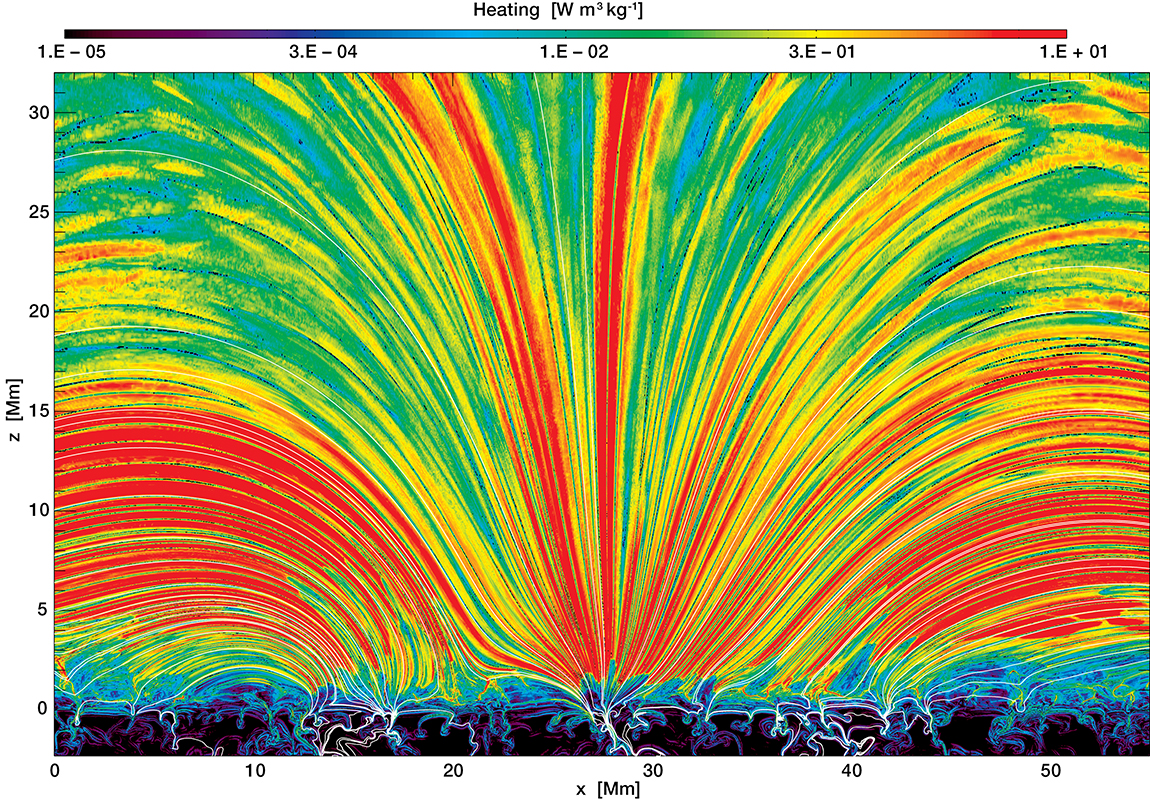
By comparing the results of our simulations with images taken by the IRIS spacecraft, we have been able to explain some of the mission's puzzling findings. The simulations have helped reveal how small-scale magnetic fields impact the lower solar atmosphere (chromosphere) and how friction between ionized and neutral particles dissipates magnetic energy and helps heat the chromosphere. Understanding the properties of the chromosphere is important, since this part of the Sun is the main source of the ultra-violet radiation that impacts Earth's upper atmosphere.
Our simulations have provided critical insight into the physical mechanisms that drive some of the violent events observed by IRIS, as well as much needed advances in methods for interpreting the complex radiation data recorded by the solar observatory.
Why HPC Matters
Numerical modeling of the complex radiative transfer and physical processes of the Sun, combined with the enormous contrasts of density, temperature, and magnetic field within the solar atmosphere, demands powerful supercomputing resources. Our simulations utilize the massively parallel capabilities of the Pleiades supercomputer at the NASA Advanced Supercomputing facility at NASA's Ames Research Center. Approximately 2 million processor-hours (48 days on 1,728 processors) were required to compute one hour of solar time.
What's Next
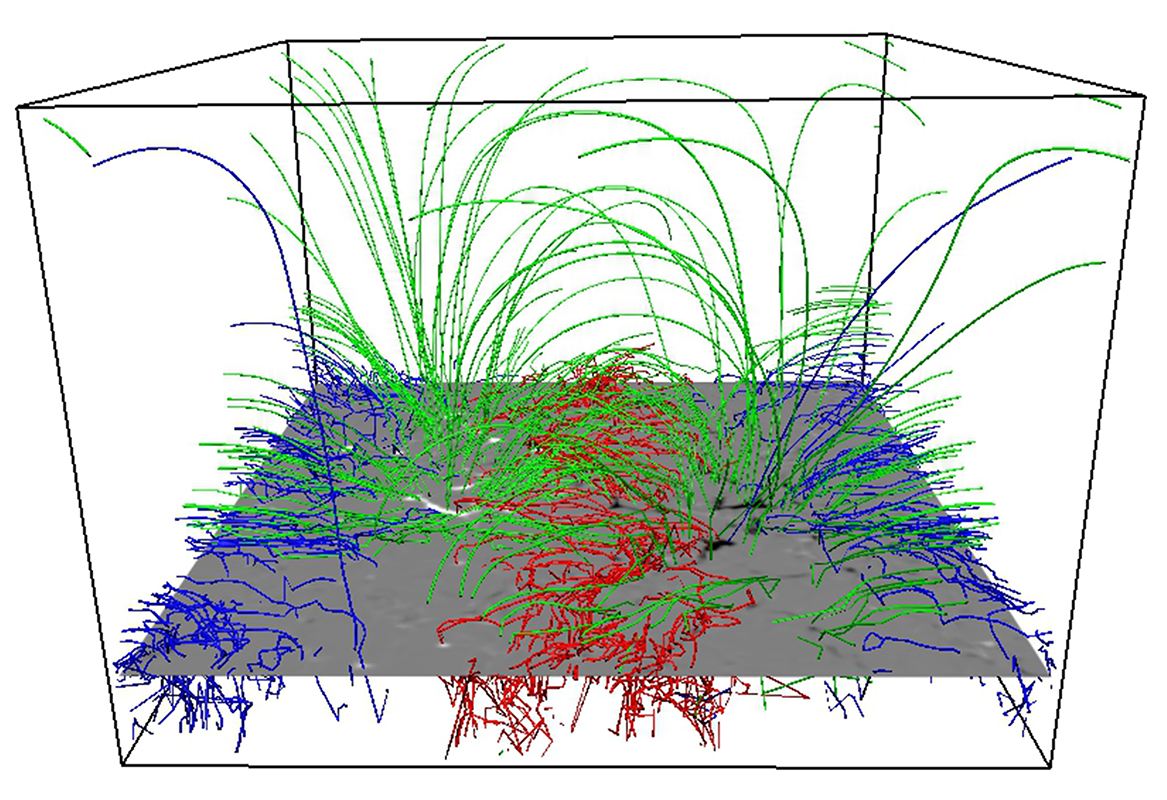
As we learn more from the discrepancies between the observations and simulations, we are working on new solar simulations with much higher spatial resolution to better resolve some of the dominant spatial scales in the solar atmosphere, and on larger computational volumes to capture the large-scale behavior of the Sun's magnetic field. This is expected to lead to better agreement with IRIS observations, which will in turn provide a better understanding of the complex mechanisms at work in our closest star.
More Media
See additional images/videos related to this demo in our media gallery.
mats.carlsson@astro.uio.no Bart De Pontieu, Lockheed Martin Solar and Astrophysics Laboratory
bdp@lmsal.com