
Building the Space Launch System Booster Separation Database
Overview
NASA's new Space Launch System (SLS) will be the first rocket since the Saturn V to carry astronauts beyond low Earth orbit, carrying 10% more payload than Saturn V and three times the payload of the space shuttle. The SLS configuration consists of a center core and two solid rocket boosters, which separate from the core as their fuel is exhausted two minutes from liftoff. There are 16 booster-separation motors (BSMs), whose short-duration burn provide the thrust to push the boosters away from the core. The aerodynamic forces that occur during flight play an important role in determining the flight of the boosters away from the core. Therefore, an accurate booster-separation aerodynamic database is needed to verify the design of the booster-separation system. This database is being built with a combination of computational fluid dynamics (CFD) simulations and a wind-tunnel test performed at NASA's Langley Research Center.
Project Details
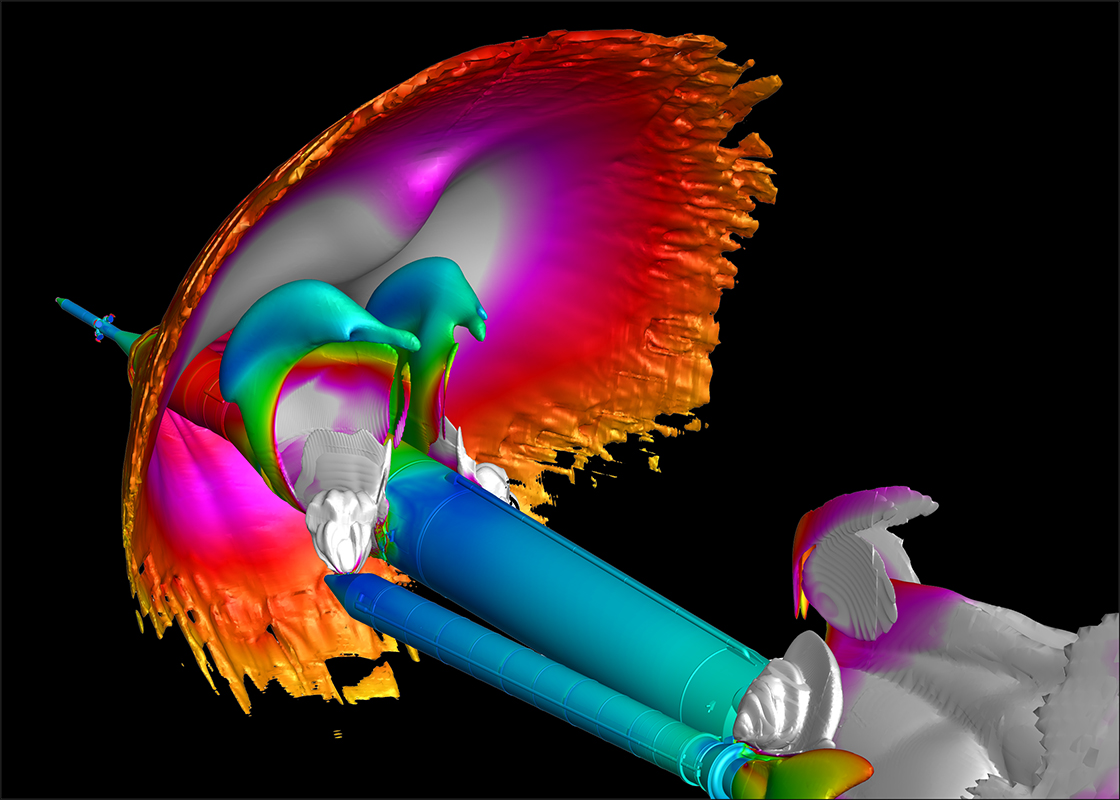
This project used CFD simulations with the inviscid Cart3D flow solver, developed at NASA's Ames Research Center, to compute the aerodynamic forces on the two solid-rocket boosters and the core. Additional terms for the database were built using the results from a wind-tunnel test and with the high-fidelity OVERFLOW CFD solver. The CFD calculations include simulating the aerodynamic effects of 22 different plumes firing during the separation, including 16 BSM plumes, the plumes from the four core-stage main engines, and two plumes from the boosters.
The aerodynamic data is a function of eight independent variables. These include three translation variables and two rotation variables to define the booster position and orientation relative to the core, the free-stream angle of attack and angle of side-slip of the core, and the relative thrust of the booster-separation motors. In addition, separate sets of computations were run to simulate the possible effects caused by one of the core-stage engines failing.
Results and Impact
Over 22,000 Cart3D simulations were used to fill the parametric space describing the booster separation event. In addition, 390 OVERFLOW simulations were run to provide higher-fidelity data. Comparisons among the Cart3D results, the wind-tunnel data, and the OVERFLOW data showed that the Cart3D code could accurately predict the booster and core aerodynamics to within an acceptable margin.
The new database will be used by the Guidance, Navigation, and Control group at NASA's Marshall Space Flight Center to simulate the SLS booster-separation event. These simulations will be run to ensure that the boosters can separate successfully without recontacting the core under all possible flight conditions, in order to verify the design of the SLS booster-separation system.
Why HPC Matters

All of the CFD simulations were run on the Pleiades supercomputer, primarily on the 24-core Intel Xeon “Haswell” nodes. Each of the Cart3D simulations required approximately 200 core hours, and the OVERFLOW runs required at least 20,000 core hours. A total of 12.7 million core hours were used to complete the computations. Most of these simulations were run over a two-month period, during which the project used 400 dedicated Haswell nodes (9,600 cores) and approximately 50 terabytes of short-term disk storage.
Stuart Rogers, NASA Ames Research Centerstuart.e.rogers@nasa.gov Derek Dalle, STC, NASA Ames Research Center
derek.j.dalle@nasa.gov