
Discovering How Galaxies Form: Comparing Simulations with Hubble Images
Overview
The farther away a galaxy is, the longer it takes for its light to travel to Earth. If we observe a galaxy whose light took 5 billion years to reach us, we see it as it was 5 billion years ago. When we look out in space, therefore, we look back in time—galaxies that are farther away are seen at an earlier stage in their evolution.
We live in the disk of the Milky Way galaxy, which has a spheroid at its center. Nearby, other large galaxies are also combinations of stellar disks and spheroids. However, images of faraway galaxies from the Hubble Space Telescope reveal that when they first form, they are very different from the mature galaxies we see near our own Milky Way. Understanding the reasons for this is a challenge for theoretical astrophysicists.
Project Details
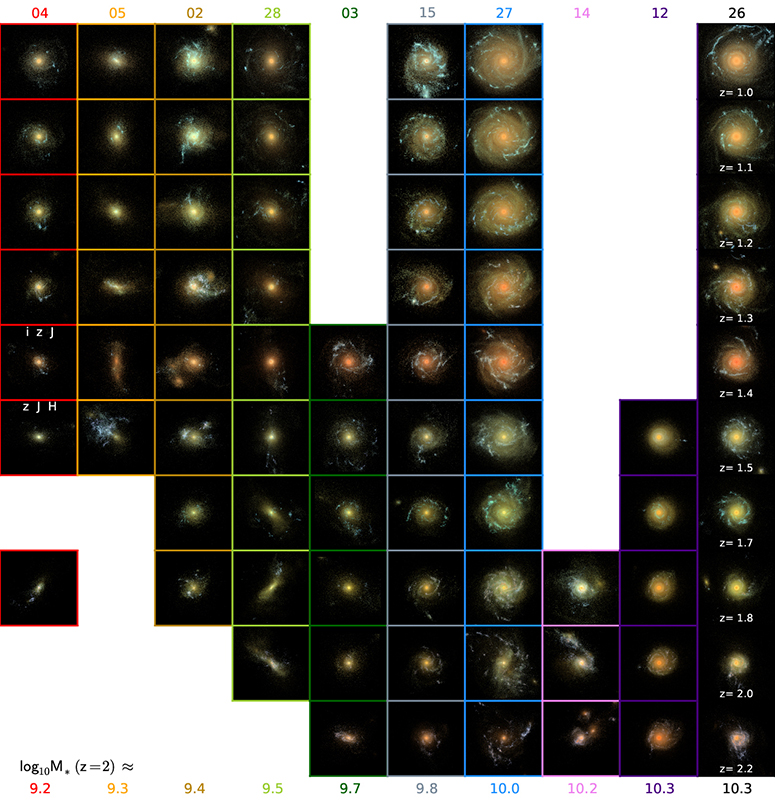
The Hubble images show that new galaxies are sausage-shaped, and a majority of star-forming galaxies have giant clumps of stars hundreds of times more massive than those in nearby galaxies. We used to think that galaxies grow in size as they grow in mass, but observations show instead that galaxies typically undergo one or more compaction processes that rapidly shrink their sizes. Our latest high-resolution supercomputer simulations show all of these phenomena, and are helping us understand how and why these processes occur.
Until a few years ago, even the best galaxy simulations were not much like real galaxies. But now, with increased supercomputer power and improved simulation codes, we are producing simulated galaxies that closely resemble the images and spectra of galaxies both nearby and in the early universe—and this can help answer our challenging astrophysics questions.
The key improvements in galaxy simulation are: the ability to start from realistic cosmological initial conditions; significant increases in resolution; and increased realism of the simulated astrophysics. For example, in nearby regions where stars are forming, observatories have revealed “pillars of creation”—regions where dust protects developing planetary systems from the intense radiation of the most massive, short-lived stars. Our simulations now include this radiation, as well as the effects that occur when these massive stars explode as supernovas.
Results and Impact
Our simulation results show that forming galaxies are sausage-shaped because they form along the long filaments of the cosmic web of dark matter, and that massive clumps form in early galaxies because the galaxies contain so much gas that their disks become violently unstable. In the simulations, this instability is one of three reasons that forming galaxies shrink dramatically; we are now working to determine observations that can clarify which of these processes is responsible for compaction in specific observed galaxies.
Our work supports the largest-ever Hubble Space Telescope project, the Cosmic Assembly Near-infrared Deep Extragalactic Legacy Survey (CANDELS). The simulations not only help explain many of the key features observed in galaxies that are in the process of formation, but they also help researchers make predictions for upcoming missions, such as the James Webb Space Telescope (JWST), which will provide more detailed images and spectra of even more distant galaxies. The JWST is scheduled for launch in 2018.
Why HPC Matters
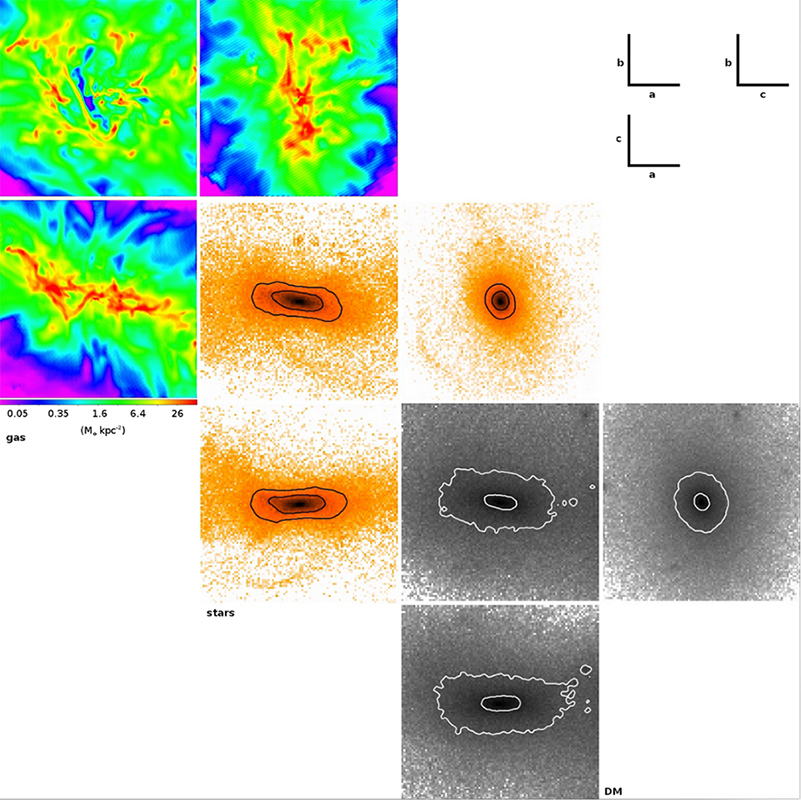
We used tens of millions of processor hours on NASA's Pleiades supercomputer to model both the large-scale distribution of galaxies in the cosmic web and regions that focus on a central galaxy and its surrounding galaxies. Our project includes the largest suite of galaxy simulations ever run at such high resolution with realistic astrophysical assumptions. We use our Sunrise software to produce realistic images and spectra of the simulated galaxies, including the effects of stellar evolution and dust scattering and absorption of starlight, for comparison with Hubble images.
What's Next
We have recently sped up our simulation code, allowing us to run more simulations that extend all the way from the Big Bang to the present, with higher resolution and more realistic astrophysics. We are now simulating a wider range of galaxies, which will help us understand even more about their origin and evolution, such as the effects of early-universe formation versus later formation, and rapid versus slow rotation.
Joel Primack, University of California Santa Cruzjoel@ucsc.edu