
High-Fidelity Physics-Based Analysis and Design of Complex Configurations
Overview
NASA missions require a wide range of modeling tools to design and analyze next-generation flight vehicles, with operating conditions ranging from low-speed subsonic flight to high-velocity launch and reentry. In many cases, developing new vehicle technologies depends on improving our understanding of fundamental physics beyond the capabilities of the analysis and design tools commonly used throughout the aerospace industry. Advanced modeling tools must also be able to quantify the effects of changing hundreds, or even thousands, of variables on key engineering quantities. The ultimate goal is to use modeling and simulation in a formal optimization framework to systematically improve vehicle performance during the design and development phases. To be successful, the simulation tools must use the most advanced numerical methods and physical models, sound mathematics, and good software design practices. We are developing the FUN3D toolset at NASA Langley Research Center to meet these agency objectives.
Project Details

FUN3D is an unstructured-grid computational fluid dynamics suite of codes that includes high-fidelity modeling, as well as a range of models for structural effects, acoustics, radiation, ablation, and chemistry. A leader in the development of simulation-based design tools, FUN3D provides a very powerful adjoint-based capability for accommodating large numbers of design variables. This technology has also been instrumental in developing adjoint-based methods for mesh adaptation and error estimation, which significantly reduces the uncertainties in accuracy typically present in numerical simulations.
FUN3D has been scaled to 80,000 cores on meshes comprised of several billion elements. This capability is instrumental for successful analysis and design required to complete many NASA missions.
Results and Impact
FUN3D is widely used by numerous NASA programs, industry, the U.S. Department of Defense, and over 100 academic institutions for conducting research. Results from a previous collaboration with researchers at the Department of Energy were recognized with the Gordon Bell Prize, a prestigious award for outstanding achievements in high-performance computing. Because of its unique capabilities and performance on large-scale computing platforms, FUN3D is widely used throughout the aerospace industry. Several recent and ongoing applications of FUN3D include:
- Support for NASA programs including fixed-wing and rotary wing vehicle design, sonic boom mitigation, and the development of the new Space Launch System.
- Development of commercial crew spacecraft at companies such as SpaceX.
- Development of efficient green energy concepts, such as distributed electric propulsion, wind turbines, and drag reduction for long-haul trucking.
Why HPC Matters
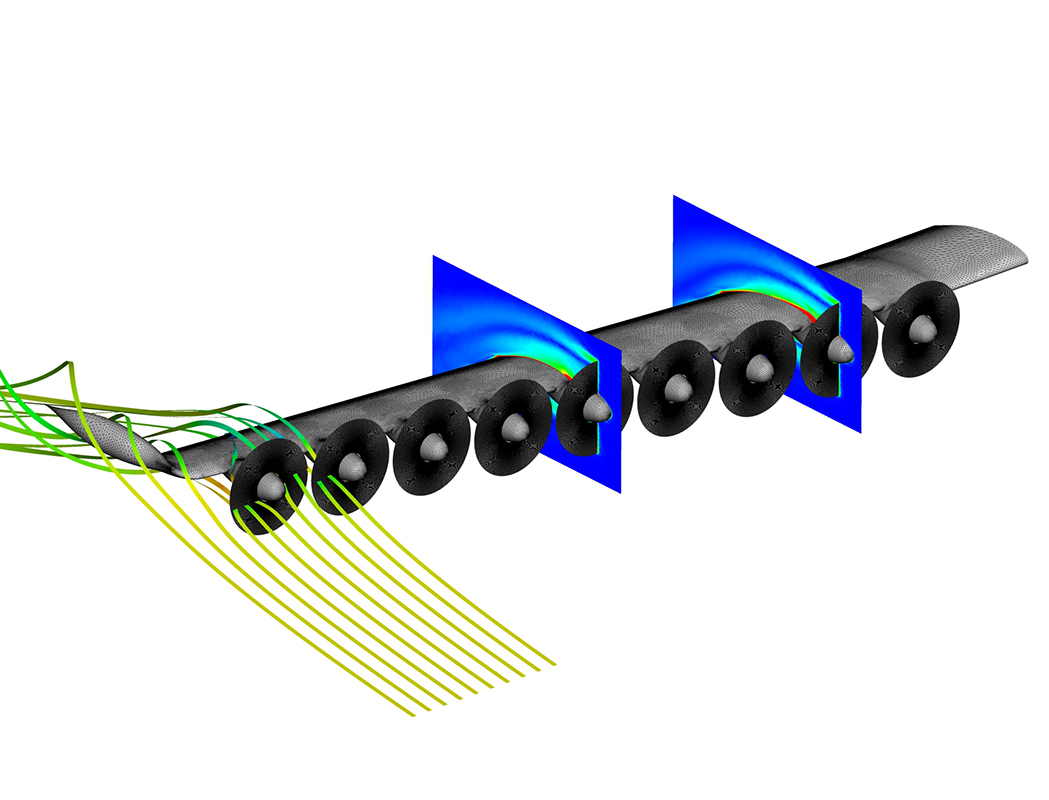
FUN3D simulations require frequent solutions of several billion simultaneous equations. These intensive calculations can only be efficiently accomplished using high-end computing resources, such as the Pleiades supercomputer at the NASA Advanced Supercomputing facility.
Kyle Anderson, NASA Langley Research Centerwilliam.k.anderson@nasa.gov Eric Nielsen, NASA Langley Research Center
eric.j.nielsen@nasa.gov