
Improved Resolution of Rotorcraft Flows Using Adaptive Mesh Refinement
Overview
Helicopters, tiltrotor aircraft, and drones provide many important civil and military services due to their ability to take off and land vertically without requiring an airport. However, rotorcraft can be noisy: the tips of spinning rotor blades produce vortices that may pass closely by other rotor blades when the vehicle is in forward flight. This blade-vortex interaction (BVI) phenomenon can create sharp pressure peaks on the blades, producing high sound levels that disturb people below and alert a foreign military of an approaching aircraft.
Another important phenomenon, called dynamic stall, also limits helicopter speed and performance while in forward flight. The lift generated by a spinning rotor blade as it advances into the headwind must be balanced by pitching the blade up as it retreats away from the headwind, toward the vehicle's tail. Additional lift is generated on the retreating side by pitching the blade up to large angles of attack. However, at some point the blade can stall when a vortex forms at the blade leading edge and then detaches and traverses toward the back of the blade—causing the rotor blade to experience a nose-down pitching moment.
Project Details

Both BVI and dynamic stall are difficult to accurately predict with computational fluid dynamics (CFD), in part due to poor grid resolution on the rotor blades. NASA's Revolutionary Vertical Lift Technology (RVLT) Project has successfully used adaptive mesh refinement (AMR) to locally refine the mesh in the rotor wake. In this project, near-body AMR is used for the first time to locally refine the mesh on the rotor blades. Near-body AMR enables high-resolution accuracy of BVI pressure peaks and dynamic stall vortices that dynamically move throughout the rotor-generated flow field.
Results and Impact
High-resolution near-body AMR will greatly improve accuracy in predicting BVI sound levels and dynamic stall lift history for a spinning rotor. Since these phenomena dynamically move throughout the flow field, it is impractical to resolve the entire rotor blade to the levels required for these predictions without using AMR. NASA's RVLT project has used AMR to:
- For the first time, apply near-body AMR to rotors in forward flight using the OVERFLOW Navier-Stokes CFD code.
- Demonstrate improved spatial resolution for the challenging BVI and dynamic stall phenomena. This approach can lead to improved vehicle designs with higher flight speeds and reduced sound levels.
- Verify whether the remaining discrepancies between computation and experiment are due to deficiencies in the aerodynamic resolution or deficiencies in the structural model of a flexible rotor blade.
Why HPC Matters
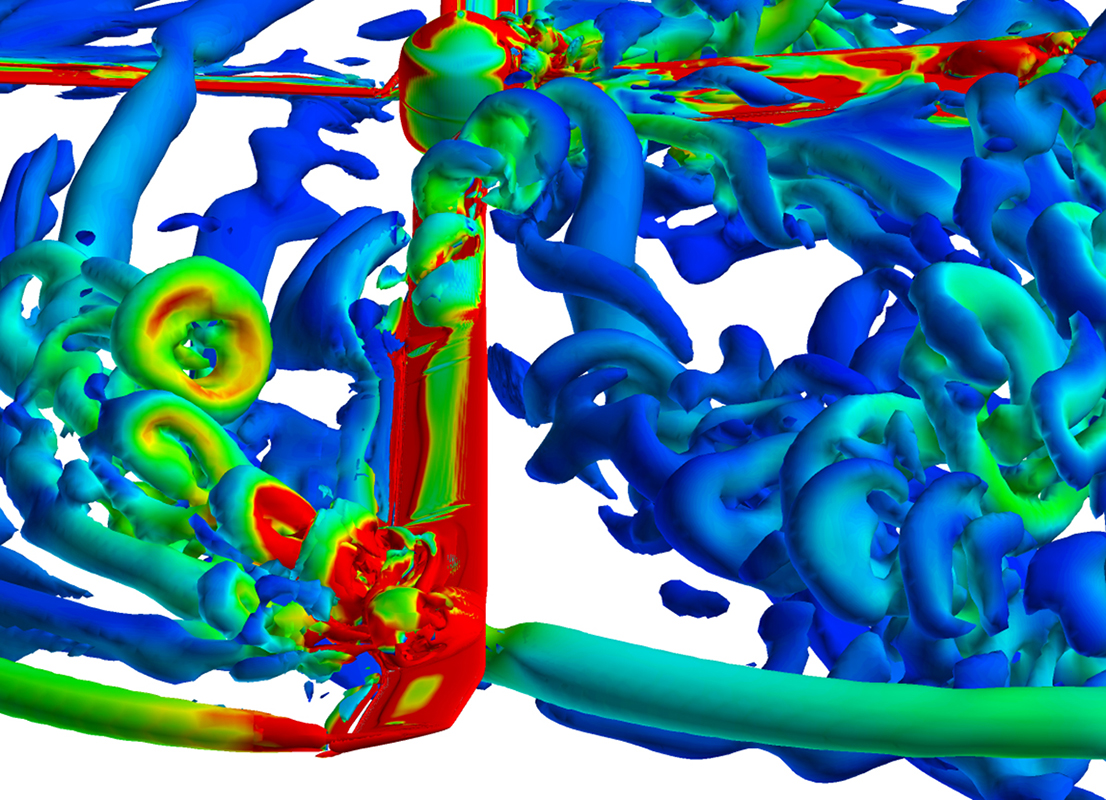
These flow simulations were made possible by NASA's Pleiades supercomputer. Solutions can require 1,000–6,000 cores for 1–2 weeks; using 2,000 cores for one week is typical. Grid sizes vary from 80–800 million grid points, and solutions typically require 5–24 hours of wall-clock time per rotor revolution, and up to 100 terabytes of disk space in order to make high-resolution movies of the unsteady flow simulations. Time-dependent animations are crucial to improve our understanding of which flow phenomena are responsible for the aerodynamic response.
What's Next
BVI and dynamic stall are important phenomena that are poorly resolved with traditional, non-AMR methods. Further computations will be carried out to quantify and validate the approach with experimental measurements. This AMR method will also be included in a multidisciplinary design analysis and optimization (MDAO) framework to reduce vehicle noise and control dynamic stall to achieve higher flight speeds.
More Media
See additional images/videos related to this demo in our media gallery.
neal.chaderjian@nasa.gov