
Airframe Noise Prediction Grand Challenge: Simulating a Large Airliner Landing
Overview
Reduction of aircraft noise is a high-priority goal of NASA’s Aeronautics Research Mission Directorate. Airframe noise contributes significantly to the total noise generated by modern aircraft during approach and landing. Simulation-based prediction of airframe noise is essential for the design of effective noise-reduction strategies that can substantially improve the quality of life in communities near major airports.
Physically accurate prediction of airframe noise for a full-scale large airliner with high-lift devices and undercarriage deployed is a grand challenge for the aerospace community. Such simulations were deemed unattainable just a few years ago. A simulation methodology we used previously to generate high-fidelity aeroacoustic data for a full-scale, isolated Boeing 777 nose landing gear that accurately matched trends observed during flight tests has been extended to a full-scale large airliner in landing configuration.
In partnership with the Boeing Company to study airframe noise, we are using Dassault Systeme’s Lattice Boltzmann code PowerFLOW to investigate the complex, unsteady flow field around a full-scale large civil transport to obtain a greater understanding of the prominent noise-generation mechanisms and locate the major sources.
Project Details
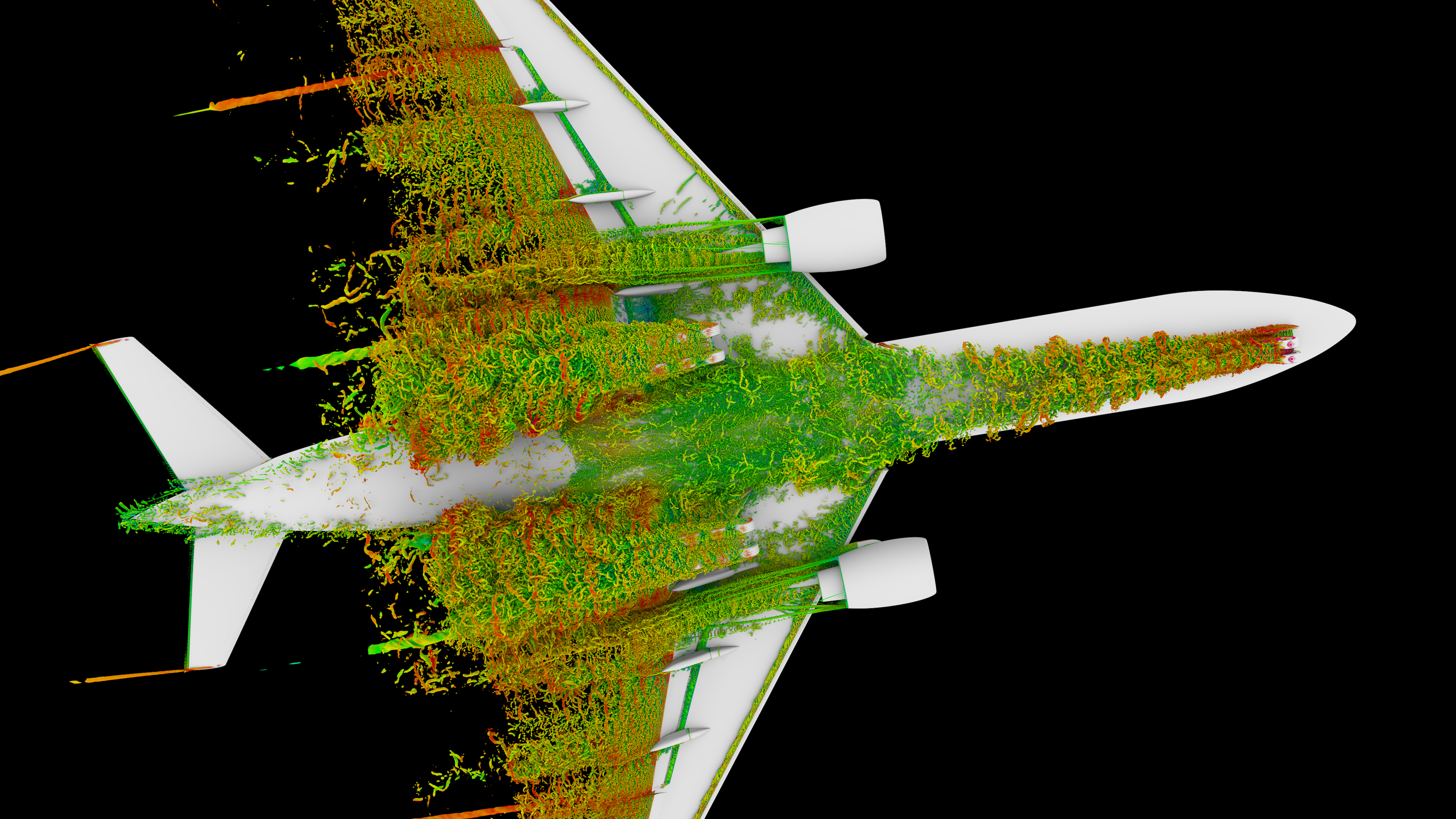
For large, twin-aisle civil airliners, the undercarriage and wing high-lift devices are the dominant sources of airframe noise. The extreme geometrical complexity of these aircraft during landing generates noise-producing flow features that contain a broad range of spatio-temporal scales. Physics-based prediction of landing-gear noise requires a fundamental understanding of the time-dependent flow field produced by each component and the resulting interactions among these flow fields. To gain insight into these phenomena, we are running simulations on the Pleiades supercomputer at the NASA Advanced Supercomputing (NAS) facility. Our goals are: to accurately compute the far-field noise signature of a full-scale, twin-aisle airliner in landing configuration; and to validate the predicted results against measured acoustic data obtained from flight tests of the same aircraft.
Results and Impact
These simulations were run on low-resolution meshes to establish best practices for achieving the numerical, spatial, and temporal resolution required to properly capture the key noise-producing flow features. We are conducting ongoing, preliminary comparisons of the predicted levels and frequency content of the noise spectrum on the ground with flight test data, which so far indicate that good agreement will be achieved. These encouraging results bode well for the suitability of our current simulation approach to solving this airframe noise grand challenge.
Why HPC Matters
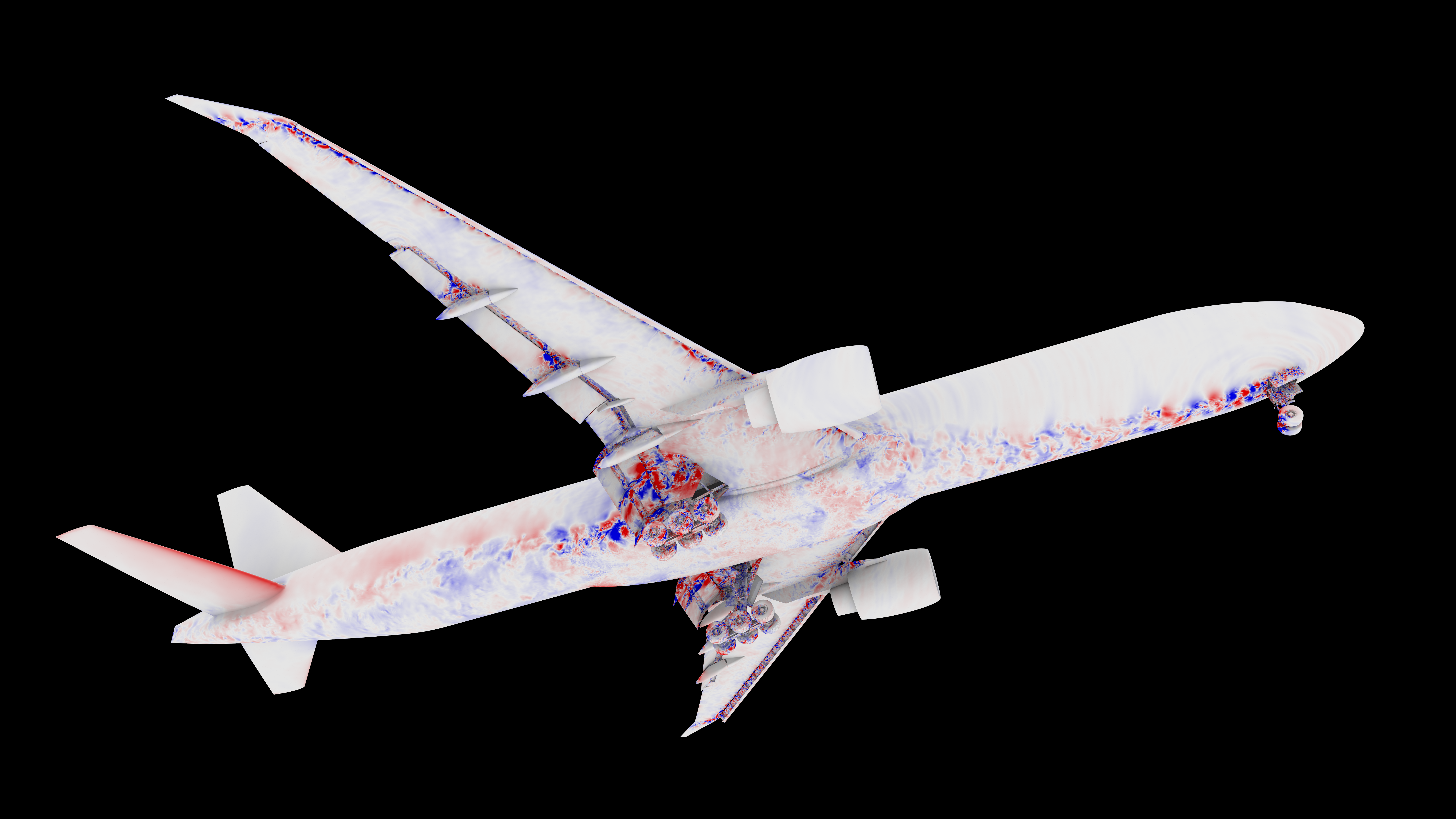
High-fidelity airframe noise simulations of the complete airliner require a vast number of calculations that can only be performed on supercomputers. Our current low-resolution simulations required 14 billion cells to discretize the volume surrounding the complete aircraft with landing gear and wing high-lift devices deployed. The simulation was run on 6,000 Pleiades cores and used over 1.4 million processor hours. To compute the far-field noise spectrum, the simulation generated over 50 terabytes of data. The combined capabilities of Pleiades and the post-processing expertise available at the NAS facility have enabled high-resolution definition and visualization of the prominent flow features over a broad range of spatial-temporal scales.
What's Next
To capture the high-frequency segment of the far-field noise spectrum, we will perform the simulations on a finer spatial grid. We anticipate that these fine-resolution simulations will comprise 28 billion cells and require 7.5 million processor hours, distributed over 10,000 to 12,000 Pleiades cores.
More Information
- NASA Aeronautics Strategic Implementation Plan
- See the poster for this demonstration (PDF, 516KB). As shown in the NASA booth at SC19.
mehdi.r.khorrami@nasa.gov