
Building Booster Separation Aerodynamic Databases for Artemis II
Overview
The Artemis program is NASA’s mission to land the first woman and next man on the Moon by 2024. Artemis II, the first crewed flight of the program, will send humans to near-lunar space for the first time since the end of the Apollo program. This mission consists of an Orion crew capsule launched atop NASA’s Space Launch System (SLS), one of the most powerful rockets ever constructed. The SLS configuration consists of two solid rocket boosters attached to a center core. Two minutes after liftoff, the solid rocket boosters separate from the center core by means of 16 booster separation motors (BSMs) firing simultaneously. Aerodynamic forces play a critical role during this separation, and accurate databases are necessary to ensure that boosters move safely from the core stage without recontacting it. These databases are constructed using computational fluid dynamics (CFD), as the flight conditions and complex interactions of the various components are difficult to model in an experimental setting.
Project Details
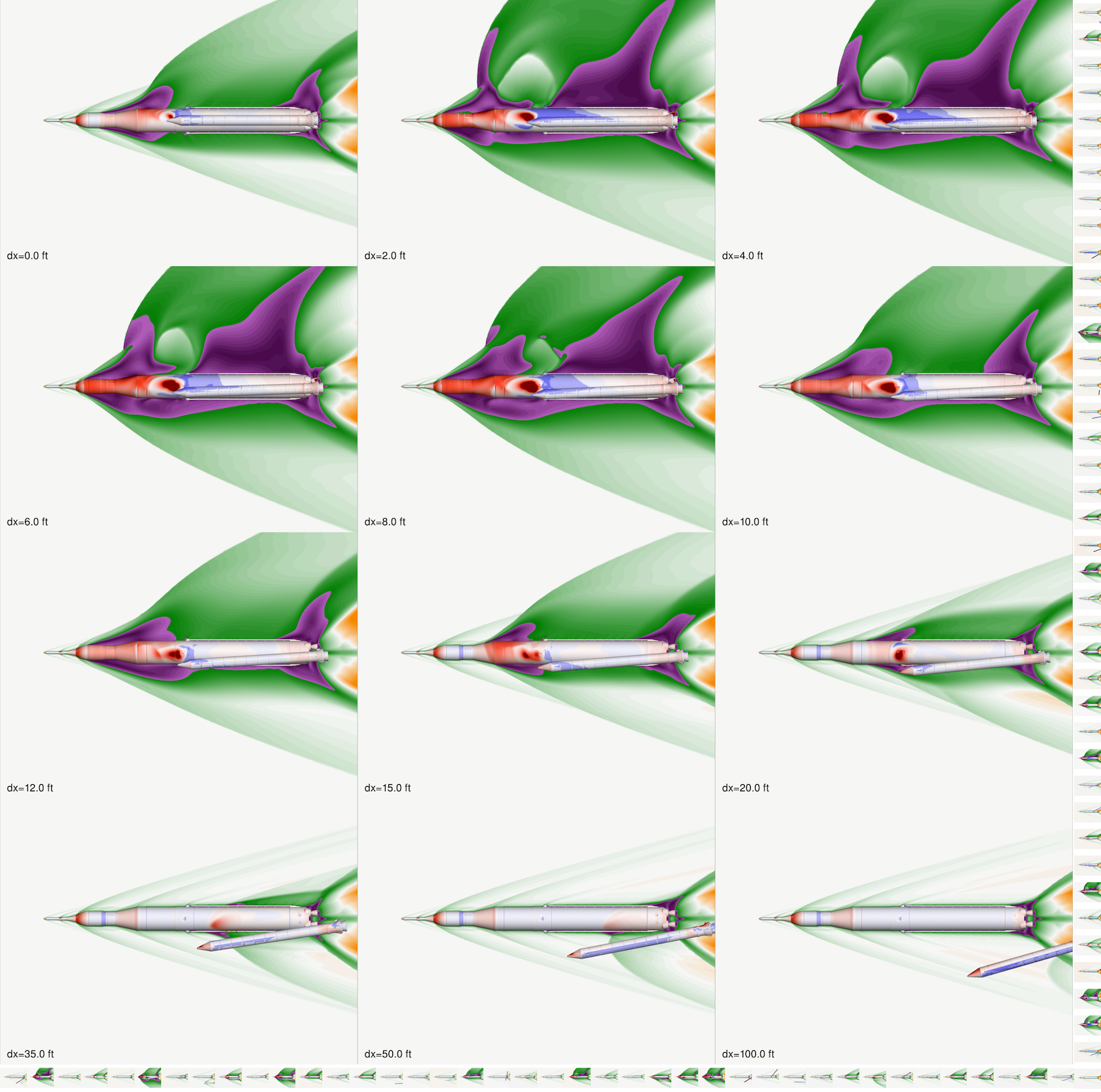
CFD simulations made using NASA’s FUN3D flow solver were used to formulate the booster separation databases for Artemis II. The CFD calculations include simulating the aerodynamic effects of 22 different plumes firing during the separation, counting the four core stage main engines, the two boosters, and all 16 BSMs. The aerodynamic data itself is a function of 13 independent variables: six describing position (three for translation and three for rotation); four describing free-stream conditions (angles of attack/sideslip, Mach number, and air density); and three describing thrust conditions (core, booster, and BSMs). In addition, separate sets of computations were run to simulate the possible effects that could be caused by one of the core stage engines failing.
Results and Impact
These databases will be used by the Guidance, Navigation, and Control (GNC) group at NASA’s Marshall Space Flight Center to model the booster separation event for Artemis II. The GNC team will incorporate the aerodynamic data into their dynamic simulations, which will be used to ensure that the boosters can separate successfully without recontacting the core under all possible flight conditions. Ultimately, the results of those simulations will be critical in reducing the risk to the crew of Artemis II during booster separation.
Why HPC Matters
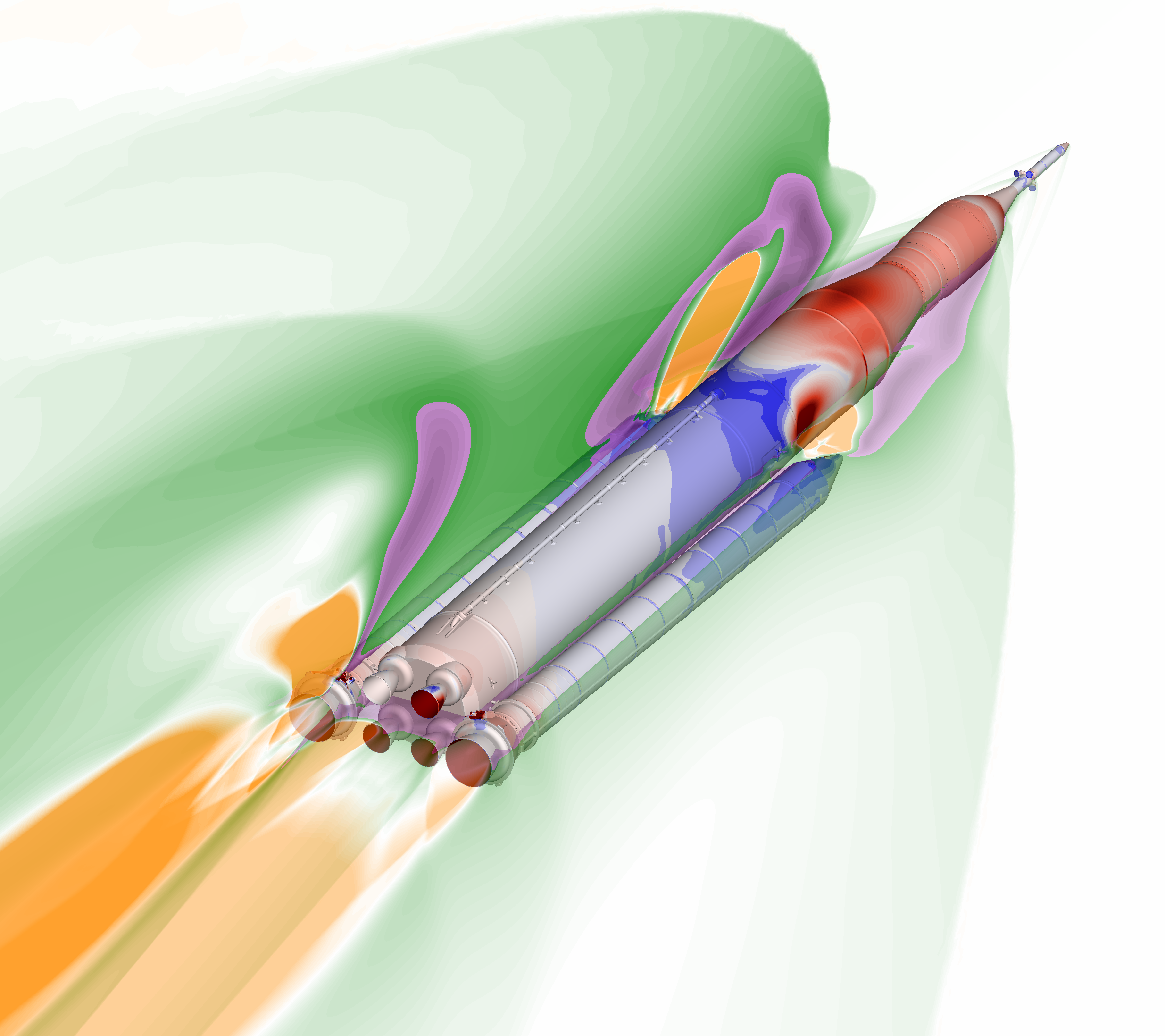
All CFD simulations were run on the Pleiades and Electra supercomputers at the NASA Advanced Supercomputing (NAS) facility over the course of a three-month period. The nominal database required 5,780 FUN3D simulations, while the core stage engine failure databases required over 8,000 total simulations. Each case used approximately 2,500 core hours to complete, and the entire project needed anywhere from 50 to 100 terabytes of short-term storage at any given time.
More Information
- See the poster for this demonstration (PDF, 503KB). As shown in the NASA booth at SC19.
- Download the demonstration slide deck (PPSX, 216.5MB) as presented in the NASA booth at SC19. Click "Read Only" after launching presentation.
jamie.g.meeroff@nasa.gov Derek Dalle, NASA Ames Research Center
derek.j.dalle@nasa.gov