
Realistic Simulations of the Coupled Atmosphere-Ocean-Ice System
Overview
Recent studies have emphasized the importance of small-scale atmospheric and oceanic processes for driving air-sea exchange processes—for example, individual clouds and oceanic storms, called mesoscale eddies, which are not resolved by current weather and climate models. In this project, we study these processes by coupling two flagship data-assimilating NASA models: the Goddard Earth Observing System (GEOS), which is used for global cloud-resolving simulations with horizontal grid spacing as small as 1.5 kilometers (km); and the Estimating the Circulation and Climate of the Ocean (ECCO) model, which is used for global-ocean, submesoscale and internal-wave-admitting simulations with horizontal grid spacing as small as 1–2 km. What is missing in both the atmospheric and oceanic high-resolution simulations is the ability to accurately represent coupled air-sea exchange processes. We are addressing this deficiency by running coupled ocean-atmosphere simulations, where the GEOS atmospheric model and the ECCO ocean model are both run at km-scale resolution.
Project Details
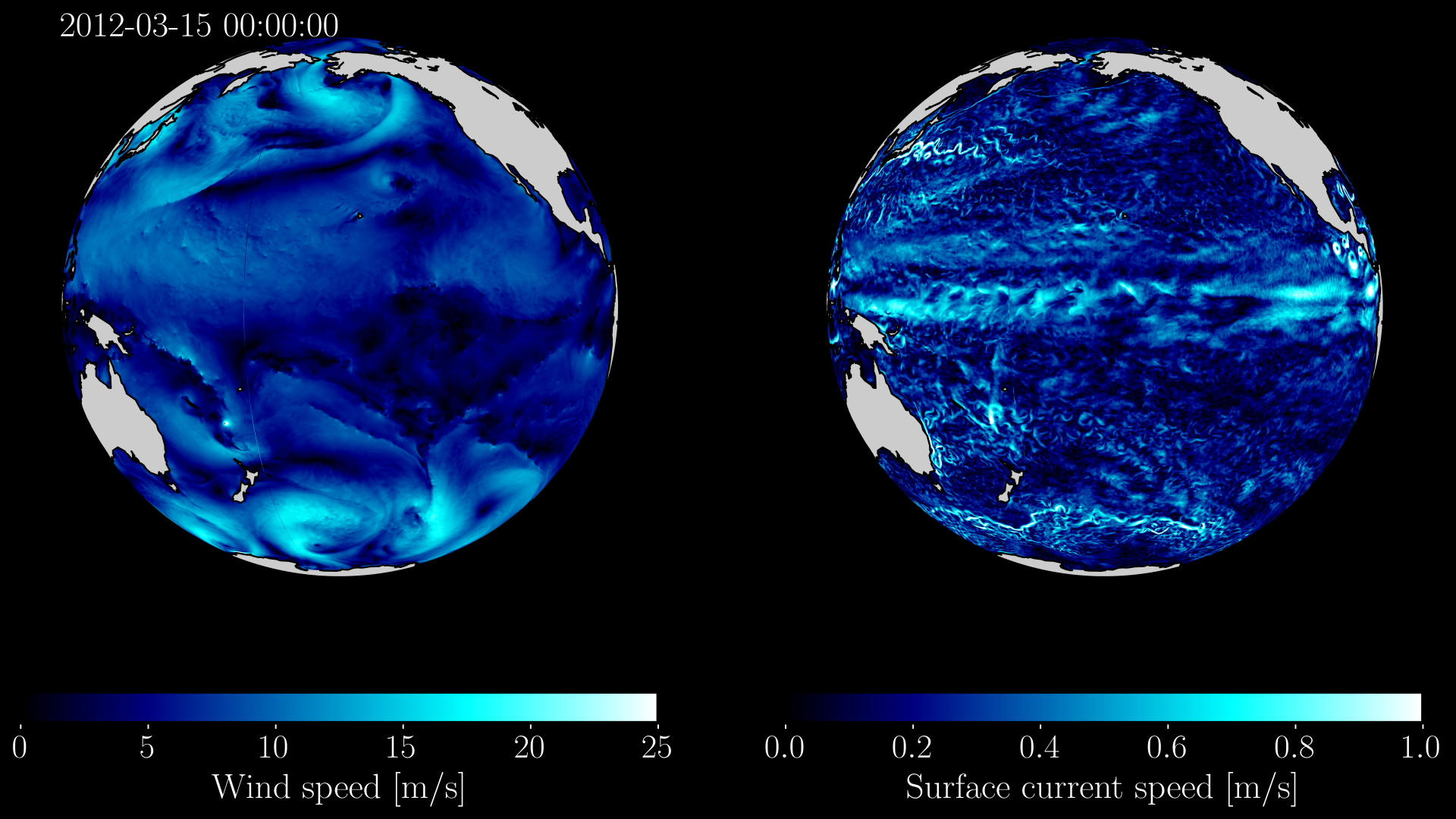
The high-resolution GEOS and ECCO simulations enable the study of how swirls of ocean water, called eddies, affect circulation of both the ocean and the atmosphere. Eddies represent a major pathway for transferring heat from the ocean to the atmosphere. Growing evidence shows eddies have remote impacts on wintertime European blocking (causing anomalously cold and dry weather), monsoon rainfall, and rainfall along the U.S. North Pacific Coast. To date, we have developed simulations with horizontal grid spacing as small as 7-km for the GEOS atmosphere and 2- to 4-km for the ECCO ocean. The first diagnostic of coupled-model output revealed three-to-six-day oscillations of sea surface temperatures and surface wind anomalies, a phenomenon appearing in observational records and reanalyses but previously unseen in ocean-only simulations.
Results and Impact
We expect that the coupled simulations will be used by scientists in the ocean research community for many of the same purposes as the separate oceanic and atmospheric simulations have already been used, but with much increased realism in the description of air-sea interactions and oceanic and atmospheric planetary boundary layers. These simulations are guiding our understanding of coupled air-sea exchange processes and their parameterization in coarser-resolution weather and climate models. They are also being used to guide the utilization of existing satellite observations and the development of new instruments. In particular, a realistic coupled nature simulation will be an invaluable resource for carrying out NASA’s Observation System Simulation Experiments for use in existing, planned, and proposed missions.
Why HPC Matters

NASA supercomputing resources are revolutionizing Earth science studies by enabling increasingly realistic simulations of the coupled ice-ocean-atmosphere system. The simulations were carried out on up to 70,000 cores on the Pleiades and Electra supercomputers at the NASA Advanced Supercomputing (NAS) facility, and the Discover system at the NASA Center for Climate Simulation (NCCS), and are being made available to the scientific community on NAS and NCCS data portals.
What's Next
In setting up the coupled GEOS/ECCO simulations, we encountered both computational and scientific issues, such as: the efficiency of input/output (I/O); a lack of compatibility between the high-resolution atmospheric and oceanic land masks; the representation of sea ice in the coupled system; and the proper method to distribute runoff into the ocean to avoid instability. Our ongoing work aims to address these difficulties and to decrease the grid spacing to 3 km in the atmosphere and 1- to 2-km in the ocean.
More Information
- Estimating the Circulation and Climate of the Ocean
- Global Modeling and Assimilation: GEOS Systems
- NASA Observing System Simulation Experiments
- SKIM, a Candidate Satellite Mission Exploring Global Ocean Currents and Waves
- Characterizing the Transition From Balanced to Unbalanced Motions in the Southern California Current
- See the poster for this demonstration (PDF, 3.2MB). As shown in the NASA booth at SC19.
- Download the demonstration slide deck (PPSX, 9.4MB) as presented in the NASA booth at SC19. Click "Read Only" after launching presentation.
cnh@mit.edu Dimitris Menemenlis, Jet Propulsion Laboratory
menemenlis@jpl.nasa.gov