
Minimizing Sonic Boom through Simulation-Based Design: The X-59 Airplane
Overview
One of NASA’s six Strategic Thrusts for the agency’s Aeronautics Research Mission Directorate is “Innovation in Commercial Supersonic Aircraft,” with a vision of fast air travel available to a broad spectrum of the traveling public. Unlike the Concorde, future supersonic aircraft will be efficient, affordable, and environmentally responsible, generating an acceptable level of en route noise (sonic booms). The first major step toward this goal is the ongoing construction of the new X-59 Quiet SuperSonic Technology X-plane to demonstrate technologies that reduce the loudness of sonic booms to gentle thumps. The X-59 will fly over select communities to gather data on human responses to low-boom flights. This data will be delivered to U.S. and international regulators to help set certification standards for supersonic commercial aircraft and enable supersonic overland flights.
Project Details
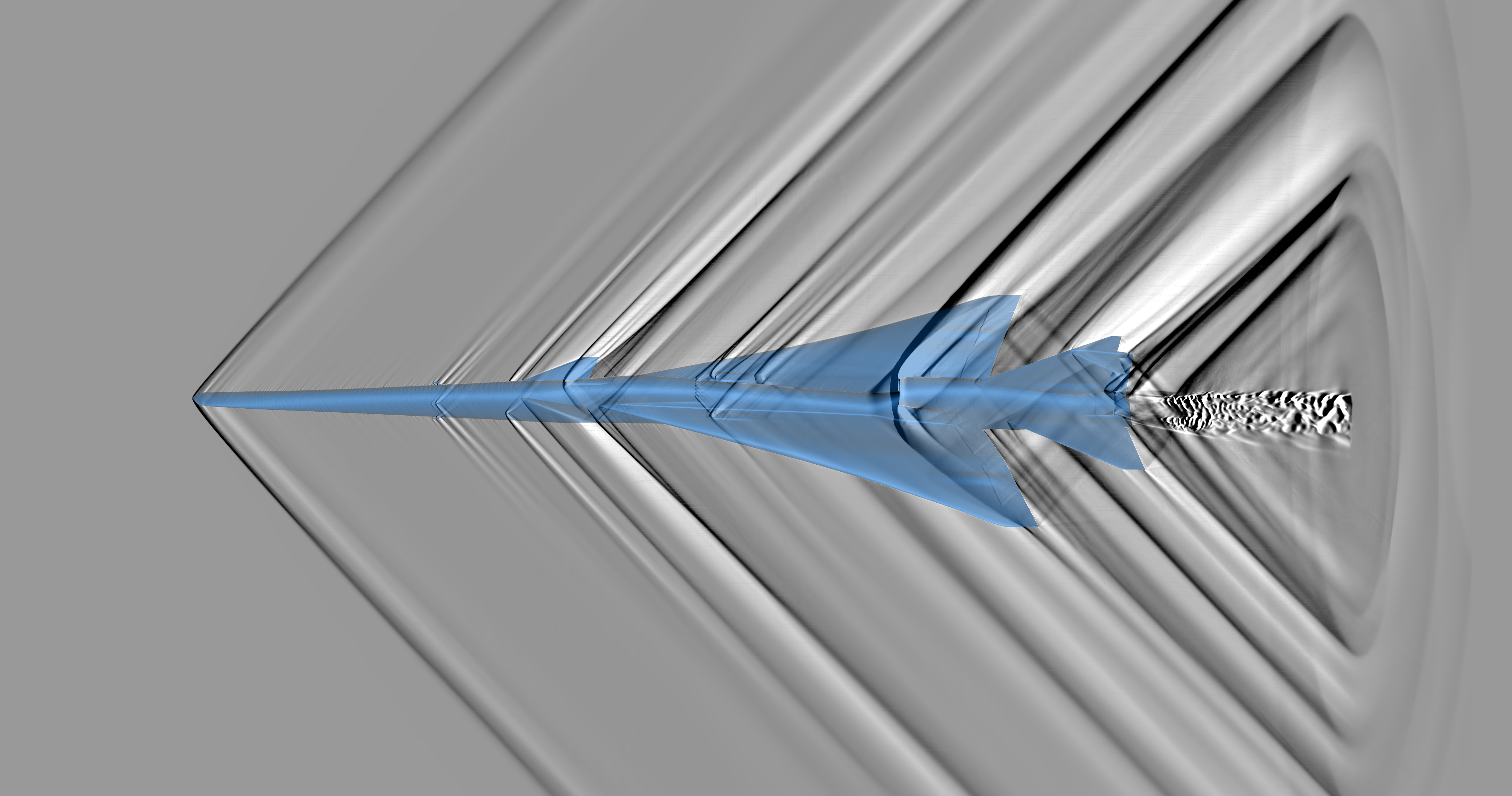
To achieve low-boom performance, we used high-fidelity computational fluid dynamics (CFD) simulations extensively to shape the X-59. While performance optimization of traditional aircraft primarily involves maximizing the lift-to-drag ratio, prediction and minimization of sonic boom noise is an additional requirement that is unique to commercial supersonic flight. In a typical simulation, a nearfield pressure signature is extracted from the simulated flowfield and propagated from a flight altitude of around 55,000 feet through the atmosphere to the ground to obtain the sonic boom noise carpet. NASA’s production-level Cart3D simulation package for CFD has been used extensively to determine the pressure field near the aircraft and evaluate the ground noise carpet of each major design evolution of the X-59. Cart3D is coupled with both an atmospheric propagation solver to estimate the noise level on the ground, and uncertainty quantification tools to provide uncertainty estimates in the pressure signatures due to variations in the aircraft’s operating conditions and configuration.
Results and Impact
These Cart3D simulations have contributed to various design improvements throughout the project, such as reducing the noise generated by the nose of the aircraft, instrumentation probes, and secondary-air-systems inlets. Cart3D is also used to support supersonic wind-tunnel tests; most recently we used it to verify the design of a new wind-tunnel strut that holds the aircraft model in position but does not interfere with its pressure signature. A unique capability of this CFD simulation package is its automatic mesh refinement capability, which minimizes numerical errors in the simulations. This not only ensures automatic verification of Cart3D simulations, but is also used to guide meshing requirements for other CFD solvers used in NASA’s X-59 and Commercial Supersonic Technology projects.
Why HPC Matters
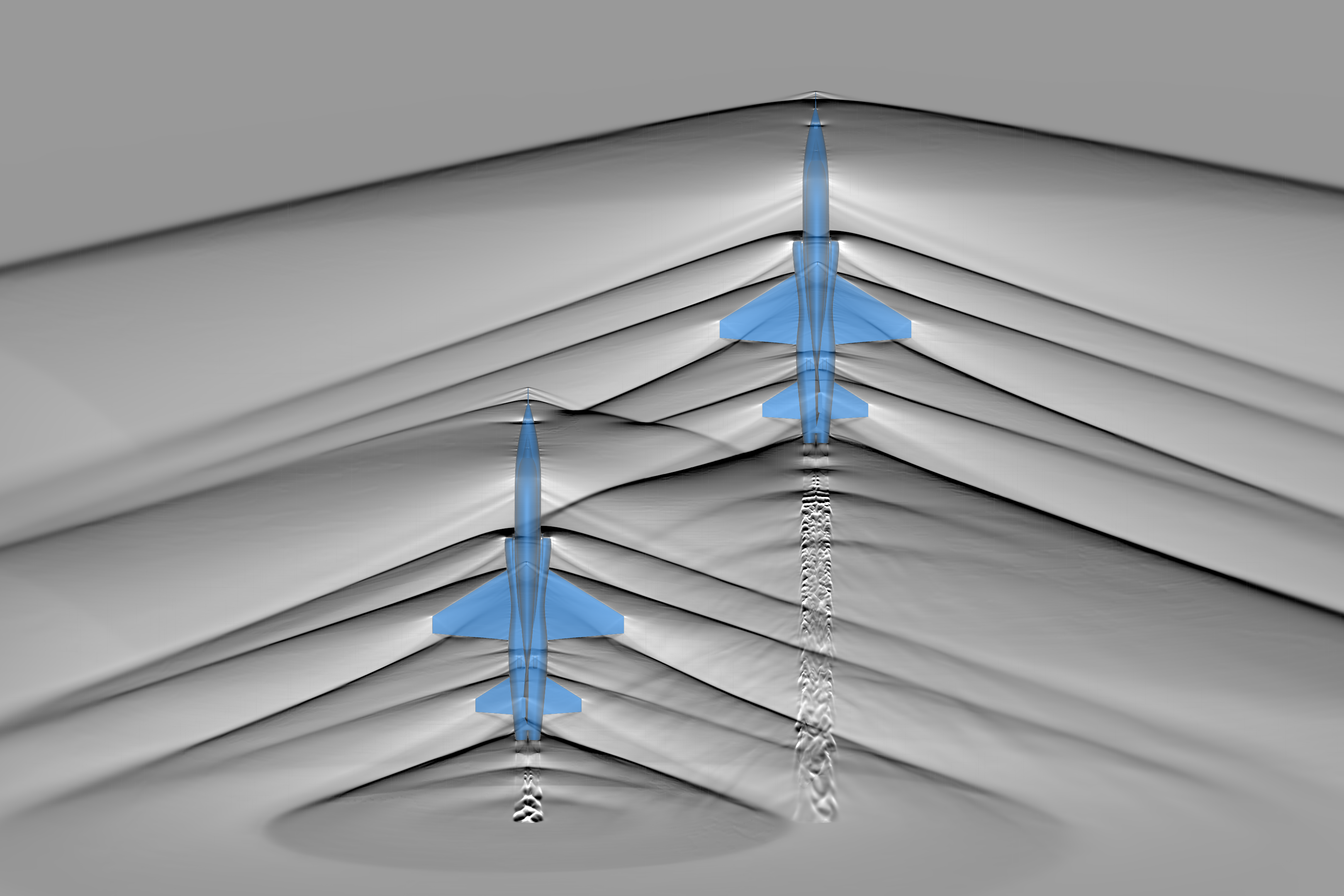
Our simulations are run on the Pleiades, Electra, and Endeavour supercomputers at the NASA Advanced Supercomputing facility. The large capacities of Pleiades and Electra are critical for handling the thousands of cases required for aerodynamic performance databases, shape optimization, and uncertainty quantification of the X-plane. We use the Electra system for most production runs, where a typical case turnaround is roughly an hour on several hundred cores. On the shared-memory Endeavour system, our fine-mesh simulations complete in about 8 hours on 512 cores.
More Information
- Cart3D Documentation
- NASA Low-Boom Flight Demonstration
- See the poster for this demonstration (PDF, 502KB). As shown in the NASA booth at SC19.
- Download the demonstration slide deck (PPSX, 98.8MB) as presented in the NASA booth at SC19. Click "Read Only" after launching presentation.
marian.nemec@nasa.gov Michael Aftosmis, NASA Ames Research Center
michael.aftosmis@nasa.gov