
Predicting Quadcopter Drone Noise Using the Lattice Boltzmann Method
Overview
The market for new vertical takeoff and landing vehicles, including autonomous urban air taxis and drones for applications such as package delivery, imaging, and surveillance, continues to grow rapidly. While electrification of the propulsion system and complete autonomy for operational efficiency are key pacing items, aerodynamic noise continues to be the biggest roadblock to community acceptance and widespread adoption. Novel computational fluid dynamics (CFD) approaches like the Lattice Boltzmann Method (LBM) promise to be ten times faster than traditional methods—and extremely accurate—for analyzing these types of flows.
Project Details

We used the Lattice Boltzmann solver within NASA’s Launch Ascent and Vehicle Aerodynamics (LAVA) solver framework to predict the aerodynamic noise generated by an isolated Straight Up Imaging (SUI) quadcopter drone in forward flight, derived from first principles. The blades were represented on the automatically generated Cartesian grid through an in-house algorithm to complete the streaming step for lattice links broken by the geometry.
Results and Impact
In detailed comparisons with data from a dedicated experiment, our predicted mean thrust is within 1% of the value measured experimentally. The predicted far-field sound pressure levels also compare very well with measurements. Sensitivity to grid resolution of both the predicted performance and the aerodynamic noise generated by the propeller blades are carefully documented. To the best of our knowledge, the present study represents the first successful prediction of drone noise from first principles using the Lattice Boltzmann approach. The computational efficiency of the solver and the complete absence of labor-intensive manual volume mesh generation in the workflow are key factors that make routine aeroacoustic analysis of urban air taxis and drones from first principles possible. Assessment of the LAVA LBM for quadcopter noise predictions showed the following results:
- Coupled with far-field acoustic propagation in the LAVA framework, LBM successfully predicted tonal noise levels and captured broadband noise trends accurately for the first time.
- No manual CFD mesh generation was required; the model used adaptive mesh refinement (AMR) based on running statistics of pressure fluctuations and turbulent kinetic energy.
- Simulated 30-rotor rotations with 568 million cells were completed in under 125 hours, despite LBM using only Cartesian isotropic cells, which make it very expensive to resolve thin propellers.
- LBM is attractive because it is the only tool to demonstrate it can capture complex rotorcraft broadband wake turbulence noise so far; however, it is rather expensive for aerodynamic performance and tonal noise.
Why HPC Matters
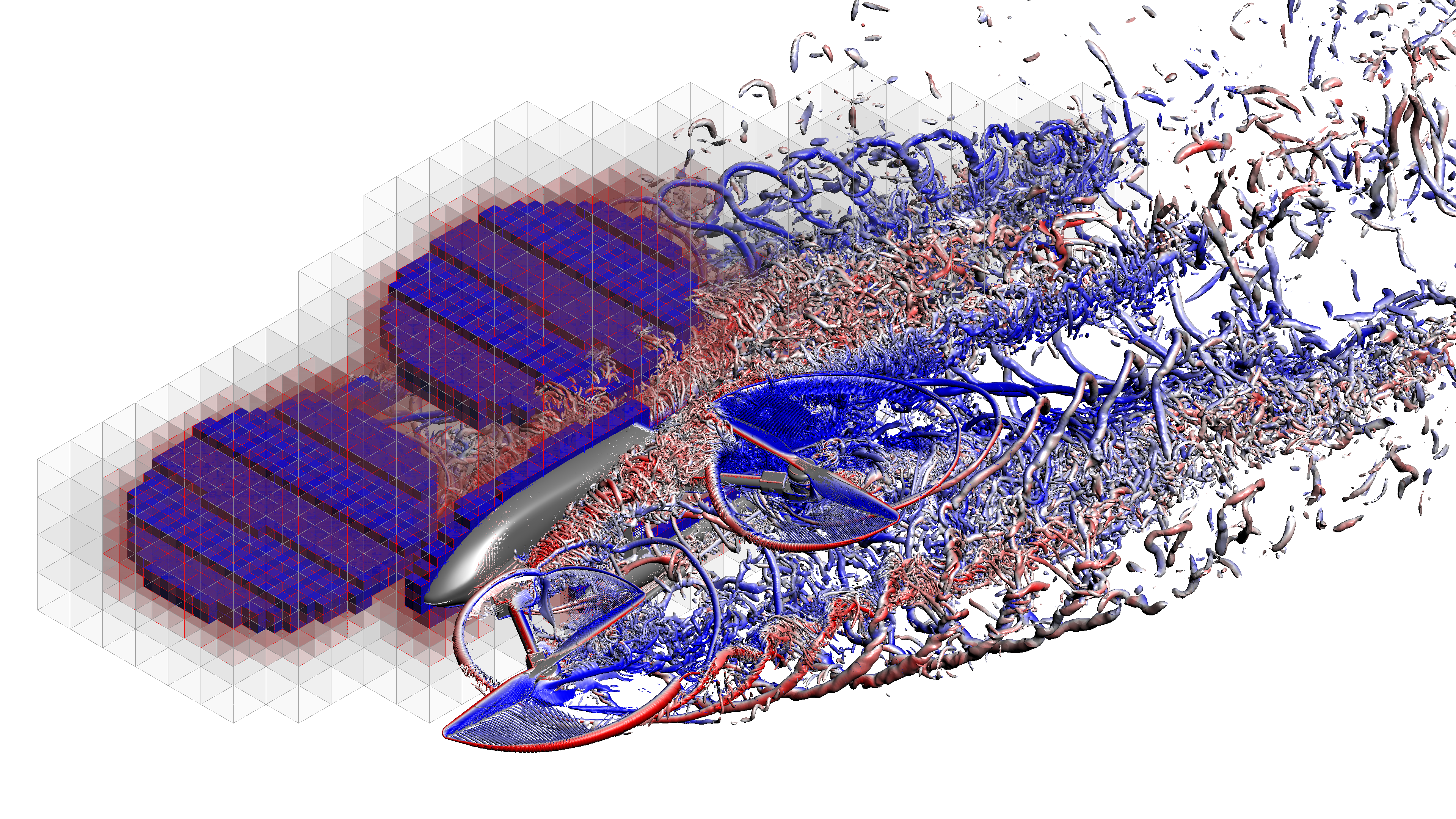
The simulations were run on hundreds of Intel Xeon Skylake cores on the Electra supercomputer at the NASA Advanced Supercomputing (NAS) facility, and several terabytes of data were generated for each calculation. Data analysis and visualization were conducted using the facility’s high-performance systems and custom in-house visualization software. High-performance computing is the key enabler that makes performing high-fidelity quadcopter noise simulations possible within useful turnaround times.
More Information
- See the poster for this demonstration (PDF, 653KB). As shown in the NASA booth at SC19.
- Download the demonstration slide deck (PDF, 22.2MB) as presented in the NASA booth at SC19.
michael.f.barad@nasa.gov Cetin Kiris, NASA Ames Research Center
cetin.c.kiris@nasa.gov