
Predicting Orion Pad Abort Vibrations to Keep Artemis Astronauts Safe
Overview
NASA’s Artemis Program aims to transport humans to interplanetary destinations such as the Moon—and eventually Mars—and return them safely back to Earth via the Orion crew module. During launch, Orion will sit atop the Space Launch System (SLS), a rocket more powerful than the Saturn V that propelled the Apollo capsules into space. In the event of a problem during launch, Orion’s Launch Abort System (LAS) is designed to carry the spacecraft and its crew to safety, away from the rocket. The LAS is positioned on top of Orion during takeoff, and jettisoned once it has safely reached low-Earth orbit.
In order to propel the crew module away to safety, the LAS uses an abort motor that produces four large high-speed exhaust plumes that flow along the sides of Orion, generating extremely strong acoustic vibrations. These vibrations need to be carefully analyzed to ensure the safety of the astronauts. To better understand the effects of acceleration on the strength of the vibrations generated by the plumes on the surface of the LAS, we produced a detailed turbulence-resolving simulation of the Pad Abort 1 (PA-1) flight test conducted in 2010, where the Orion LAS accelerates to over ten times the gravity of Earth.
Project Details
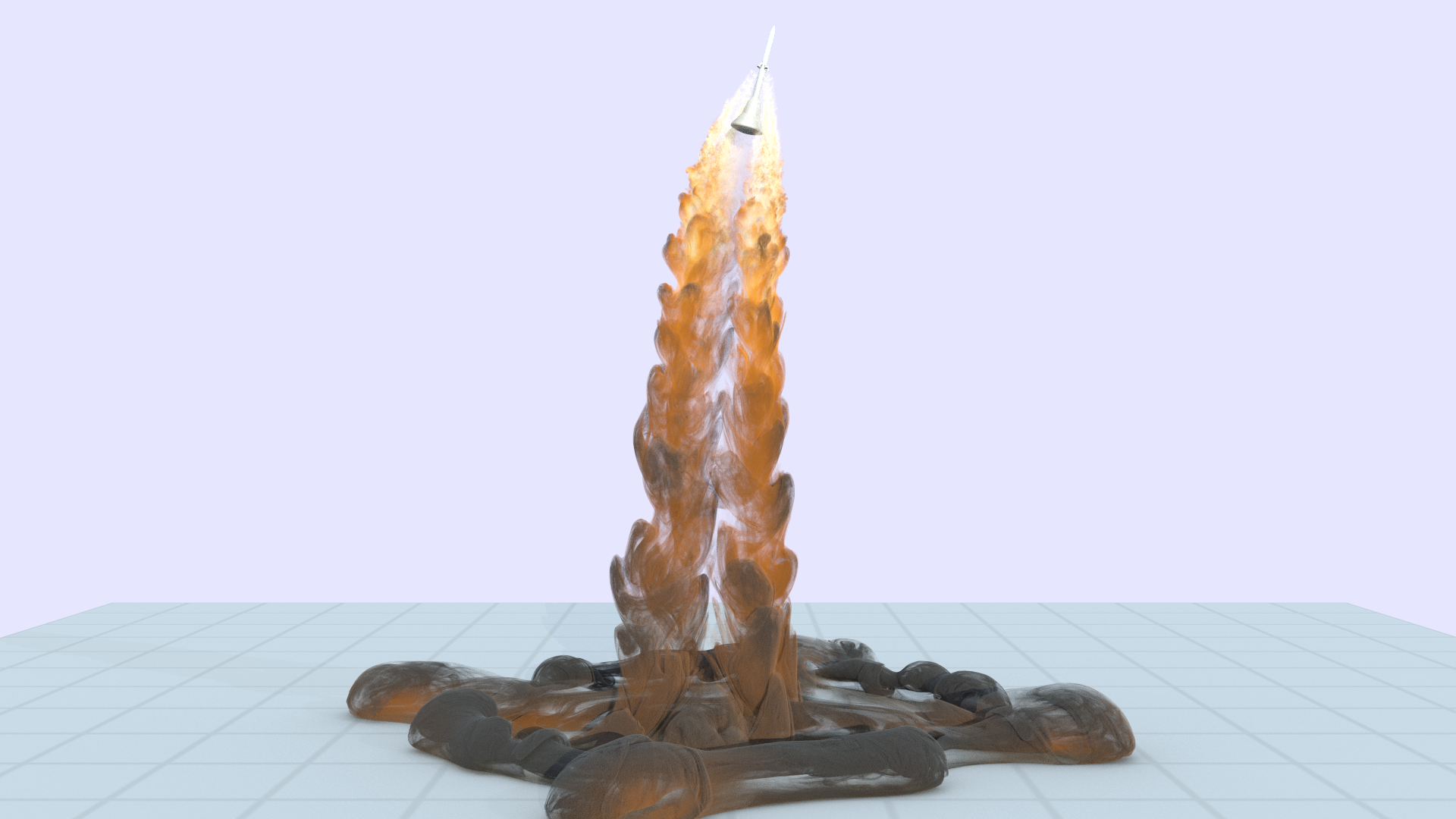
The Launch, Ascent, and Vehicle Aerodynamics (LAVA) team at NASA’s Ames Research Center has been closely collaborating with the Orion Loads and Dynamics team at Johnson Space Center since 2017 to help characterize the vibrations imparted by the LAS abort motor plumes onto the LAS structure. During this time, the team has run multiple simulations for various launch abort scenarios using the cutting-edge LAVA computational fluid dynamics (CFD) software. To investigate the relationship between vehicle acceleration and unsteady loads on the LAS, and to validate the LAVA predictions with flight test data, we simulated the PA-1 flight test and compared it to a simulation where the vehicle is at rest during the abort sequence.
Results and Impact
The simulation of the accelerating PA-1 flight test is unprecedented in scale and scope, and it demonstrates a new capability for NASA. It is the first turbulence-resolving simulation of an accelerating pad abort scenario with enough fidelity to accurately predict the acoustic vibrations on the surface of the LAS when compared to the flight test data—and it was completed in a short-enough turnaround time to affect engineering decisions. Results have already contributed to a better understanding of the effects of acceleration and angle of attack on the acoustic environment. The success of this simulation also opens the door to more analysis that can help reduce uncertainty for abort scenarios that are difficult or too expensive to test, further helping to reduce risk and ensure the safety of astronauts when using the LAS.
Why HPC Matters
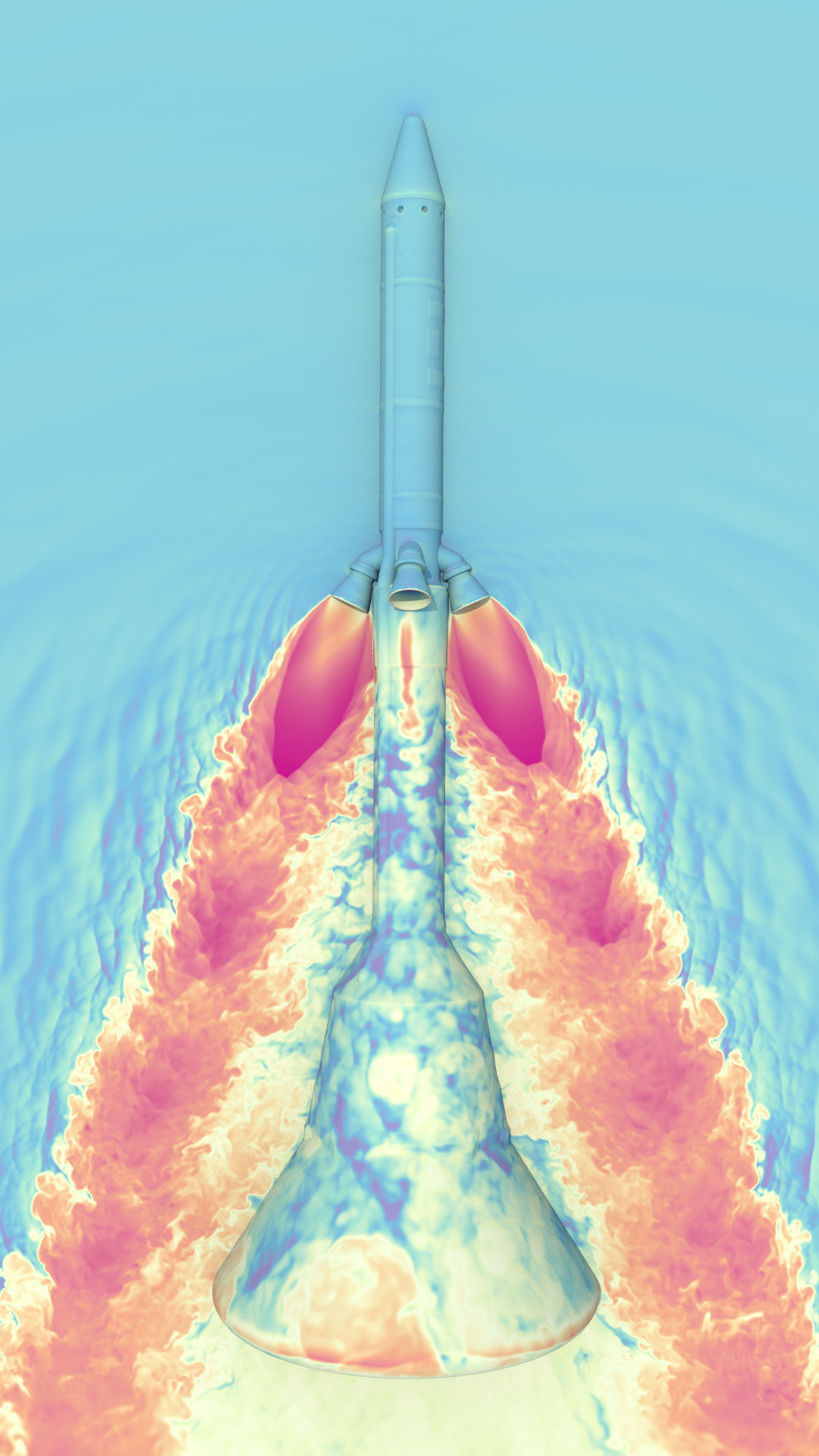
The PA-1 simulation was performed with an adapted Cartesian mesh with 600 million cells, and completed for nearly 572,000 time steps corresponding to 1.25 seconds of real time. It made full use of 400 Skylake nodes, corresponding to 16,000 cores total, via hybrid MPI-OpenMP parallelism on NASA’s Electra supercomputer for 1.5 months, generating nearly 200 terabytes of data. The NASA Advanced Supercomputing Division’s visualization experts provided passive particle renderings that helped enrich our understanding of the fluid dynamics of the launch abort motor plumes.
More Information
- Computational Framework for Launch, Ascent, and Vehicle Aerodynamics (LAVA)
- NASA Edge Live Podcast: Orion Pad Abort 1 Flight Test
- See the poster for this demonstration (PDF, 477KB). As shown in the NASA booth at SC19.
- Download the demonstration slide deck (PDF, 46.8MB) as presented in the NASA booth at SC19.
francois.cadieux@nasa.gov Cetin Kiris, NASA Ames Research Center
cetin.c.kiris@nasa.gov