
Simulating Rocky Exoplanet Atmospheres with General Circulation Models
Overview
Are we alone in the Universe? This question has been asked since the first humans observed the night sky. Do stars other than Sun also have planets orbiting them? This second question was answered in 1992 with the discovery of the first exoplanet. Thousands of exoplanets have now been discovered, and some of the largest and hottest (the so-called “hot Jupiters” or “hot Neptunes”) have already been characterized by current telescopes such as the Hubble Space Telescope. To search for life-as-we-know-it, astronomers target rocky (and thus Earth-like) planets orbiting within the “habitable zone.” This zone corresponds to the planet-to-star distance where liquid water can be sustained on the planetary surface at atmospheric conditions similar to Earth. While dozens of such planets have already been discovered, their atmospheric characterization requires more advanced telescopes, such as NASA’s James Webb Space Telescope (JWST), that are going to be operational in the 2020 decade. Among the prime targets for such characterization are Proxima Centauri b—the closest rocky exoplanet to Earth—and TRAPPIST-1—a seven-rocky-planet system.
Project Details
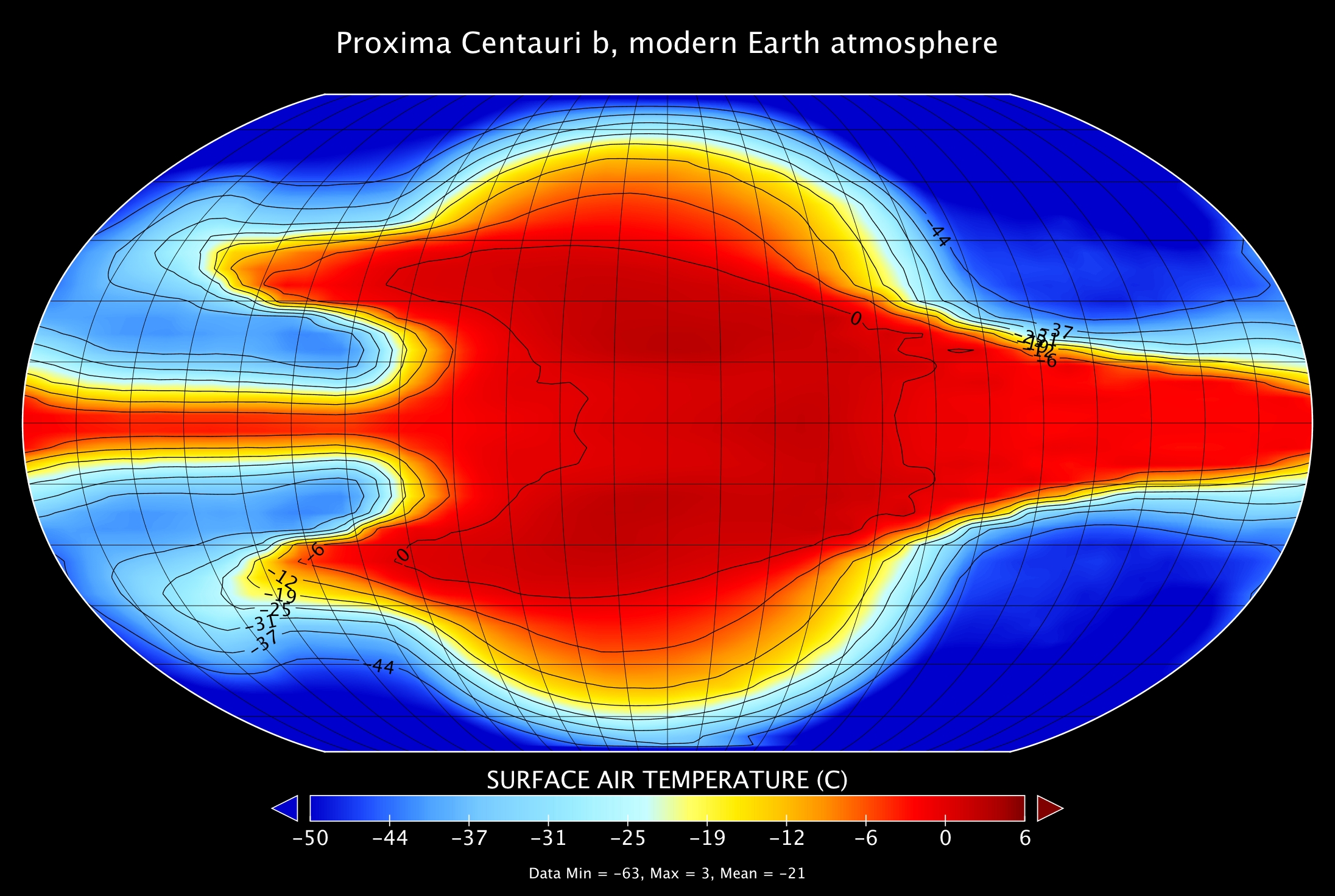
Upstream of JWST observations, scientists are using 3D general circulation models (GCMs) to evaluate potential climate states and their associated temporal- and spatial-dependent observable signals. NASA researchers have performed GCM simulations on the NASA Center for Climate Simulation (NCCS) Discover supercomputer. These simulations of Proxima Centauri b and TRAPPIST-1e assumed a modern Earth-like atmospheric composition and used two different GCMs: ROCKE3D, developed at the NASA Goddard Institute for Space Studies, and LMD-G, developed at the Laboratoire de Météorologie Dynamique in Paris, France. Presentations will discuss the habitability of these planets and their potential for atmospheric characterization.
Results and Impact
Simulations show that Proxima Centauri b and TRAPPIST-1e are both capable of retaining liquid water on their surfaces for a variety of atmospheric compositions, making them potentially habitable. However, planets orbiting M dwarf stars may face tremendous challenges to preserving their atmospheres against stellar flares. JWST observations will be needed to answer the question “Can planets around M dwarf stars have atmospheres?”
Why HPC Matters

GCM simulations aim to resolve—in 3D—the physics and dynamics of a planet’s atmosphere and therefore require significant computational resources. The two GCMs used in this work, ROCKE3D and LMD-G, have been run on the NCCS Discover supercomputer. Depending on spatial resolution, approximately 50 cores are simultaneously used per simulation, which can last from a few days to a few weeks.
More Information
- Habitable Climate Scenarios for Proxima Centauri b with a Dynamic Ocean
- Modeling Climate Diversity, Tidal Dynamics and the Fate of Volatiles on TRAPPIST-1 Planets
- See the poster for this demonstration (PDF, 623KB). As shown in the NASA booth at SC19.
thomas.j.fauchez@nasa.gov Anthony D. Del Genio, NASA Goddard Institute for Space Studies
anthony.d.delgenio@nasa.gov