
Exploring the Origins of Extreme Magnetism in Red Dwarf Stars
Overview
With NASA missions such as Kepler, K2—and now TESS—yielding ever more success in detecting exoplanets, it is clear that the question of habitability goes beyond simply being a terrestrial planet in a star’s “Goldilocks Zone.” As we have learned as residents of the solar system, stellar magnetic activity in the form of wind, flares, and coronal mass ejections can have substantial impacts on planetary atmospheres and surfaces. On and around Earth, the X-rays and charged particles released by the Sun’s activity can disrupt our communications networks, threaten power grids, and pose serious health risks to astronauts. For planets with less effective magnetic shielding, such as Mars or Venus, this activity can lead to dramatic atmospheric losses and alterations of atmospheric chemistry.
The majority of stars in the universe, including the solar system’s nearest neighbor, Proxima-Centauri, are red dwarfs—also known as M-dwarfs—but not one of them is visible to the naked eye. Compared to the Sun, M-dwarfs are small, cold, and very dim, but this has not diminished their magnetic activity. Instead, many M-dwarfs appear to have surfaces carpeted by strong magnetic fields, and give off frequent flares that may be a thousand times more energetic than those typical of the Sun. The radiation environment around such stars could have devastating consequences for their planets’ potential habitability.
Project Details
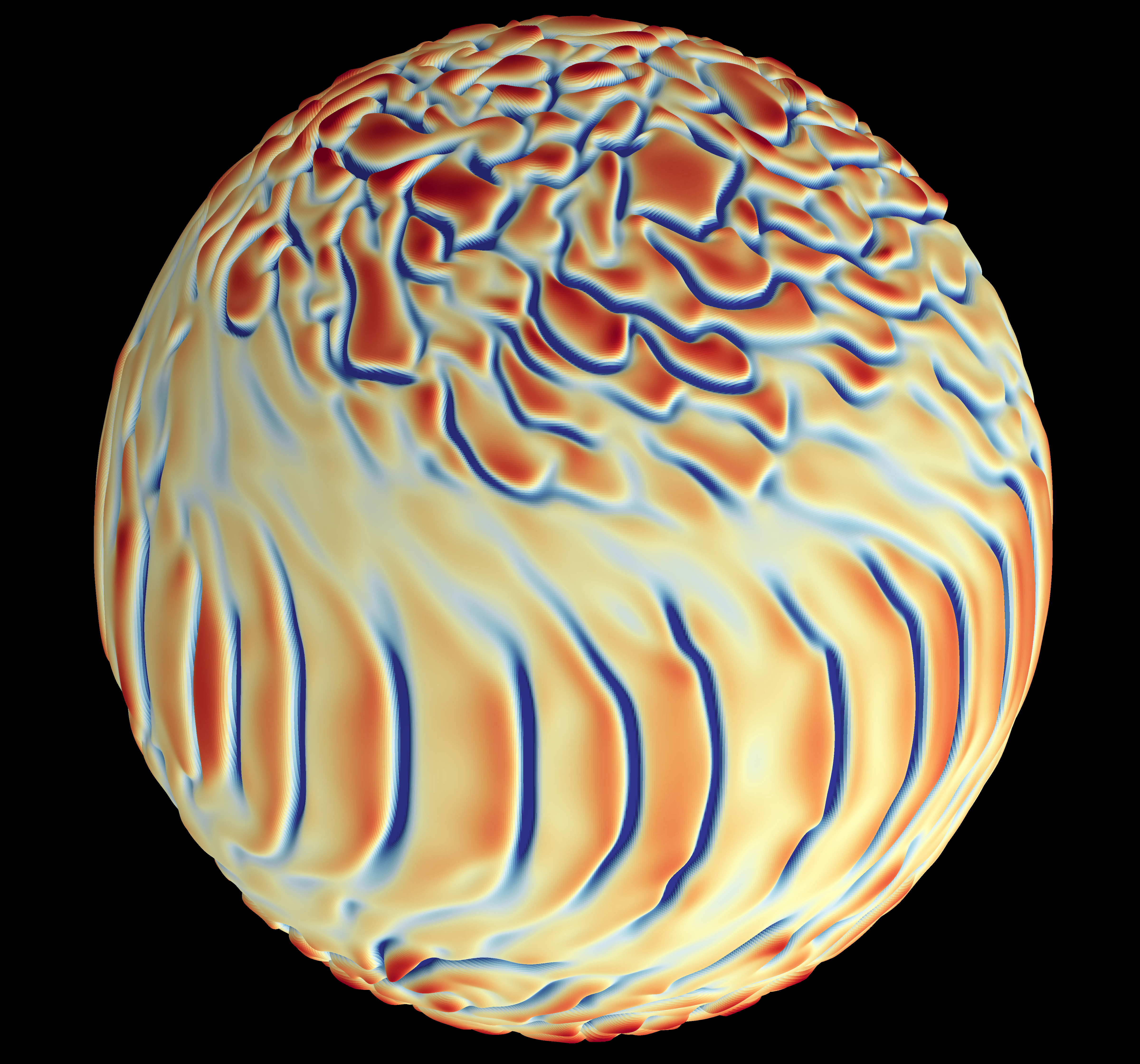
By employing high-resolution magnetohydrodynamic (MHD) simulations of these unassuming stars’ interiors, using NASA supercomputers, we are building toward an understanding of how M-dwarfs generate such intense magnetism, how that magnetism shapes their multi-billion-year evolution, and what it might mean for the exoplanets orbiting them.
We use the open source Rayleigh code to study the magnetized convection occurring within M-dwarf stars. So far, early (more massive) M-dwarfs have been completely untouched as the subject of thorough computational studies, so we have been undertaking extensive studies of the types of flows and dynamos that can be achieved within such stars. We have taken great interest in the role that a layer of rotational shear, known as the tachocline, may play in shaping the global
fields of these stars, especially as they relate to the process of stellar spin-down.
Results and Impact
The project is still young, but has so far yielded a number of results. Our models have demonstrated that the tachocline can act as a reservoir for magnetic fields in these stars, stabilizing and prolonging their global cycles even when it is not the primary generation site. When the tachocline participates directly in field generation, it enables certain dynamo configurations that are unstable without it. We found that transitions between dynamo states in these stars are capable of releasing sufficient magnetic energy in the form of buoyantly rising flux ropes to power observed superflares, whose deep origins are yet to be well explained. Finally, we found that the presence of a tachocline in these stars leads to their surface fields being stronger and organized on larger spatial scales, both of which allow these stars to shed angular momentum through their magnetized winds more quickly than stars without tachoclines.
Why HPC Matters
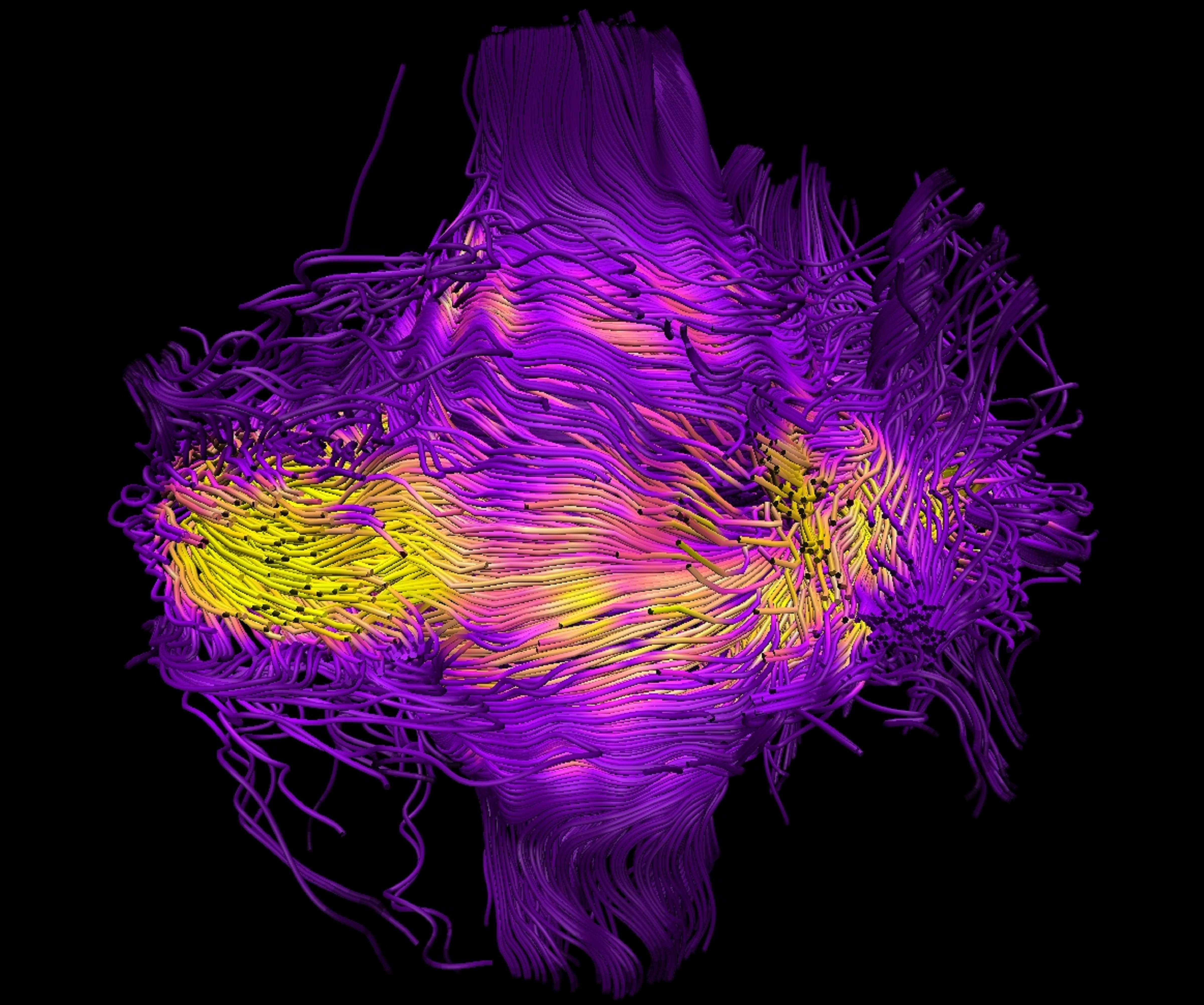
This project could not exist without NASA high-performance computing resources. We make extensive use of the Pleiades supercomputer at the NASA Advanced Supercomputing facility: each model requires anywhere from 1,024 to 4,096 cores and runs for dozens to hundreds of hours, depending on what result we hope to get out of it. In the process, each run generates multiple terabytes of output, which quickly balloons beyond what we are able to store locally.
More Information
- See the poster for this demonstration (PDF, 551MB). As shown in the NASA booth at SC19.
- Download the demonstration slide deck (PPSX, 153.3MB) as presented in the NASA booth at SC19. Click "Read Only" after launching presentation.
connor.bice@colorado.edu Juri Toomre, University of Colorado Boulder and JILA
jtoomre@lcd.colorado.edu