
The Future of Global Numerical Weather Prediction with GEOS
Overview
The prediction capabilities of global models have continuously evolved from traditional, medium-range, global weather prediction applications to span scales from hourly prediction of convective-scale storms to seasonal Earth system prediction. This evolution has increased the demands on the system infrastructure design and workflow to achieve the required performance on modern high-performance computing (HPC) platforms. The planned evolution of NASA’s Goddard Earth Observing System (GEOS) modeling and assimilation system will stress the capabilities of conventional HPC, overwhelming the available compute cycles at the NASA Center for Climate Simulation (NCCS) in the coming 5–10 years.
Project Details
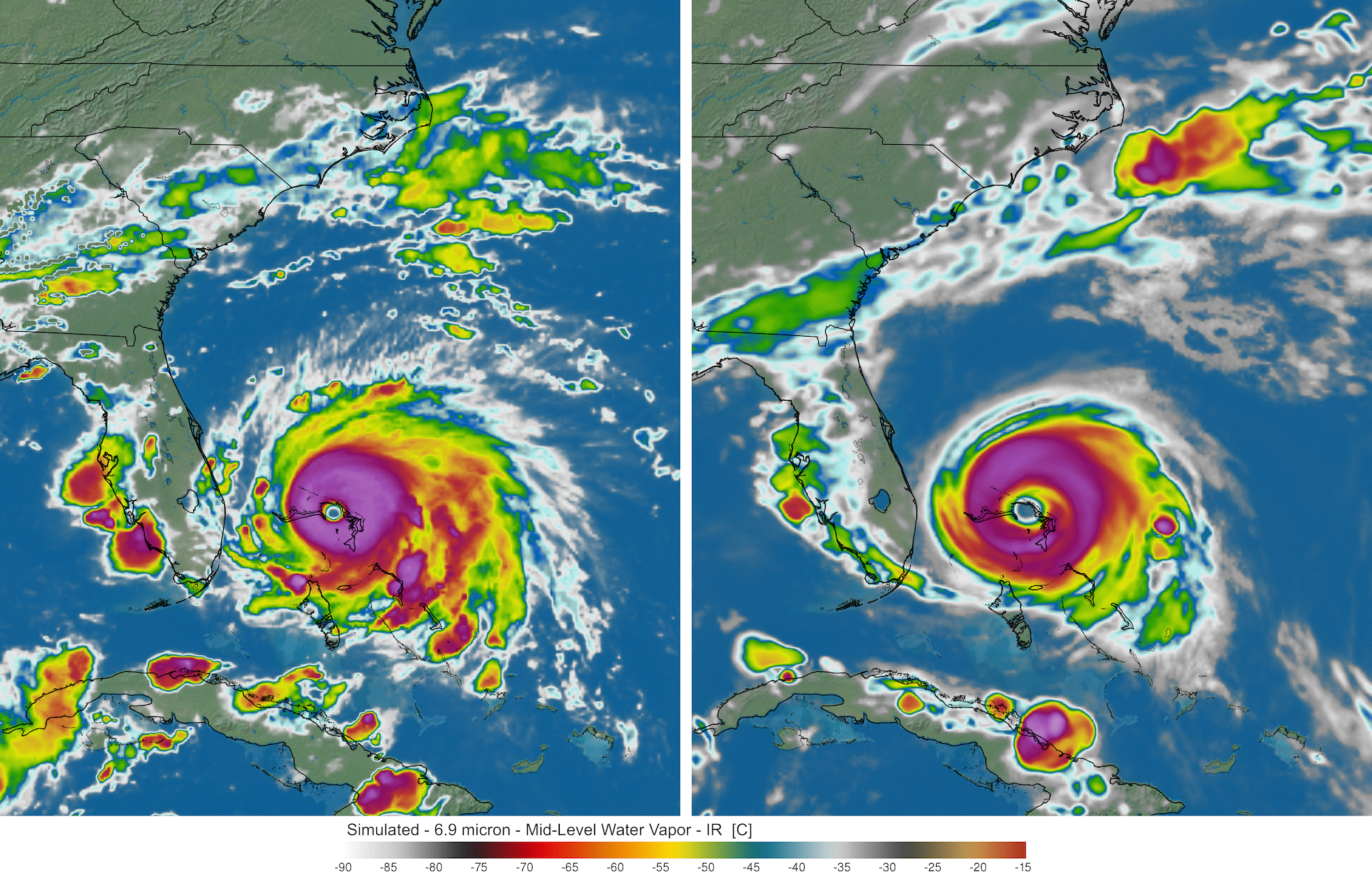
Such demands have led Global Modeling and Assimilation Office (GMAO) developers to re-design the key elements of GEOS assimilation and modeling systems to achieve significant performance gains on anticipated exascale platforms. Transitioning the assimilation system to a new, unified, interagency framework—the Joint Effort for Data assimilation Integration (JEDI) system—positions GEOS to exploit new and efficient data assimilation algorithms within an Earth system context that fully integrates atmospheric and oceanic models. GMAO researchers are exploring the suitability of the GEOS model, leveraging a domain-specific language approach and artificial intelligence to accelerate computational performance and data exchange efficiency of the integrated Earth system model. We will highlight recent efforts in these areas and emphasize the demand for further development and re-design to achieve the science objectives in support of NASA’s Earth system modeling and assimilation missions.
Results and Impact
The future of global, numerical weather prediction (NWP) can be explored today with the recent expansion of the NCCS Discover supercomputer to 6.7 petaflops. Using up to 80,000 Intel Skylake processors, an advanced version of the GEOS model produced near-real-time global weather forecasts at resolutions of 6 kilometers that will be typical of operational NWP systems in the year 2025 and beyond. These forecasts include the extreme tornado season across the United States in May–June 2019 and the extreme Category 5 Hurricane Dorian in August–September 2019. This advanced version of GEOS produces significant improvements in the representation and prediction of these severe events.
Why HPC Matters

High-end computing (HEC) at NASA—specifically the NCCS and the NASA Advanced Supercomputing (NAS) Division— provides an essential resource for preparing our modeling systems for emerging HEC systems and exploring new science developments. While current GEOS configurations require thousands of computational cores, configurations over the coming decade will require scalability approaching millions of cores. Exposing additional parallelism within GEOS becomes essential for reaching these scalability targets. Partnerships with the NCCS and NAS support our exploration of traditional hybrid parallelism approaches within GEOS today and prepare our models for future HEC platforms by exposing new depths of parallelism within our application components.
More Information
- Global Modeling and Assimilation Office
- See the poster for this demonstration (PDF, 3.9MB). As shown in the NASA booth at SC19.
william.m.putman@nasa.gov