
Using CFD to Develop NASA’s X-57 Maxwell Flight Simulator
Overview
In recent years, NASA has developed the X-57 “Maxwell” electric aircraft, which aims to achieve a fivefold reduction in energy consumption compared to conventional aircraft propulsion. Aeronautics research teams from NASA’s Ames Research Center, Armstrong Flight Research Center, and Langley Research Center are collaborating to construct multiple aerodynamic databases to develop a stability and control model for the X-57’s flight simulator. Populating this database requires simulation and analysis of multiple flight conditions, aircraft configurations, and propulsion settings. To date, 800 cases have been completed and more than 2,000 additional CFD simulations will be run using the Launch Ascent and Vehicle Aerodynamics (LAVA) flow solver developed at Ames.
Project Details

Aerodynamic databases for the X-57 program are populated by performing steady-state Reynolds-Averaged Navier-Stokes (RANS) computational fluid dynamics (CFD) simulations for a variety of conditions across the flight envelope. Integrated aerodynamic loads and moments over the aircraft surface—the main quantities of interest—will help to assess stability and control characteristics of the aircraft. Multiple CFD codes have been used for this study to gain confidence and quantify uncertainty, including NASA’s LAVA flow solver and Star-CCM+ commercial solver.
The key goal of this effort is to develop an accurate model of the X-57 aerodynamic performance and stability characteristics to implement in the aircraft flight simulator. The X-57 contains 12 high-lift propellers across each wing, providing distributed propulsion during takeoff and landing, and two cruise propellers at the wing tips, which are the primary source of thrust during cruise. We are producing databases for each of the propulsion settings and comparing the effects to the corresponding no-power case. Accurately predicting the impacts of propulsion ensures the flight simulator will perform in a manner consistent with actual flight.
Results and Impact
Preliminary validation studies performed prior to building the initial database demonstrated that all flow solvers used for this analysis could predict aerodynamic forces and moments within 8% of the experimental data, and within 5% across codes. Studies that addressed best practices for CFD mesh generation, turbulence model usage, and numerical scheme selection were a crucial step to success.
Many takeaways and lessons learned from this analysis will be valuable to future NASA aeronautics research. For example, a process for pre-database preparation and validation was established to reduce the risk of inaccurate CFD predictions that would waste computing resources. We anticipate that this process can be applied to many future aeronautics applications that require the simulation of a large number of conditions. This procedure, as well as recently developed pre- and post-processing tools, will likely reduce the amount of overhead and computational cost required for future NASA programs that require database development.
Why HPC Matters
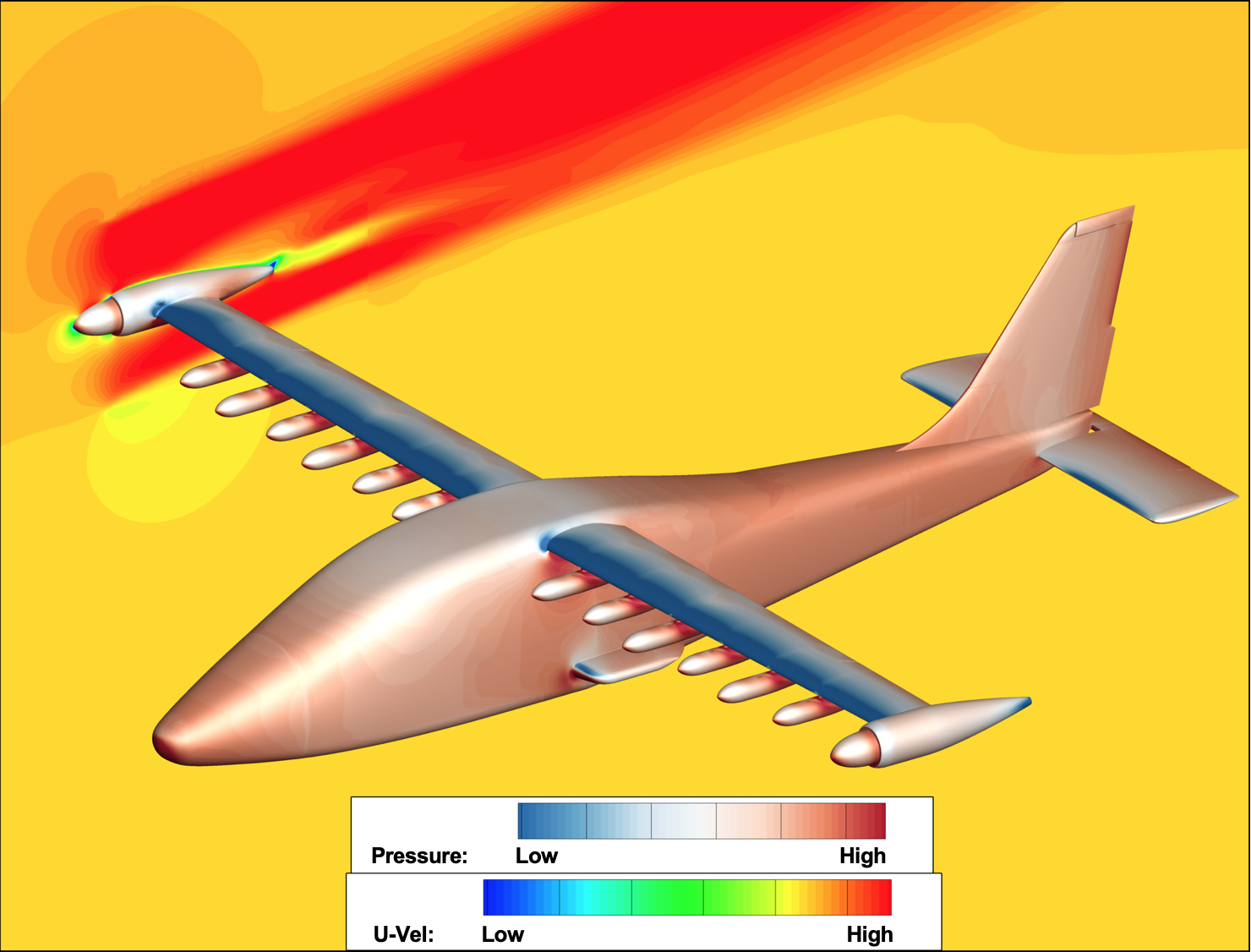
Large-scale CFD simulations like these cannot be performed without the use of high-performance parallel computing resources. All of the database simulations completed so far for this project were run across 1,200 Intel Ivy Bridge cores on NASA’s Pleiades supercomputer, with each case requiring 16 hours of wall time—a net usage of 16 million core hours for all simulations run to date.
More Information
- See the poster for this demonstration (PDF, 1.4MB). As shown in the NASA booth at SC19.
- Download the demonstration slide deck (PPSX, 155.4MB) as presented in the NASA booth at SC19. Click "Read Only" after launching presentation.
jared.c.duensing@nasa.gov Cetin Kiris, NASA Ames Research Center
cetin.c.kiris@nasa.gov