
Numerically Modeling the Weather and Climate of Mars
Overview
Martian atmospheric and climate modeling is of both scientific and engineering importance. As a global system that is in many ways analogous to the Earth’s climate system, better study of Mars allows us to expand our understanding of fundamental planetary climate system behaviors, and allows us to test terrestrial meteorological and climate models in novel regimes. These models are then used in practical application to assist in the design and operation of NASA spacecraft bound for Mars.
In our research, we have developed Martian adaptations of the widely used National Center for Atmospheric Research (NCAR) Weather Research and Forecasting (WRF) and Model for Prediction Across Scales (MPAS) terrestrial micro-, meso-, and global scale models. The models are used on NASA supercomputers to study processes on scales from the decimeter-scale boundary layer winds that will influence the flight of the 2020 Mars Helicopter, to the long-term evolution of Mars’ global dust and water cycles, and the role of trace gases and carbon dioxide clouds in warming the ancient climate system.
Project Details
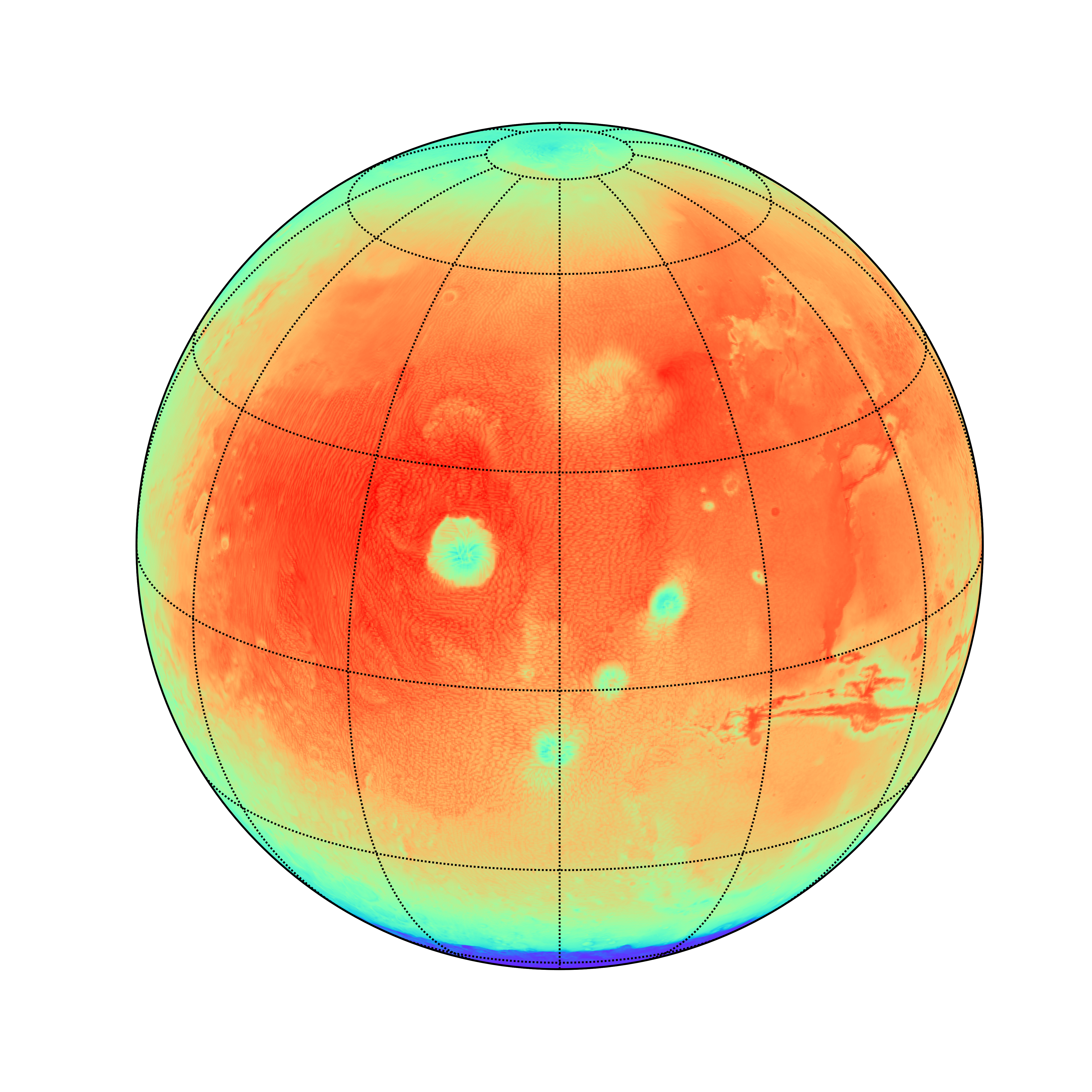
Most of the core problems in Martian meteorology and climate dynamics require study via detailed fluid dynamical simulation. These problems are computationally intense and require efficient numerical approaches to take maximum advantage of parallel computation. WRF is designed to use such systems, and can be efficiently run across hundreds of processes. WRF is sufficiently flexible that the same system can be configured to run as a limited-area boundary layer model (grid spacing of about 10–100 meters), as a full global model (grid spacing of about 10–300 kilometers), or as a nested model with multiple domains at varied resolution embedded within each other. However, the structured nature of the WRF mesh limits the linearity of scaling as the number of processes exceeds several hundred. The latest NCAR model, MPAS, addresses this with an unstructured mesh that scales much more effectively. The ability to run higher-resolution, larger-domain simulations enables several advances, including: much more detailed examination of processes involving the interaction between organized convective systems and global-scale circulations (such as dust storm growth); analysis of the interaction of boundary layer thermal and shear shows with mesoscale flow systems; and study of the coupled lower atmosphere and thermosphere.
Results and Impact
Numerical modeling allows us to assess disparate spacecraft and telescope observations within a consistent theoretical framework. Our results enable a wide range of observations to be conceptually understood. For example, they allowed Curiosity rover observations of surface pressure to be understood in terms of a locally induced hydrostatic rebalancing of air over the widely varying local topographic relief, in addition to the more commonly understood large-scale thermal tides. Our modeling has also led to better understanding of the roles of surface dust availability and putative orbital angular momentum coupling in the occurrence of global dust storms. The wide variety of studies supported by our modeling helps NASA achieve its goal of understanding how planetary systems work, and assists the agency in designing and operating spacecraft.
Why HPC Matters
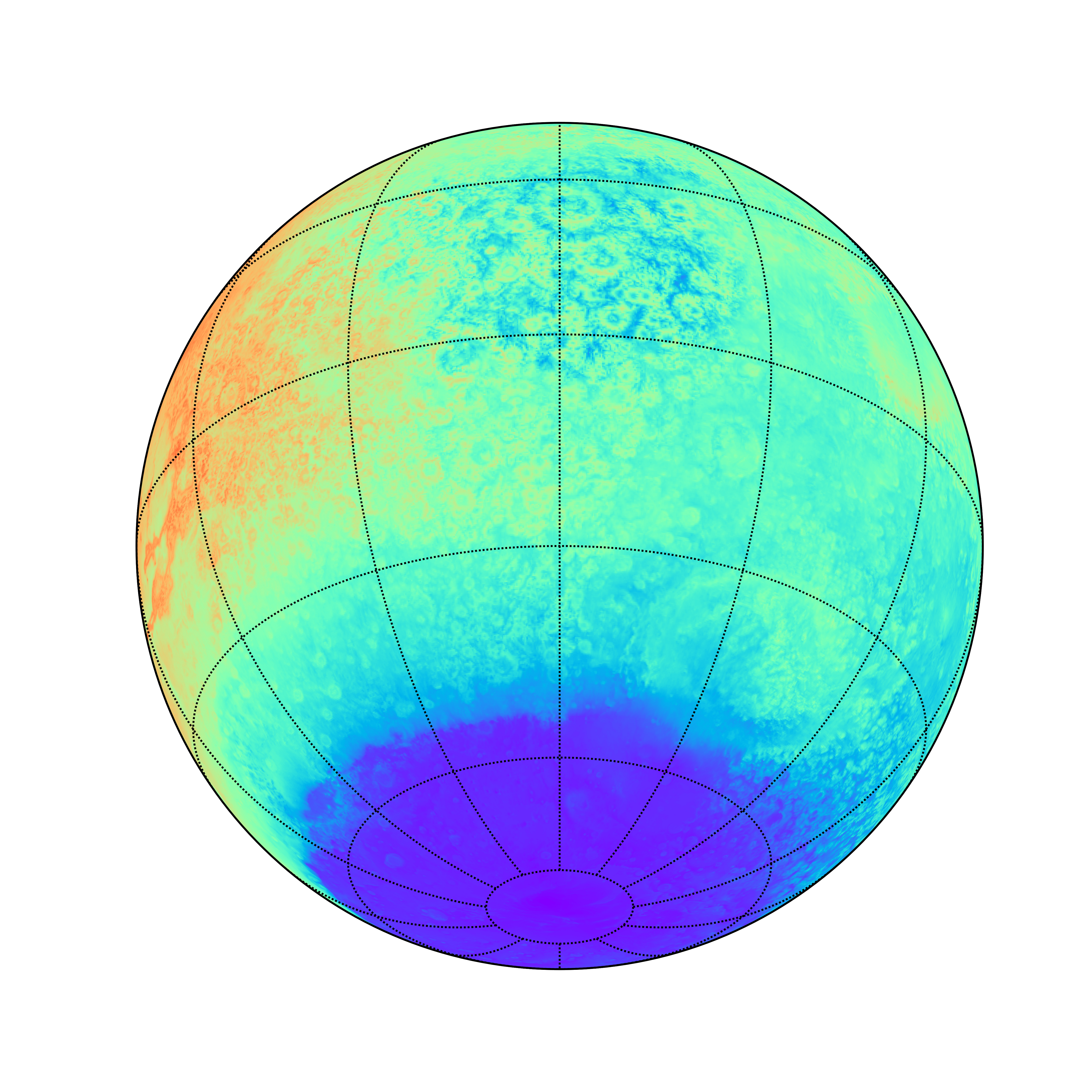
Our research program would be impossible without NASA’s Pleiades supercomputer. Typically, a single low-resolution, decadal global simulation requires from tens to hundreds of processes for about 10 days. Our highest resolution eddy-resolving simulations can require days across thousands of processes. For some of these cases, intermediate data volumes in the range of tens of terabytes are required in order to generate final archived data files of up to hundreds of gigabytes.
More Information
- The Sensitivity of Solsticial Pauses to Atmospheric Ice and Dust in the MarsWRF General Circulation Model
- MarsMPAS- A New Global Mesoscale Circulation Model for Mars
- An Initial Assessment of the Impact of Postulated Orbit-Spin Coupling on Mars Dust Storm Variability in Fully Interactive Dust Simulations
- On the Relationship Between Surface Pressure, Terrain Elevation, and Air Temperature. Part I: The Large Diurnal Surface Pressure Range at Gale Crater, Mars and its Origin Due to Lateral Hydrostatic Adjustment
- The Cascade from Local to Global Dust Storms on Mars: Temporal and Spatial Thresholds on Thermal and Dynamical Feedback
- See the poster for this demonstration (PDF, 526KB). As shown in the NASA booth at SC19.
- Download the demonstration slide deck (PPSX, 81.5MB) as presented in the NASA booth at SC19. Click "Read Only" after launching presentation.
mir@aeolisresearch.com