
Simulating Air Quality and Volcanic Plumes with NASA’s GEOS CCM
Overview
The Goddard Earth Observing System (GEOS), developed at NASA’s Global Modeling and Assimilation Office (GMAO), is an Earth-system model featuring numerous connected components that work together to facilitate the simulation of Earth System processes, produce near-real-time forecasts, and generate long-term reanalysis products. Using the GEOS Chemistry-Climate Model configuration (CCM), which includes fully interactive aerosols and gas-phase chemistry, we examined how changing the resolution of an atmospheric model affects simulation results, with the goal of improving predictions of air quality and the impacts of volcanic eruptions on surface weather. We specifically examined the impacts of stratospheric ozone intrusions on air quality and of volcanic eruptions on surface meteorology.
Project Details
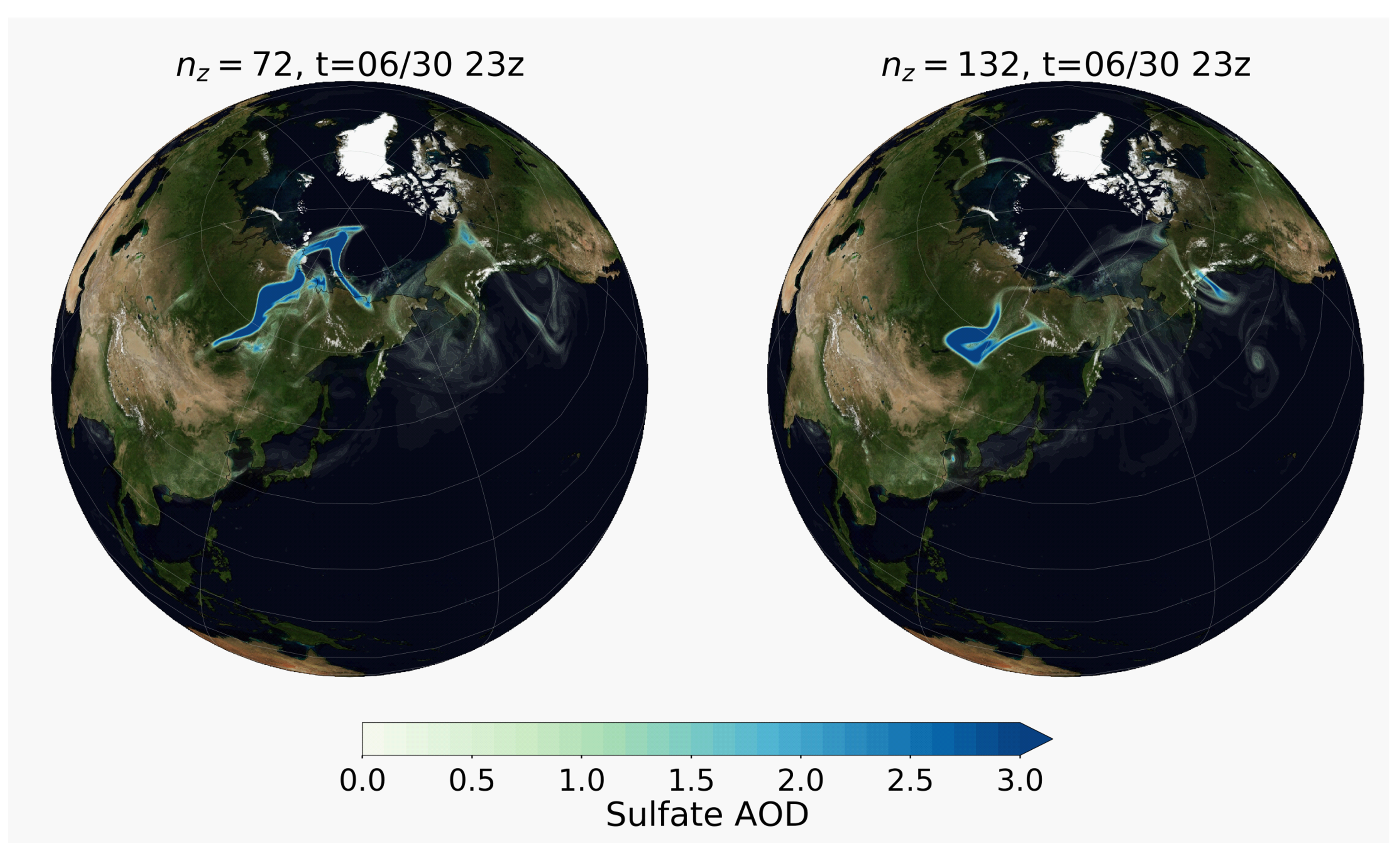
To investigate how increasing the resolution of the model’s vertical mesh would affect the simulated transfer of constituents between the stratosphere and the troposphere, we conducted two simulations, one with 72 vertical model levels (the standard configuration for GEOS) and another with 132 levels. The additional levels allowed for more detailed representation of the atmosphere’s vertical structure, particularly at the interface region between the stratosphere and troposphere. Our simulated stratospheric intrusion and volcanic plume events were both characterized by the exchange of material (such as ozone and volcanic aerosols) between the stratosphere and troposphere, which made the simulations especially sensitive to the model’s vertical resolution.
Results and Impact
Our experiments showed that increasing the vertical resolution of the model improves simulation accuracy of both the stratospheric intrusion events and the volcanic eruptions. These improvements will allow us to better interpret NASA satellite observations of real events in Earth’s atmosphere, and make better air quality forecasts.
Why HPC Matters
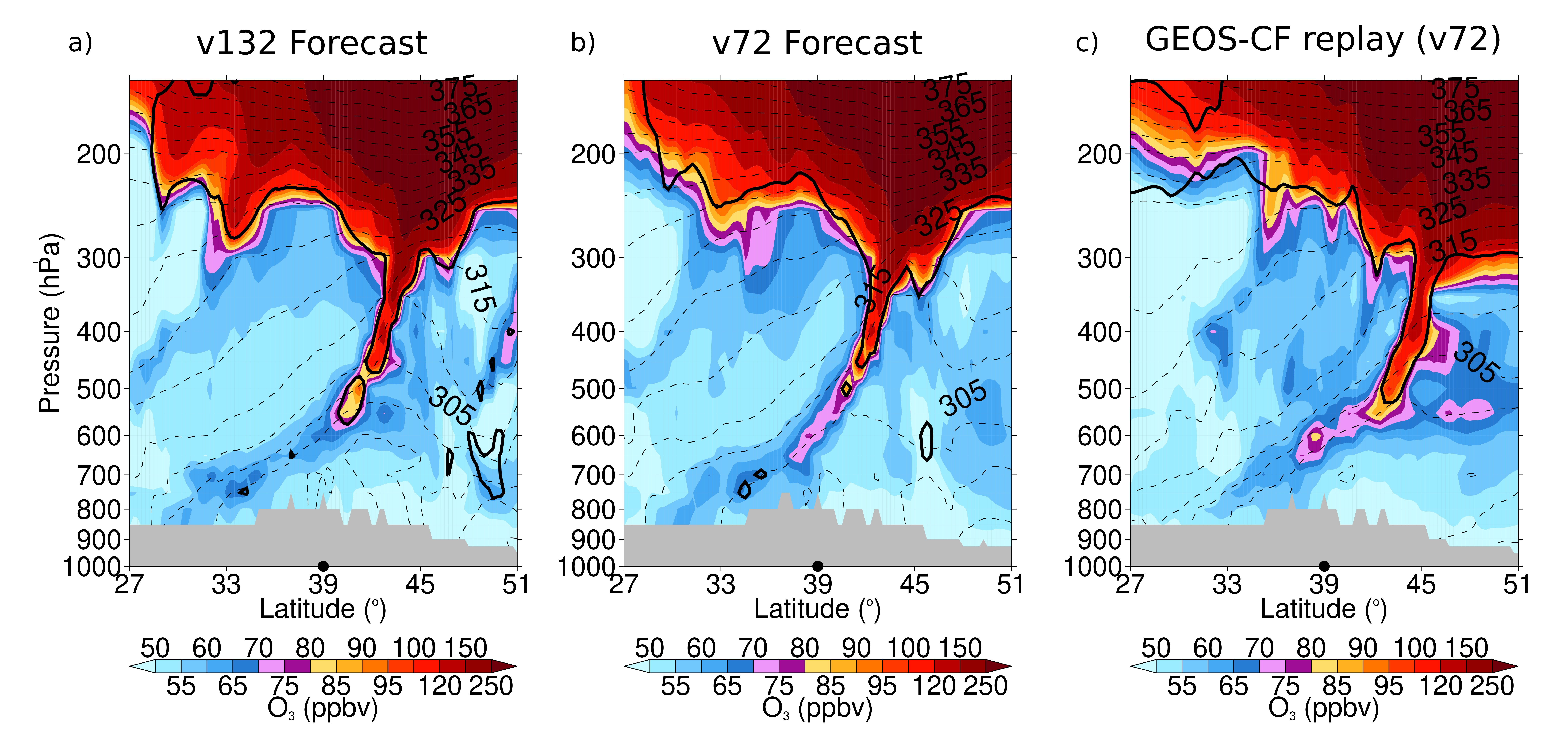
NASA’s HPC resources are essential for running and further developing the GEOS model. A typical model configuration can require hundreds to thousands of processors and terabytes of memory, and analyzing its output requires archiving terabytes to petabytes of disk space. For this project, we ran our simulations across 200 nodes on the Pleiades supercomputer at the NASA Advanced Supercomputing (NAS) facility, and stored 63 TB of data on NAS storage resources. As model development continues, and the need for higher resolution simulations grows, so will the need for additional HPC resources.
What's Next
Simulations like the ones presented here lay the groundwork for increasing the complexity and resolution of GEOS models.
More Information
- Global Simulation of Tropospheric Chemistry at 12.5-km Resolution
- Chemical Mechanisms and Their Applications in the Goddard Earth Observing System (GEOS) Earth System Model
- Dispersion of the Volcanic Sulfate Cloud from a Mount Pinatubo-like Eruption
- Stratospheric Intrusion‐influenced Ozone Air Quality Exceedances Investigated in the NASA MERRA‐2 Reanalysis
- See the poster for this demonstration (PDF, 1.2MB). As shown in the NASA booth at SC19.
elliot.m.sherman@nasa.gov Peter Colarco, NASA Goddard Space Flight Center
peter.r.colarco@nasa.gov K. Emma Knowland, NASA Goddard Space Flight Center
k.e.knowland@nasa.gov