
How Does Space Weather Affect Mercury, Earth, and Uranus?
Overview
Space weather can have devastating effects on human health and technology. Improving our understanding of its impact on Earth can potentially lead to the mitigation of space weather damage through forecasting. Moreover, investigations of the solar wind’s interactions with other planets will enhance the science returns of NASA missions such as MESSENGER to Mercury, Magnetospheric Multiscale around Earth, and the Voyager flyby past Uranus. While significant discoveries are made by NASA’s direct spacecraft observations, in situ measurements are often taken at limited points along the trajectories of planetary orbits or flybys. Such limitations can be alleviated by global numerical simulations, which allow interpretation of in situ measurements in a three-dimensional context and distinguish temporal from spatial fluctuations.
Project Details
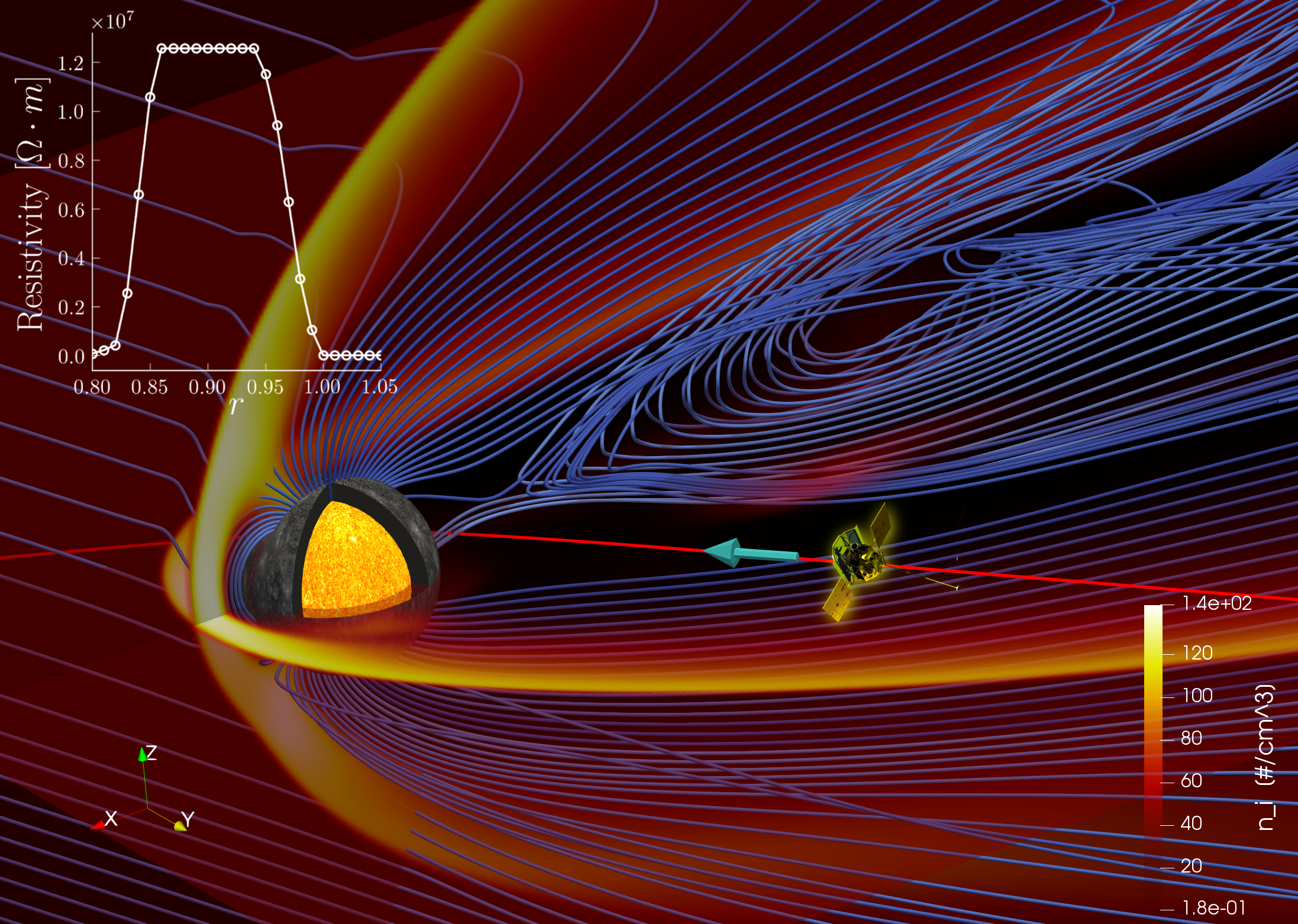
The primary science focus of our work is to study the solar wind interaction with Mercury, Earth, and Uranus by employing a 3D magnetosphere model containing the key electron physics that are essential to reproduce and interpret the observations. Many global models are based on either a fluid or hybrid (kinetic ion particles and massless electron fluid) approach for planets in our solar system and beyond. However, due to a lack of detailed electron physics, none of these models accurately treat collisionless magnetic reconnection. To solve this issue with affordable computational costs, we developed a novel multi-moment multifluid model capable of reproducing certain critical aspects of the reconnection physics from fully kinetic simulations.
For the first time, we performed global (on the scale of many tens of planetary radii) simulations of interactions between the solar wind and planetary magnetospheres, including Mercury, Earth, and Uranus, using the ten-moment multifluid (multi-ion and single-electron) model. This model solves the continuity, momentum, and pressure tensor equations of each charged species, as well as the full Maxwell equations. It is noteworthy that the new model supports all kinds of electromagnetic waves and contains lower-order kinetic physics. Given that a kinetic particle model needs hundreds of particles in each cell for eliminating particle noise, while a fluid model shows no noise with only one fluid parcel per cell, one simulation can get at least 10 times faster by employing this kinetic fluid code.
Results and Impact
The simulation results reveal highly dynamic responses of the planetary magnetospheres to varying external conditions. The model can reproduce observations beyond the traditional magnetohydrodynamic approach, including dawn-dusk asymmetries in a planet’s magnetotail and field-aligned currents. The new model is essential for capturing the electron physics associated with collisionless magnetic reconnection in a planet’s magnetosphere.
Given the significant impact of stellar winds on exoplanets residing within close-in habitable zones of M dwarfs, the investigation of the solar wind interaction with planets under extreme space weather conditions may have important implications for studying (exo)planetary habitability.
Why HPC Matters
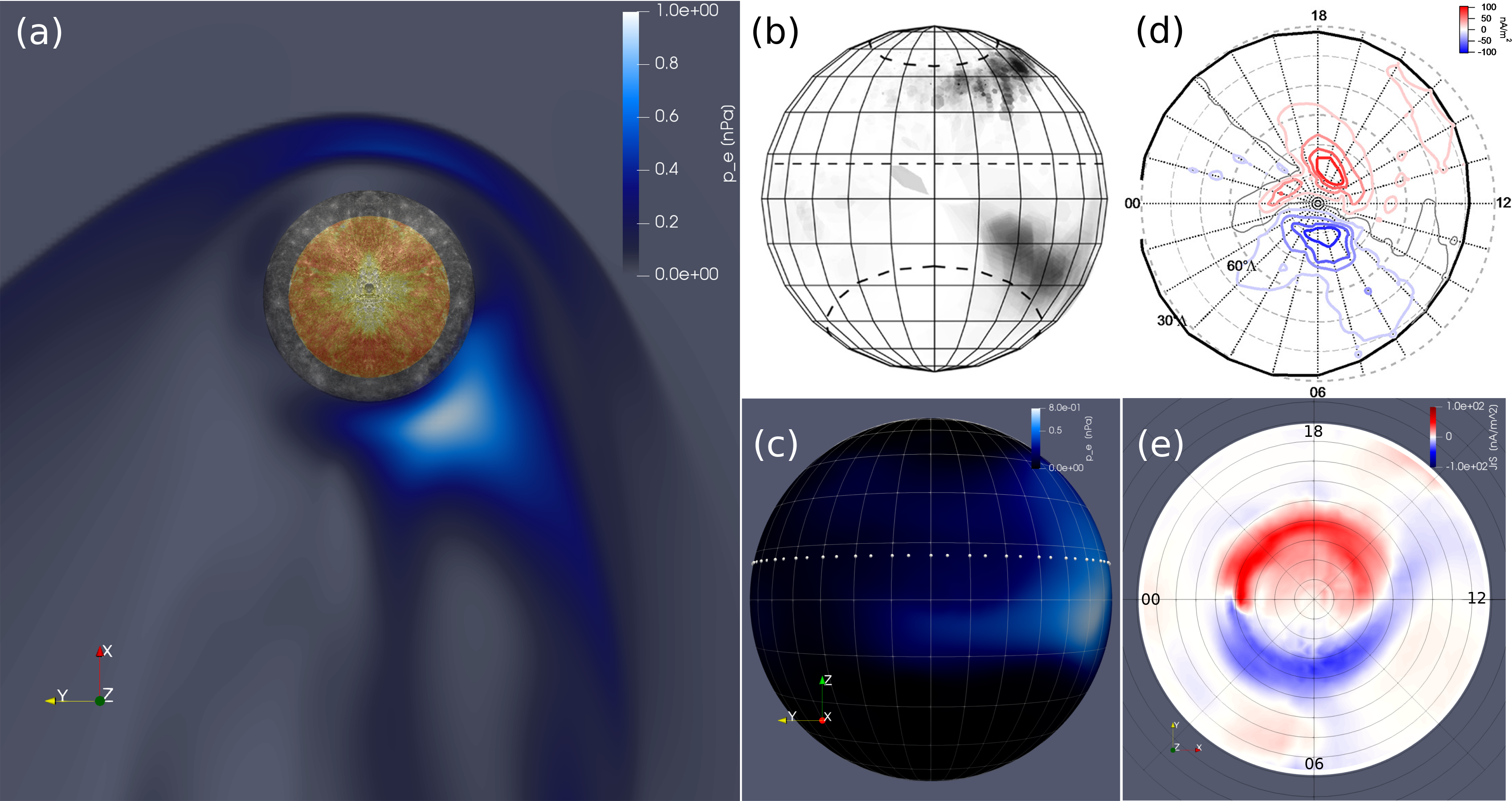
The Pleiades and Electra supercomputers at the NASA Advanced Supercomputing facility make it possible to perform our 3D high-resolution magnetospheric simulations and study the responses of different planets to varying space weather conditions. We used an unprecedented fine-grid resolution—the smallest grid size is 0.01 planetary radii—for this type of simulation, which require up to 1,300 nodes (that is, 52,000 cores).
More Information
- Global Ten-Moment Multifluid Simulations of the Solar Wind Interaction with Mercury: From the Planetary Conducting Core to the Dynamic Magnetosphere
- Exact and Locally Implicit Source Term Solvers for Multifluid-Maxwell Systems
- Is Proxima Centauri B Habitable? -- A Study of Atmospheric Loss
- See the poster for this demonstration (PDF, 610KB). As shown in the NASA booth at SC19.
- Download the demonstration slide deck (PPSX, 132.2MB) as presented in the NASA booth at SC19. Click "Read Only" after launching presentation.
dcfy@princeton.edu Liang Wang, Princeton University
lw6@princeton.edu