
Towards Multiphysics Prediction Capability for the KSC Launch Environment
Overview
When engineers at NASA’s Kennedy Space Center (KSC) redesigned and rebuilt the main flame deflector (MFD) at KSC’s Launch Complex 39B, a team of experts from the NASA Advanced Supercomputing (NAS) Division was called in to apply high-resolution computational fluid dynamics (CFD) to help identify thermal, pressure, and flow environments on and around the geometrically complex MFD. The NAS Division’s Launch Ascent and Vehicle Analysis (LAVA) team investigated both ignition overpressure waves and thermal conjugate heat transfer simulations of the MFD, the mobile launcher, and the tower, including umbilical hardware and other key components of the launch pad.
The LAVA team is currently working to improve the fidelity of these launch environment simulations by including the Ignition Overpressure Protection and Sound Suppression (IOP/SS) system. This system delivers almost a half-million gallons of water to the mobile launcher and MFD to suppress strong acoustic waves that could damage the structure or launch vehicle. Incorporating water into the simulations poses difficulties, in part due to massive variations in density and the presence of powerful shock waves. The LAVA team is in the early stages of developing multiphase capabilities that will be utilized in future launch simulations.
Project Details
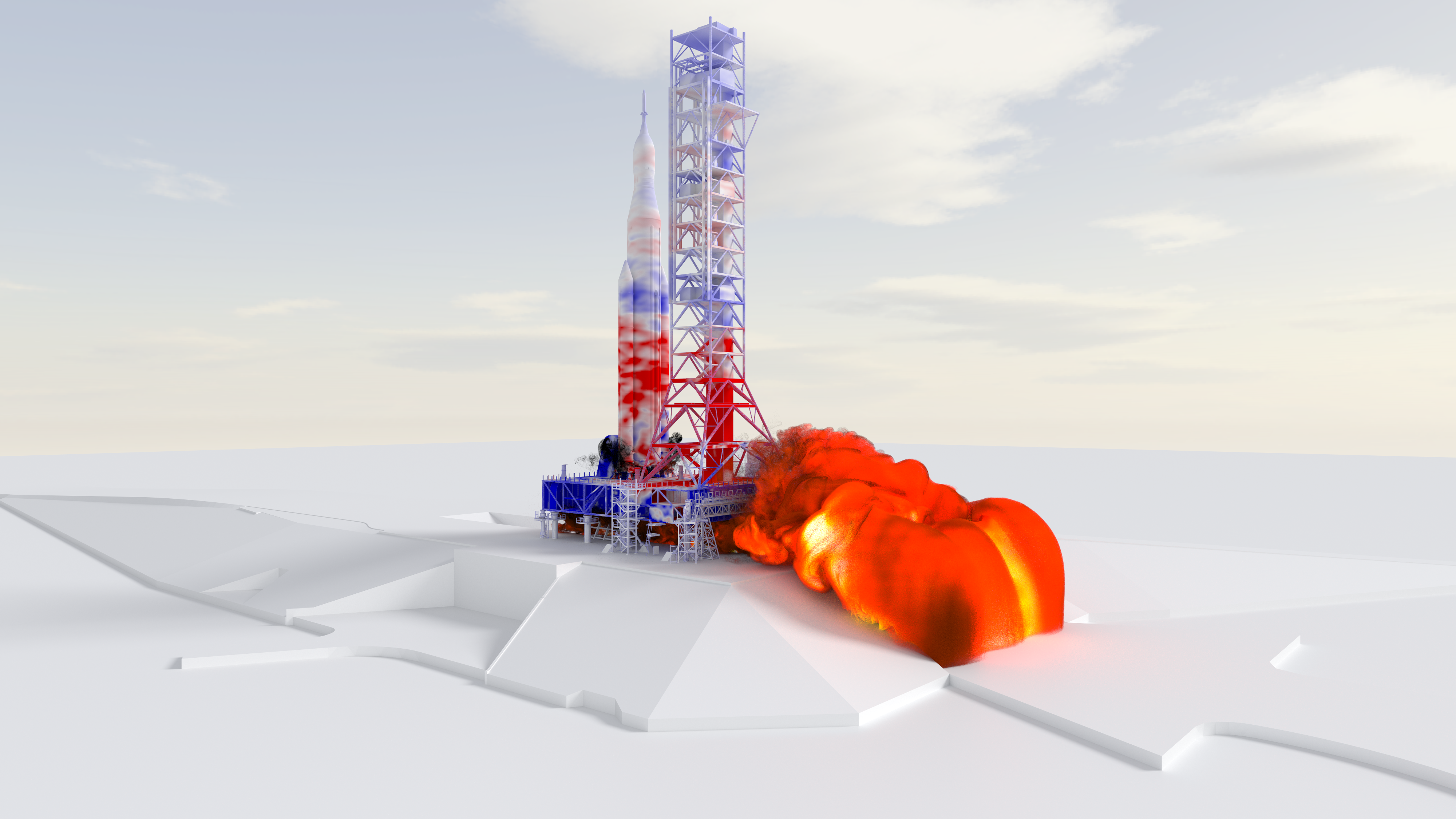
For the MFD redesign project, the LAVA team completed large-scale CFD simulations of the highly detailed, as-built pad geometry, which required the development of appropriate boundary conditions, meshing, and lift-off information. The simulations were run with the LAVA code and post-processed using statistical tools from the LAVA framework and high-end custom visualization techniques that were also developed at NAS. The extremely complex geometric topologies were easily handled using the high-order accurate LAVA immersed boundary Cartesian Navier-Stokes approach. The simulations are some of the largest conducted at NAS—the LAVA Cartesian simulation contained over 555 million cells and over 500,000 timesteps, and utilized more than 4,000 cores on NASA’s Electra supercomputer.
For the current project, the driving force is the need to incorporate relevant physics into the simulations to improve confidence in safety and mission success. The results of these simulations, obtained with advanced post-processing, will be used to evaluate the ability of the IOP/SS system to prevent violent acoustic waves that could damage the launch structure or vehicle. Incorporating the water deluge system into the new simulations requires modifications to the governing equations and implementation of new numerical techniques. Analysis of both thermal and pressure environments will be conducted and compared with the previous simulations that do not include the IOP/SS system.
Results and Impact
The results of the launch environment simulations were used to guide project engineers in the MFD redesign. The new multiphase results will give a more complete picture of the extreme conditions the launch system experiences and will help NASA reduce mission risk—averting issues and potentially saving significant amounts of time and money. This collaboration also represents a great opportunity to advance NASA Ames Research Center’s key expertise in the launch acoustics area, and to further improve the LAVA software.
Why HPC Matters
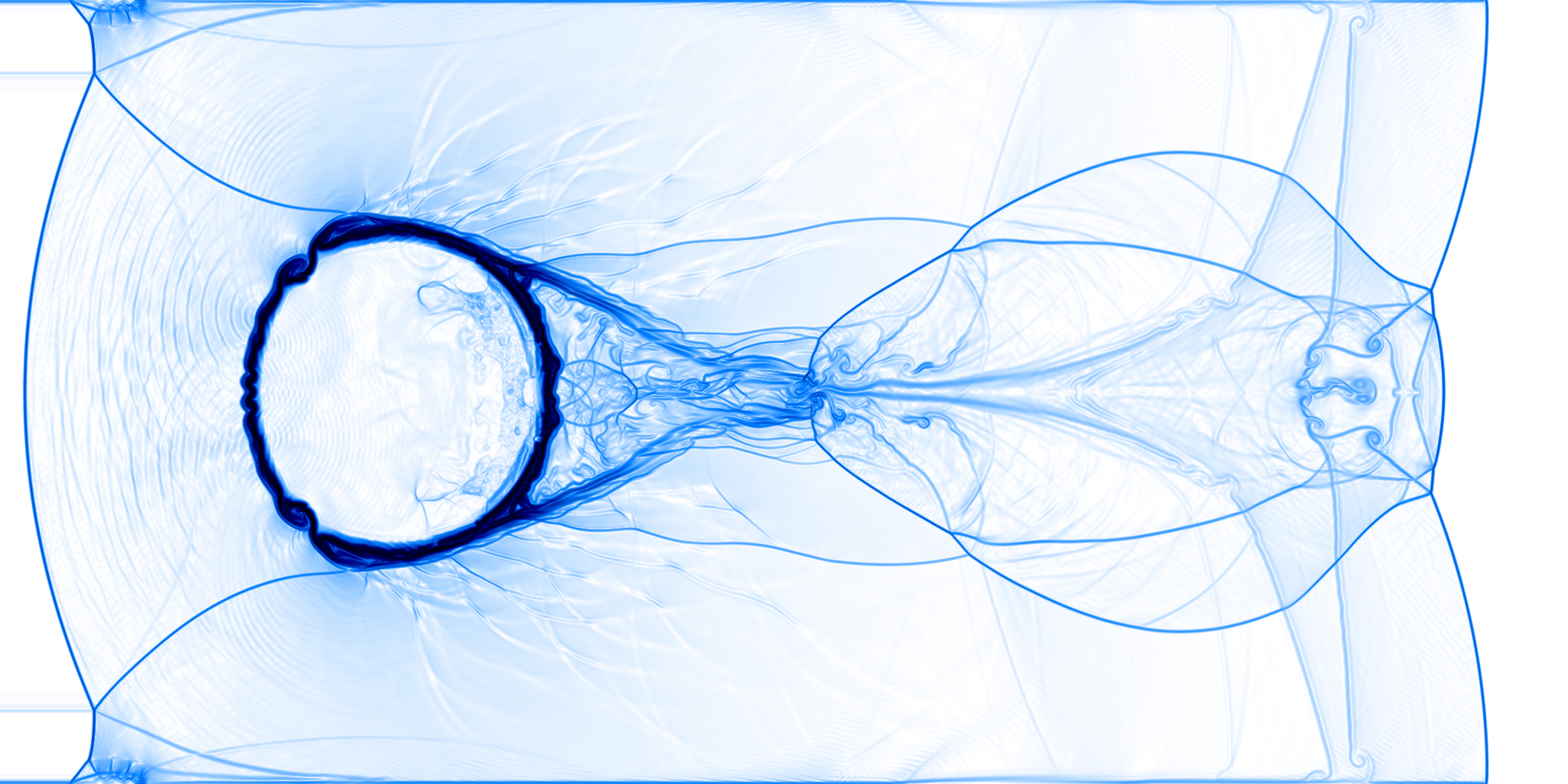
The high-resolution simulations of the launch environment required approximately five weeks of simulation time on Electra using up to 4,000 Intel Xeon Skylake cores. With the added complexity of modeling the IOP/SS system, the need for powerful computational resources also grows. Because these simulations are time-dependent, they generate hundreds of terabytes of data for each calculation.
More Information
- See the poster for this demonstration (PDF, 509KB). As shown in the NASA booth at SC19.
jordan.b.angel@nasa.gov Cetin Kiris, NASA Ames Research Center
cetin.c.kiris@nasa.gov