
Discovering Distinct Cycles in the Global Solar Dynamo
Overview
Modern society is intimately dependent on electronic communications, satellite observations, and large-scale power grids, all of which are frequently affected by space weather phenomena such as solar flares and coronal mass ejections. All space weather fundamentally has its roots in the solar magnetic field, but the global dynamo producing this magnetism remains difficult to constrain. Global simulations of the Sun’s interior magnetism, run on NASA’s massively parallel supercomputers, provide the most effective route toward understanding the global solar dynamo. Using these simulations in concert with extensive NASA observations of the Sun’s surface magnetic field will ultimately help scientists predict space weather, allowing society to be better prepared for a possibly catastrophic space weather event.
Project Details
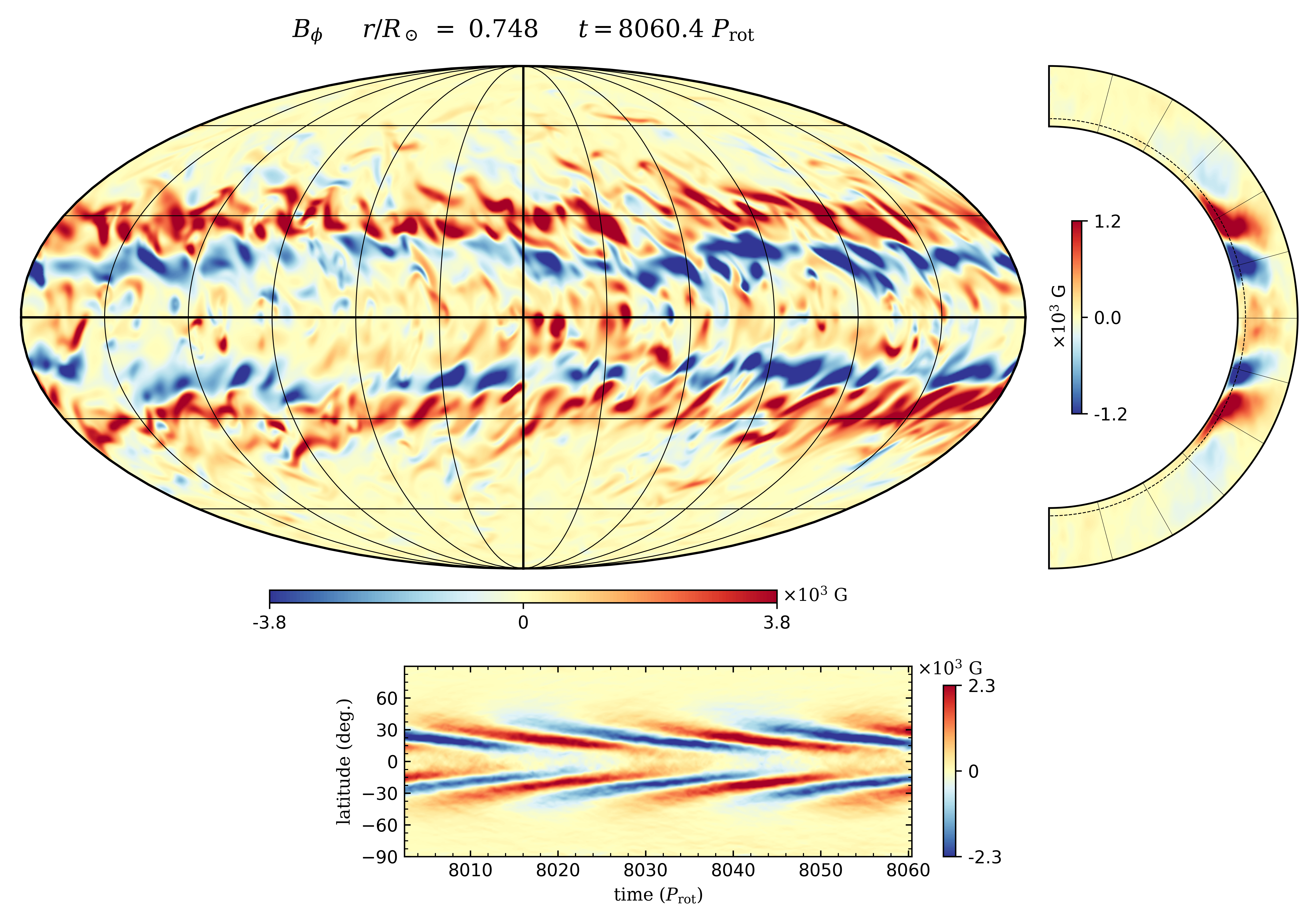
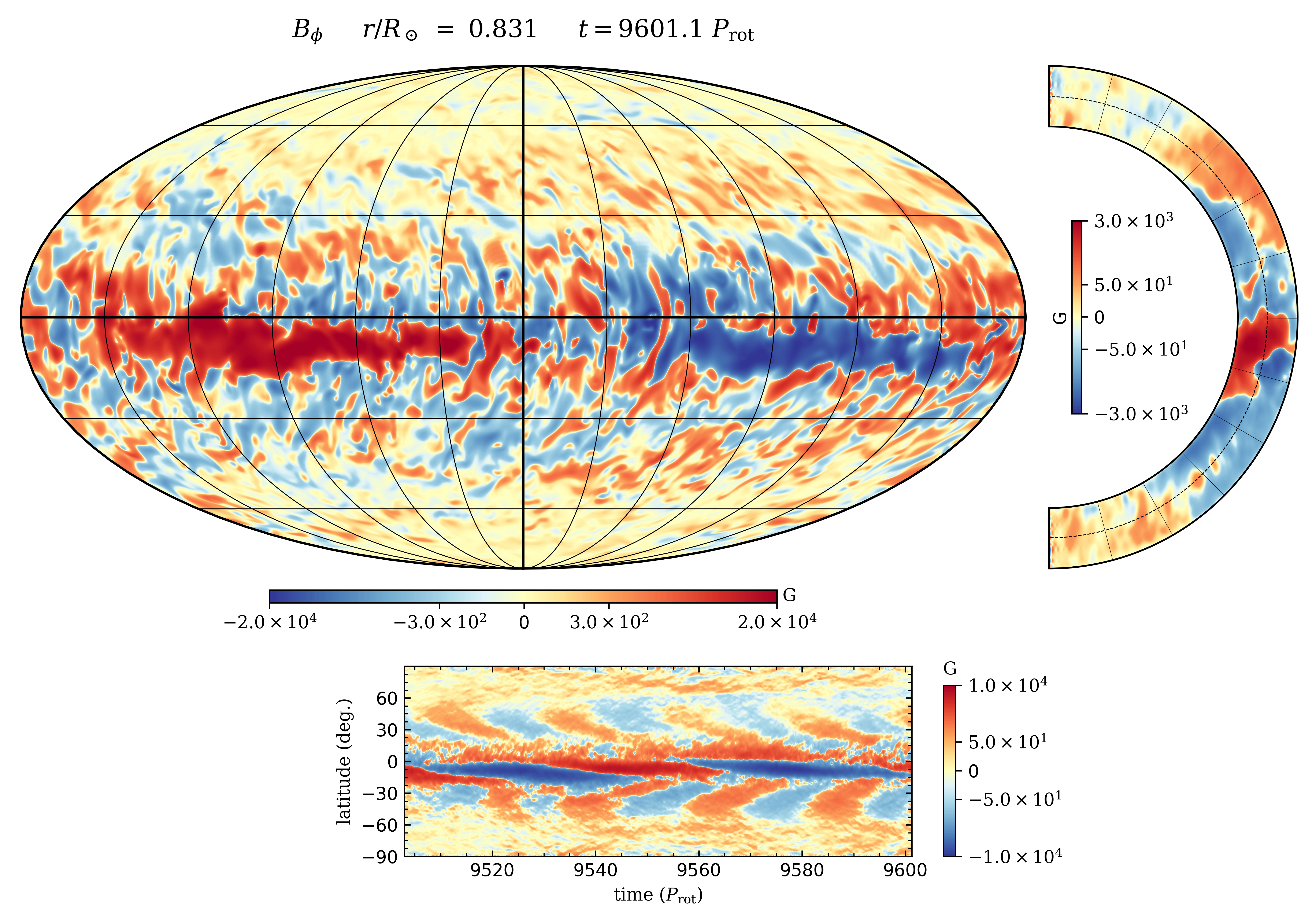
Scientists don’t know where sunspots originate in the highly turbulent solar convection zone (CZ), or the physical causes of sunspot emergence. The goal of this project is to characterize the nonlinear dynamo responsible for the cycles in solar magnetic activity (the most prominent of which is the 22-year sunspot cycle). We use the sophisticated, open source, nonlinear magnetohydrodynamic (MHD) code Rayleigh to simulate a magnetized fluid in a rotating, convecting spherical shell. Our simulations reproduce regular cycles during which globally connected “wreaths” of magnetism reverse polarity and migrate toward the equator, two features highly reminiscent of the sunspot cycle. Additionally, there is an asymmetric cycle, during which strong magnetism preferentially occupies one hemisphere at certain longitudes, reminiscent of the “active longitudes” and “active hemispheres” observed on the Sun. This new class of simulations allows us to better synthesize our understanding of distinct features of the solar cycle.
Results and Impact
Our new class of simulations builds on previous numerical work aimed at understanding equatorward propagation in the sunspot cycle, regular polarity reversals, and active longitudes. We offer for the first time a systematic, integrated perspective on these disparate phenomena and present a detailed description of the MHD processes at work in our simulations. We will produce publicly available data products that will allow modelers of the photosphere to cleanly compare our results with observations from NASA’s Solar and Heliospheric Observatory (SOHO) and Solar Dynamics Observatory (SDO) missions.
Why HPC Matters
A global simulation of the solar dynamo that hopes to capture much of the small-scale, turbulent structures associated with convective flows requires several million core-hours of computer time. Our work would not be possible without the infrastructure of the Pleiades supercomputer at the NASA Advanced Supercomputing (NAS) facility. Over the last year, we used about 15 million core-hours for this project and generated over 20 terabytes of data. We frequently relied on the excellent support provided by NAS staff to allow the Rayleigh code to scale up to run on 8,192 Broadwell cores, or 293 Broadwell nodes. The videos for this work, as well as much of the MHD analysis, were all made on the high-memory (756 GB) data analysis nodes on Pleiades.
What's Next
Historically, Parker’s “interface dynamo” has been used to explain the regular 22-year sunspot cycle. This theory attributes a central role to the tachocline of shear at the base of the CZ, where the differential rotation (fast equator and slow poles) transitions sharply to solid body rotation. The next step in the current study is to include a stably stratified region below the CZ and a tachocline of shear at the transition between these two regions.
More Information
- The Sun May Have a Dual Personality, Simulations Suggest
- NASA SOHO
- NASA SDO Mission
- See the poster for this demonstration (PDF, 601KB). As shown in the NASA booth at SC19.
- Download the demonstration slide deck (PPSX, 159.4MB) as presented in the NASA booth at SC19. Click "Read Only" after launching presentation.
loren.matilsky@colorado.edu Juri Toomre, University of Colorado Boulder and JILA
jtoomre@lcd.colorado.edu