
Predicting Jet Noise for Full-Scale Low-Boom Aircraft
Overview
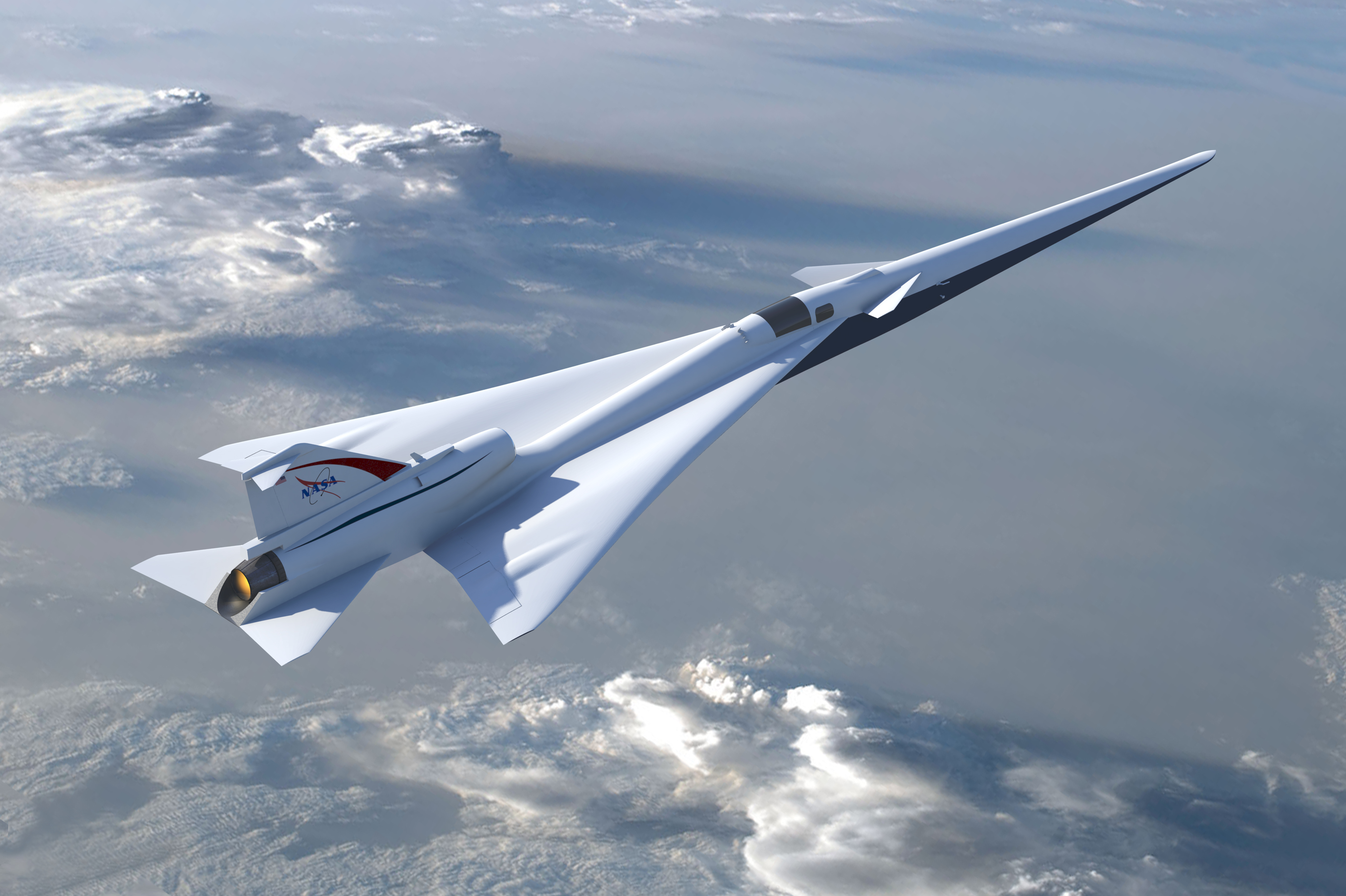
NASA’s supersonic vehicle research addresses the development of tools, technologies, and knowledge to help eliminate today’s technical barriers to practical commercial supersonic flight. Although the major focus of this development has been on reducing the ground signature at supersonic cruise, in order for an airplane to be certified it must also satisfy noise constraints during takeoff and landing when it is traveling at subsonic speeds. The dominant source of sound during this phase is jet noise. Computational aeroacoustic simulation tools can be used to assess new designs for NASA’s Low-Boom Flight Demonstrator aircraft at these lower speeds. We are further scrutinizing both modeling and simulation practices and the use of hybrid Reynolds-averaged Navier Stokes/Large-Eddy Simulation (RANS/LES) methods, and are developing new methods to predict jet noise—including surface interaction noise—on a full flight configuration airplane.
Project Details
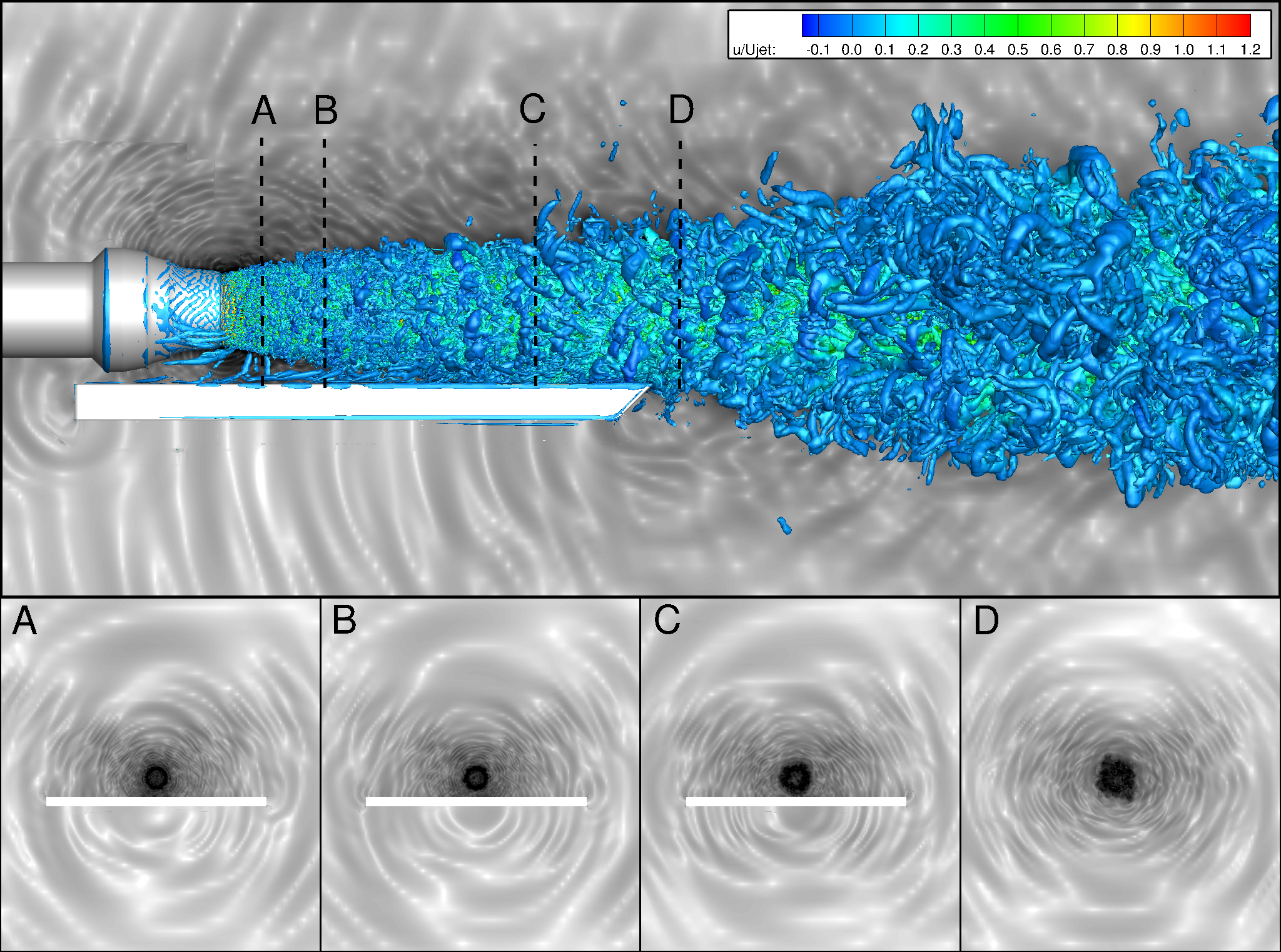
While great advancements have been made toward predicting jet noise with computational fluid dynamics (CFD) solvers—including high-fidelity simulations at flight Reynolds numbers and some modeling of simple but important geometric features, such as jet surface interaction noise—most simulations rely on high-fidelity, wall-modeled LES methods and are still limited to simple geometries due to the complexity of the problem. However, the scale-resolving simulations needed to predict accurate far-field noise are still too computationally demanding to investigate full airframe interaction noise using wall-modeled LES.
A possible strategy to achieve full-scale airframe simulations including jet-noise prediction is the use of a hybrid RANS/LES approach, in which most parts of the aircraft are simulated using unsteady RANS, while critical areas where most of the noise is created are simulated using LES. As a step toward predicting jet acoustics for the Low-Boom Flight Demonstrator, scientists at NASA’s Ames Research Center performed scale-resolving simulations with the Launch Ascent and Vehicle Aerodynamics (LAVA) solver scrutinizing hybrid RANS/LES methods on validation cases with increasing complexity, including jet surface interaction noise and chevron nozzle designs.
Results and Impact
By improving zonal hybrid RANS/LES capabilities (funded by NASA’s Transformational Tools and Technologies project) within the LAVA solver framework, we achieved a successful prediction of jet noise as well as jet surface interaction noise within NASA’s Commercial Supersonic Transport program. Findings from these simulations have already resulted in new insights and additional experimental investigations of certain flow phenomena. Gaining confidence in the predictive capabilities of hybrid RANS/LES for jet noise is another step toward vehicle certification by analysis.
Why HPC Matters
The Pleiades and Electra supercomputers at the NASA Advanced Supercomputing (NAS) facility are instrumental in enabling these next-level, large-scale computational aeroacoustics simulations over hundreds of nodes and thousands of cores. Each simulation generates hundreds of terabytes of data that is then analyzed in the frequency domain, which requires parallelized post-processing tools that reduce the cost of accessing data on disk. Raw computational power is not enough—large and efficient distributed filesystems are also critical. In addition, NAS’s visualization services help us go beyond what traditional data analysis tools offer.
More Information
- Computational framework for launch, ascent, and vehicle aerodynamics (LAVA)
- Jet Noise Prediction using Hybrid RANS/LES with Structured Overset Grids
- See the poster for this demonstration (PDF, 647KB). As shown in the NASA booth at SC19.
gerrit-daniel.stich@nasa.gov Cetin Kiris, NASA Ames Research Center
cetin.c.kiris@nasa.gov