
Simulating the Water Cycle and Cloud Formation on Mars
Overview
The water cycle is one of three coupled seasonal cycles that control the climate of Mars. A full understanding of how water is exchanged between the atmosphere and the surface, moves through the atmosphere, and forms clouds requires the use of sophisticated global climate models (GCMs) that have been adapted to Mars. One such GCM, under development for several decades at NASA’s Mars Climate Modeling Group at Ames Research Center, has recently been updated to include the cubed-sphere finite volume dynamical core developed at the National Oceanic and Atmospheric Administration’s Geophysical Fluid Dynamics Laboratory (NOAA/GFDL). This modern dynamical core is highly parallelized, scalable, and flexible, which enables global, multi-year, high-resolution modeling of Mars’ atmosphere and the ability to investigate a multitude of open questions about water, clouds, and the Martian climate.
Project Details

Modern GCMs adapted to Mars yield critical insight into the importance of the water cycle and water ice clouds in the Martian climate system. Water ice clouds form when atmospheric dust is present to provide ice nuclei and when cloud nucleation and growth are thermodynamically favored. Like on Earth, clouds can either cool or warm the atmosphere and/or the planet’s surface depending on their location, altitude, and optical properties. We use the GCM developed at NASA’s Mars Climate Modeling Center to investigate the water cycle and how water ice clouds affect the Martian climate.
Results and Impact
We have carefully compared the GCM results with spacecraft observations and find that radiative effects of Martian clouds, even though they are thin compared to Earth’s clouds, significantly change the thermal structure of the atmosphere and intensity of its global-scale wind systems. In this way, they help control the movement of water around the planet. In the distant past when orbital properties were different, we have found that clouds could provide a strong greenhouse effect and warm the surface by tens of Kelvin. Our studies directly address NASA’s goals to understand how bodies in the solar system evolved and they assist the agency’s mission planning activities.
Why HPC Matters
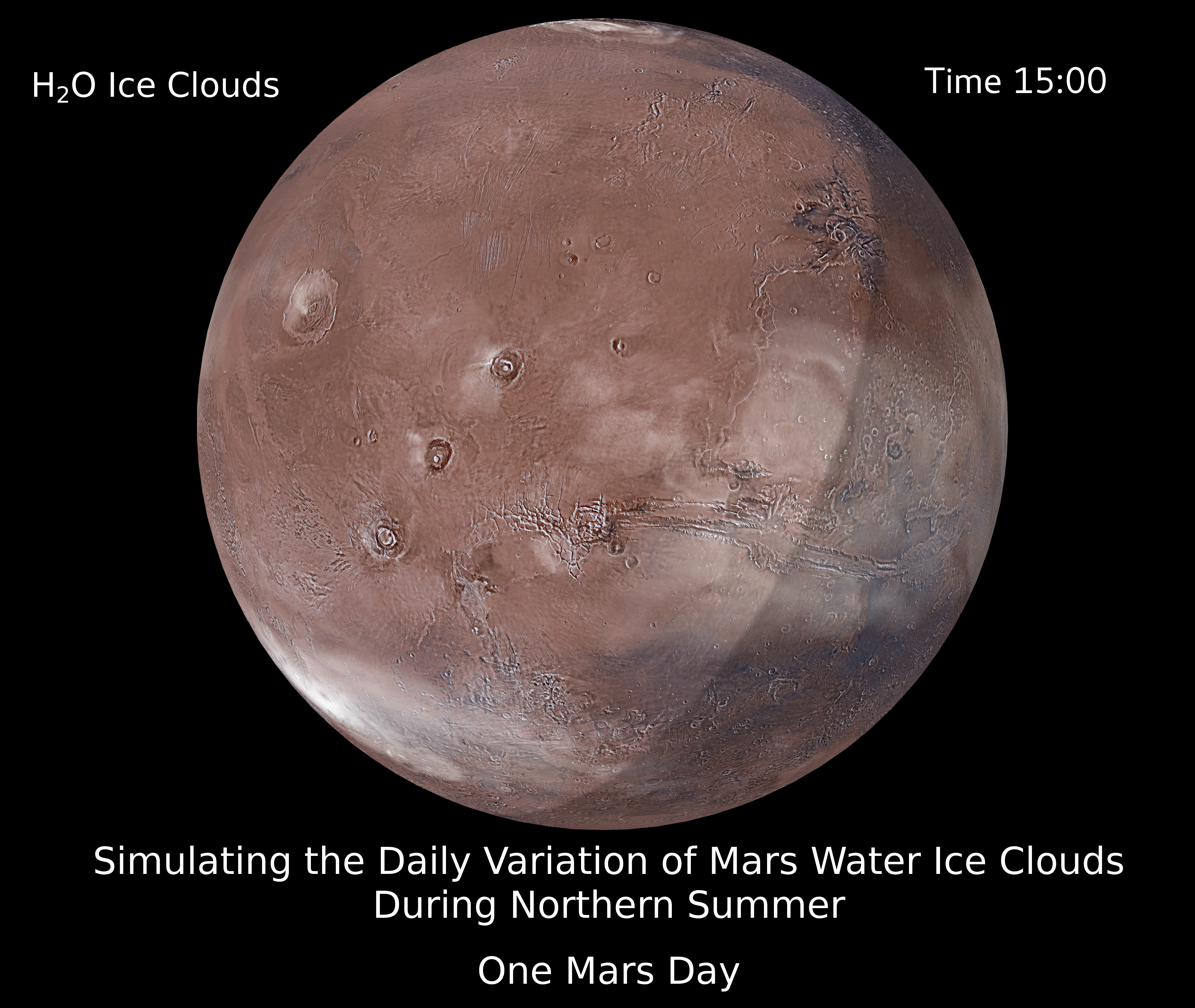
The high-performance computing resources provided by the NASA Advanced Supercomputing (NAS) Division enable three necessary requirements for the success of this project: visualization of model results, high spatial resolution capability, and fast throughput. Visualization of the four-dimensional output from GCMs is absolutely critical for interpreting the results, and running at high spatial resolution on hundreds or thousands of computational cores allows us to simulate important processes not resolvable at common grid spacings. Since we need to simulate many years of the Mars climate system to address the science questions of interest, the computational power of NASA’s Pleiades supercomputer allows us to study the impact of many different processes on practial time scales.
What's Next
We will continue to improve our representation of physical processes, increase the model spatial resolution, and conduct longer and longer simulations to study interannual variability.
More Information
- See the poster for this demonstration (PDF, 495KB). As shown in the NASA booth at SC19.
melinda.a.kahre@nasa.gov