
Revolutionizing Assessment of Unsteady Flows Using Pressure-Sensitive Paint
Overview
Many important aeroscience problems involve unsteady, separated aerodynamic flows, and the key measurement necessary for understanding these flows is surface pressure. Traditionally, hundreds of unsteady pressure sensors are used in wind tunnel tests to assess flows around aerospace vehicles and components. However, a new state-of-the-art approach is needed to decrease the overly conservative loads produced by traditional methods. An emerging optical technology, Unsteady Pressure-Sensitive Paint (uPSP), is now being used to measure global fluctuating surface pressures. Recently, uPSP was used in tests run on a model of NASA’s Space Launch System in the Unitary Plan Wind Tunnel (UPWT), located at NASA’s Ames Research Center, to determine the aeroacoustics environment and assist in developing the buffet forcing functions. The high spatial resolution of the uPSP data collected during the test will help engineers develop a more efficient, higher-performing vehicle.
Project Details
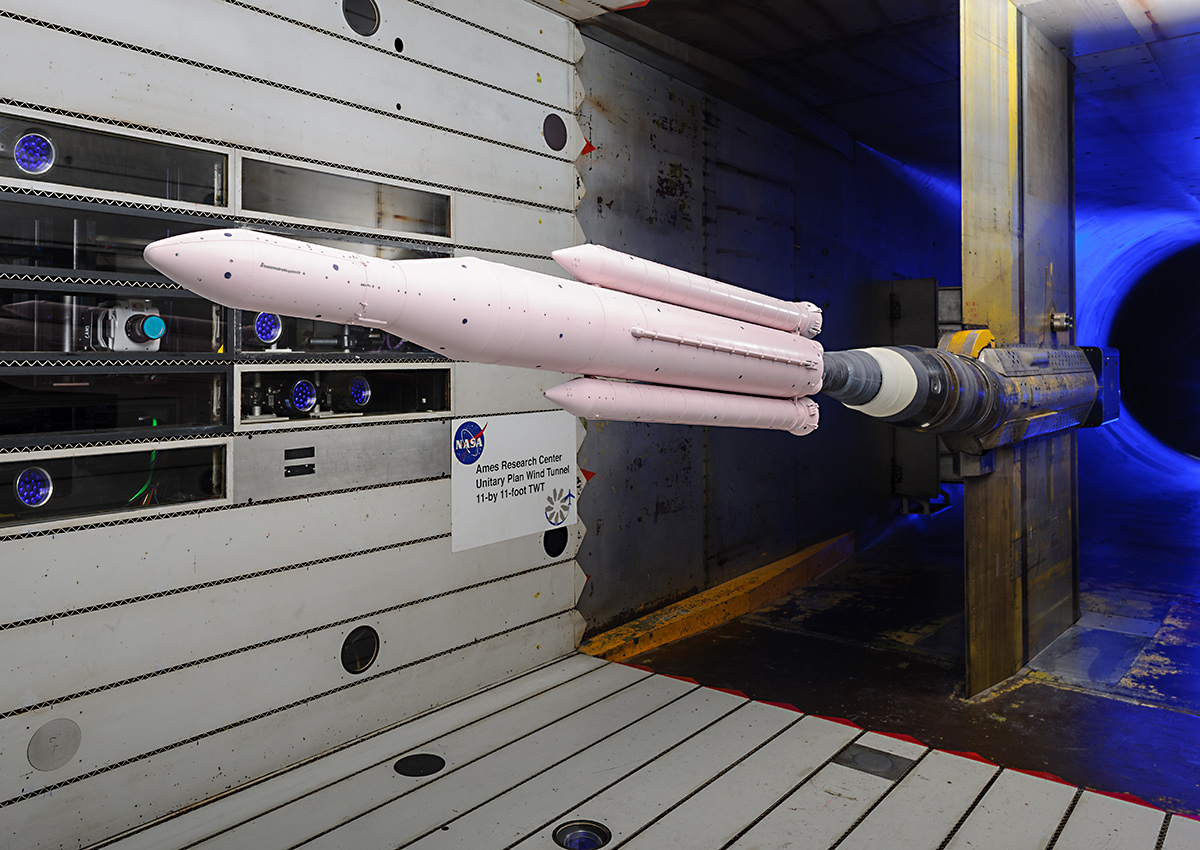
The goal of the recent test campaign was to demonstrate the power of uPSP to assess low-frequency forces, while also addressing one of the main challenges this method faces when deployed in a production wind tunnel: access to sufficient data storage and compute resources to store and process the enormous amount of data produced during the tests. Working with high-performance computing (HPC) experts at the NASA Advanced Supercomputing (NAS) facility, we established the Red Rover project to develop a secure, uni-directional, high-bandwidth connection from the UPWT to the compute and storage resources at the NAS facility, also located at Ames—about a half-mile away from the wind tunnel.
Previously, transferring uPSP data from the UPWT to the NAS supercomputers for processing required physically transporting hard drives from one facility to the other. Just uploading the data to multiple drives took over a month; clearly, this was not a sustainable approach for expanding the amount of data collected during wind tunnel campaigns. The Red Rover project aimed to transfer, process, and visualize the uPSP data, recorded by four high-speed cameras, within one hour of data collection, allowing researchers to make informed decisions about test matrix prioritization.
Results and Impact
During the test campaign, over 600 data points and more than 150 terabytes of data were acquired and securely transmitted to the NAS facility. In addition, NAS experts parallelized portions of the code used to process the uPSP data, dramatically reducing processing time from one day per test point to one minute. By connecting the power of this high spatio-temporal measurement to the power of the Pleiades supercomputer, along with the ability to quickly process and visualize the results on the NAS facility’s hyperwall, near-real-time design decisions are made possible—establishing a new path toward decreasing design cycle time and mitigating over-design of aerospace vehicles due to insufficient tools.
The project’s success was a clear demonstration of the reward when experimental and computational facilities and experts are integrated with the goal of solving the challenging problems within aeroscience.
Why HPC Matters
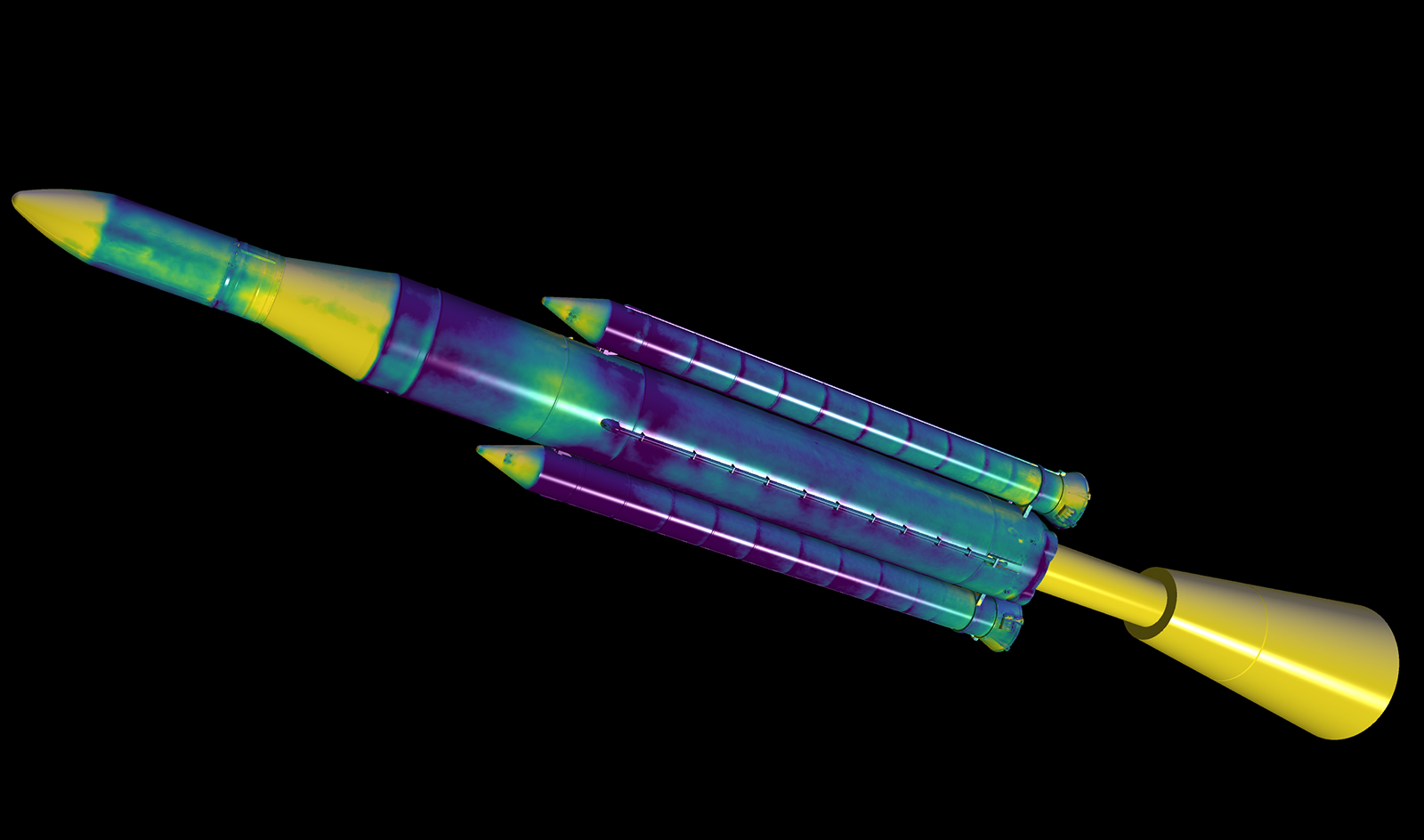
Traditionally, uPSP has been used in small facilities, with the amount of data acquired relatively small and managable. With recent improvements in uPSP technology, it can now be deployed in large production wind tunnels. High-performance computing (HPC) resources are required to store and process the enormous amount of raw data produced in uPSP tests in these larger facilities. Combined with HPC, uPSP provides a new tool to efficiently design and assess wind tunnel models in order to develop next-generation aerospace vehicles.
What’s Next
The next step is to continue developing the data products downstream of the pressure-time histories, compare results against traditional methods, and continue to validate this technology as the new state of the art for unsteady aerodynamic assessment.
More Information
- Power of Pink Provides NASA with Pressure Pictures
- Pressure Sensitive Paint for Measuring Unsteady Launch Vehicle Aerodynamic Buffet
- See the poster for this demonstration (PDF, 505KB). As shown in the NASA booth at SC19.
- Download the demonstration slide deck (PPSX, 3.94GB) as presented in the NASA booth at SC19. Click "Read Only" after launching presentation.
nettie.roozeboom@nasa.gov Ji Lie, NASA Ames Research Center
ji.lie-1@nasa.gov David Murakami, NASA Ames Research Center
david.d.murakami@nasa.gov