
Achieving Quantum Supremacy with Noisy Intermediate-Scale Quantum Devices
Overview
Quantum computing promises a great deal of compute power, with the potential to revolutionize current computational capabilities and provide large speedups for solving problems in optimization, chemistry, materials science, and machine learning. “Quantum supremacy” is the ability of a programmable quantum processor to perform a well-defined task beyond the capability of the most powerful supercomputers on Earth. However, a demonstration of quantum supremacy on today’s noisy, intermediate-scale quantum (NISQ) devices needs a careful comparison with state-of-the-art classical simulators. Such a demonstration is on the verge of taking place, and will likely involve sampling from a random quantum circuit (RQC). It is well known that sampling from RQCs using classical computers is exponentially hard with the size and depth of RQCs. Achieving quantum supremacy experimentally will represent a historic milestone in quantum computing, and unlock a wide range of possibilities, including a better understanding of the performance of quantum algorithms on real quantum hardware.
Project Details
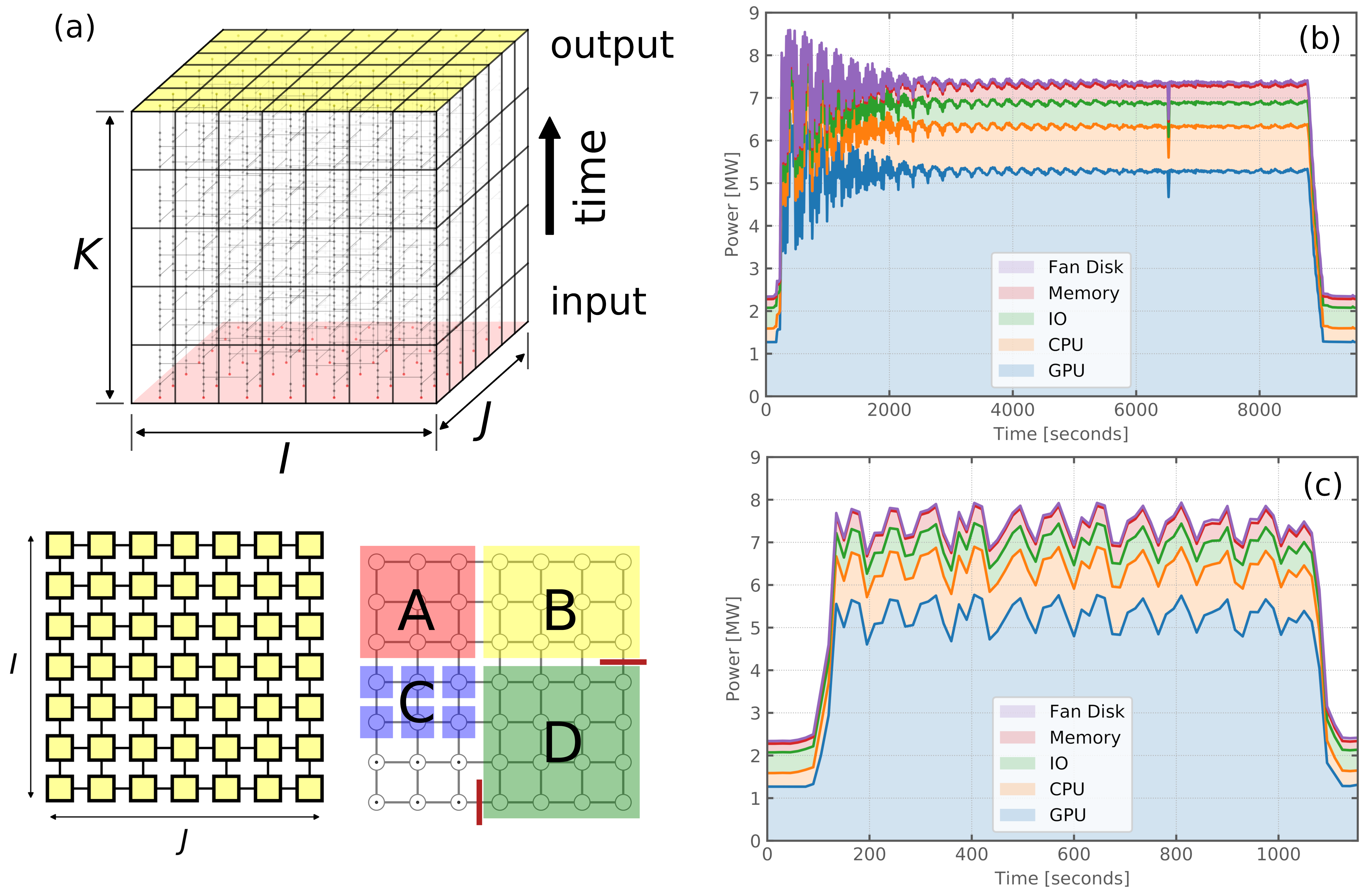
Researchers in the Quantum Artificial Intelligence Lab (QuAIL) at NASA’s Ames Research Center in Silicon Valley, in collaboration with Google and Oak Ridge National Laboratory (ORNL), have developed a quantum circuit simulator. The goal is to provide the quantum computing community with a high-performing simulator to benchmark the performance of classical supercomputers against quantum processors, assess the advantage of noisy quantum devices in performing sampling tasks, and aid in the calibration of quantum hardware. Our simulator, called qFlex, is based on tensor network contractions, which provide a large amount of arithmetic intensity to the simulation procedure, and show high performance on current supercomputers. We implement a back-end algorithm for the contractions on CPUs, and use a highly optimized tensor contraction library for graphics processing unit (GPU)-based runs. In addition, our goal is to perform highly efficient (memory and time-wise) contractions of hard quantum circuits.
Results and Impact
We have implemented a quantum circuit simulator that pushes classical supercomputers to performances above 60% of their theoretical peak, providing a fair comparison of quantum hardware with the world’s top supercomputers. We are able to benchmark square lattices of qubits, as well as Google’s Bristlecone quantum processor. Our simulator raises the bar for a quantum supremacy demonstration by benchmarking real hardware, solidifying a potential supremacy claim. It also provides further insight on the hardness of the problem and expands hardware verification possibilities. In addition, it provides a real-world application for supercomputers with efficiencies close to those of the LINPACK benchmark.
Why HPC Matters

Visualization and data analysis experts at the NASA Advanced Supercomputing facility at Ames helped with code optimization and parallelization on both the Pleiades and Electra supercomputers. We used more than 90% of the nodes on these systems over about 12 hours, achieving 64% of the peak performance of both clusters together. Such high efficiencies on top HPC systems provide a comparison for quantum processors’ computational power and a threshold for them to surpass. In addition, verifying the quantum hardware requires large amounts of classical computational resources, which are only provided by large clusters.
More Information
- Google and NASA Achieve Quantum Supremacy
- A Flexible High-Performance Simulator for the Verification and Benchmarking of Quantum Circuits Implemented on Real Hardware
- Establishing the Quantum Supremacy Frontier with a 281 Pflop/s Simulation
- The New Benchmark Quantum Computers Must Beat to Achieve Quantum Supremacy
- See the poster for this demonstration (PDF, 1.3MB). As shown in the NASA booth at SC19.
- Download the demonstration slide deck (PPSX, 13.6MB) as presented in the NASA booth at SC19. Click "Read Only" after launching presentation.
salvatore.mandra@nasa.gov Benjamin Villalonga, University of Illinois at Urbana-Champaign
vlllngc2@illinois.edu