
HPC Framework for Predicting High-Altitude Relight in Aircraft Engines
Overview
When aircraft operate at high-altitude conditions, low ambient air pressures and temperatures can lead to engine flame-out situations and hamper relight attempts. In high-altitude relight, an aircraft engine must ignite within a certain period after its initial flameout. To accomplish this, one or more ignition kernels—pockets of high-energy flow and free radicals—are introduced into the combustion chamber by firing the engine ignitor. The kernel develops into a flame front, and eventually reaches flame stabilization or extinction, depending on the kernel’s initial state and the turbulent flow evolution. There are two main challenges for predicting such events: conflicts between simulation fidelity and computational capacity, particularly with strong turbulent flow and realistic jet fuels; and the underlying stochasticity of such a problem due to turbulence and the initial spark discharge.
We have developed a comprehensive modeling framework to handle these challenges. The framework includes: a tabulated chemistry model that models non-premixed forced ignition of realistic jet fuels, incorporated into a turbulent modeling framework of large-eddy simulation (LES), using a presumed probability density function approach; and an uncertainty quantification approach, based on Monte Carlo simulations using the tabulated chemistry model, to estimate the statistical property of engine relight problems—the ignition probability.
Project Details
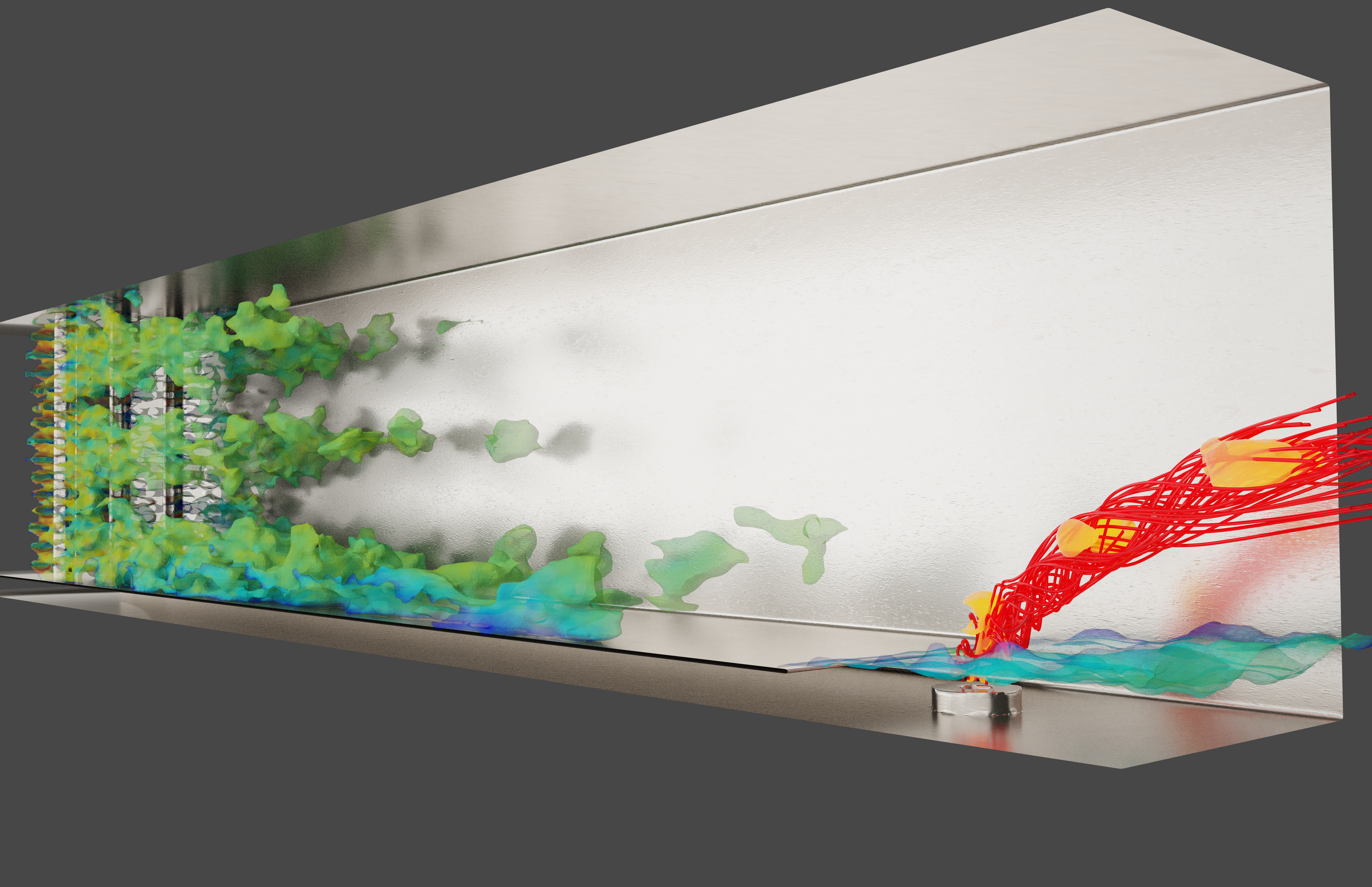
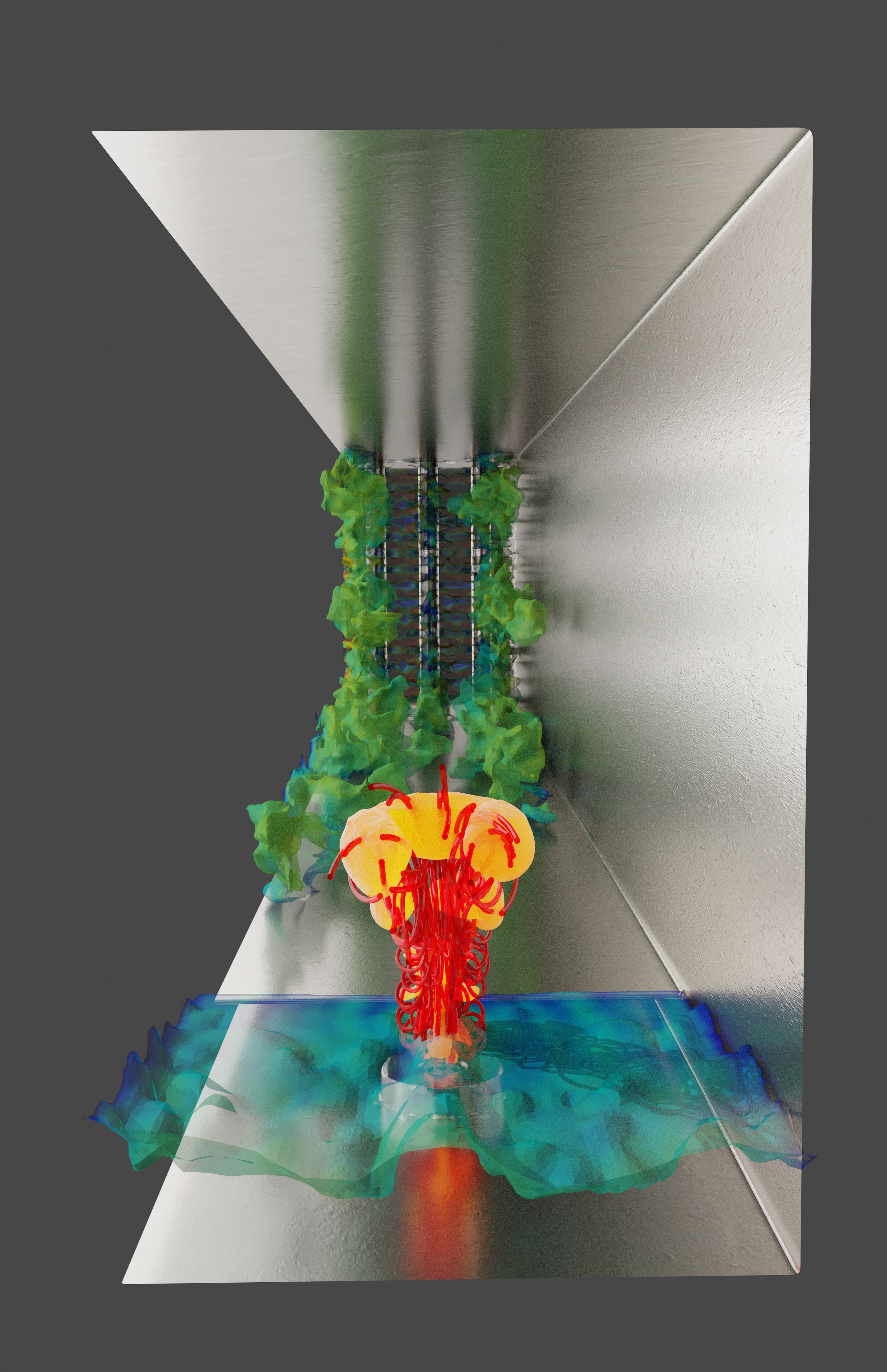
Using this framework, we performed a series of LES simulations to generate enough samples to represent the statistical effects of aleatoric parameters (e.g., turbulent flow field and the initial kernel energy) on the ignition outcome. We then used the simulation outputs to reconstruct the ignition probability using our uncertainty quantification strategy. In a typical simulation of a model combustor representing high-altitude relight, two main processes were analyzed: upstream fuel mixing, and downstream non-premixed spark ignition. Upstream, the inflow is divided into the upper and lower flow by a splitter plate; only the upper flow is fuel-mixed, while the bottom flow remains pure air. The two flows start to mix after entering the downstream chamber, where a commercial aircraft ignitor is mounted on the floor plane. With each spark discharge, a kernel is ejected from the ignitor top surface into the combustor chamber, like a pulse-jet-in-crossflow problem.
The purpose of this layout is to mimic the non-premixed, turbulent, stochastic nature of altitude relight problems. In particular, the kernel needs to transit through the non-reacting bottom flow before mixing with the fuel-seeded upper flow to ignite, while two important physical effects are competing with each other: the entrainment of fuel and the dissipation of kernel energy. Eventually, ignition succeeds or fails depending on the initial kernel status (such as size and ejection speed) and the turbulent flow conditions (such as fuel mixing and strain rate).
Results and Impact
Results show that our model can qualitatively and quantitatively predict non-premixed turbulent forced-ignition processes for a range of different operating conditions. In addition, the LES tabulation-based modeling framework provides the capability to efficiently generate abundant high-fidelity data of turbulent forced-ignition processes. This data can be applied as input for data-driven science techniques used to study patterns of altitude relight problems, benefitting future engine design.
Why HPC Matters
More than 800 simulations were performed for this project, using approximately one million core hours on NASA’s Pleiades supercomputer. High-performance computing is essential for such applications, for both the compute capability and for storing and transferring large numbers of datasets.
More Information
- A Comprehensive Modeling Procedure for Estimating Statistical Properties of Forced Ignition
- Numerical Simulation of Forced Ignition of Jet-Fuel/Air Using Large-Eddy Simulation (LES) and a Tabulation-based Ignition
- Simulation of Gas Turbine Ignition Using Large-Eddy Simulation Approach
- See the poster for this demonstration (PDF, 479KB). As shown in the NASA booth at SC19.
- Download the demonstration slide deck (PPSX, 52.4MB) as presented in the NASA booth at SC19. Click "Read Only" after launching presentation.
yhtang@umich.edu Venkat Raman, University of Michigan
ramanvr@umich.edu