
Exploring Bespoke Supercomputer Options for Weather and Climate Workloads
Overview
In this study, we researched the options available to NASA and others to develop a high-performance computing (HPC) system specifically tailored for weather and climate research. We surveyed weather and climate users and potential HPC suppliers to gather key insights. Their key concerns centered on limitations—of memory, storage latency, and bandwidth—and the current reliance on GPUs not well suited to today’s weather/climate workloads. Our recommendations include a NASA initiative to: 1) more accurately assess the range of existing and planned workloads; 2) better provide specific hardware and software requirements; and 3) help determine the various strengths and opportunities of any potential HPC design.
Project Details
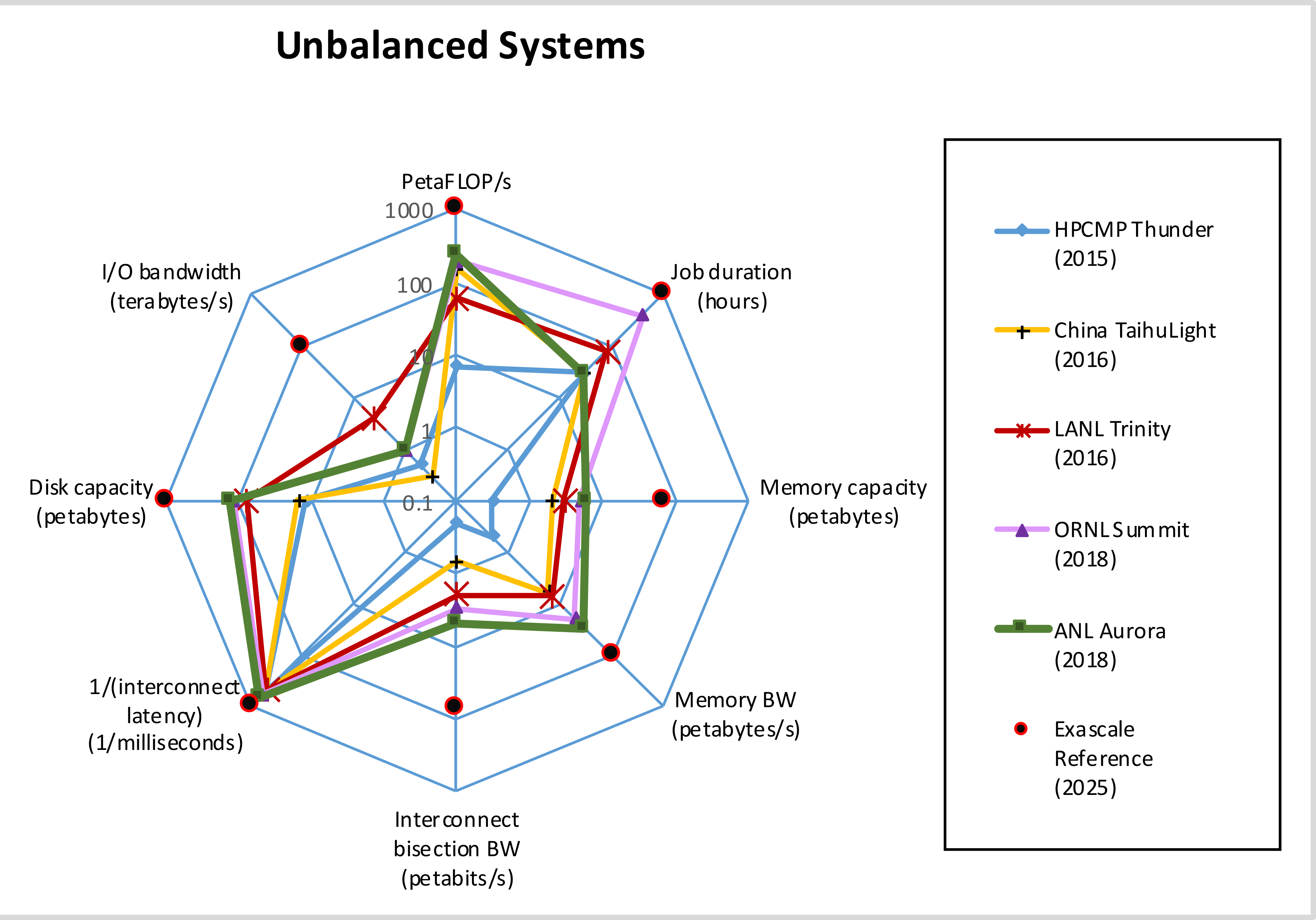
NASA set out to explore alternative architecture solutions inspired by the 2016 release of ARM licenses, the formation of the Gen-Z Consortium, the availability of High Bandwidth Memory, and user community difficulties in adopting GPU-based solutions. One possibility is to specify system requirements for a bespoke supercomputer tuned for Agency weather and climate workloads. NASA contracted with Hyperion Research to study the options and provide follow-on recommendations. The study was divided into two phases: Phase 1 involved interviewing weather and climate modeling centers around the world for requirements, and Phase 2 entailed surveying HPC vendors for their responses to the requirements.
Results and Impact
Survey respondents provided a number of suggestions for future development, noting that any project to build such a system would need to be a community effort. Currently, such projects are seen as Center/Lab specific or based on “Grand Challenge” programs with relatively short-term horizons. Another major theme centered on bringing Artificial Intelligence—particularly machine learning capabilities—into the programming mix, but that opinion was not universally supported.
All of the vendors surveyed showed interest in exploring development of a bespoke HPC system for NASA. However, most indicated that the option for building a special-purpose, one-off system or even a series of such systems over time could not be economically justified—regardless of the amount of non-recurring engineering (NRE)—unless that particular design had value within the wider weather community or even across a number of complementary verticals. Other key points included the desire for NASA to: 1) conduct a robust, pre-competitive, codesign effort with potential vendors; and 2) reexamine and modernize NASA’s existing codebase to take advantage of existing and anticipated progress in high-end hardware and software.
Why HPC Matters
NASA scientists and engineers need the power and scale of HPC resouces to understand the behavior of extremely complex systems such as weather, climate, heliophysics, astrophysics, aerospace vehicles, and launch systems.
What's Next
Recommendations for next steps include: 1) mounting a NASA initiative to more accurately assess the range of existing and planned workloads that better meet specific hardware and software requirements; 2) composing benchmarks of mini-application suites, test cases, or even full applications to help determine the various strengths and opportunities of any potential HPC design; and 3) organizing a pre-competitive co-design conference, or series of conferences, that brings together interested commercial vendors to discuss various options and opportunities. A key goal of such co-design efforts would be to discuss projections of advances in HPC hardware and software that would better align with NASA requirements but are also in keeping with larger commercial trends.
More Information
- See the poster for this demonstration (PDF, 905KB). As shown in the NASA booth at SC19.
tsengdar.j.lee@nasa.gov Robert Sorensen, Hyperion Research
bsorensen@hyperionres.com