
Fine-Scale Forest Modeling Across the North American Boreal Zone
Overview
The North American boreal forest is highly influenced by complex interactions between vegetation, wildfire, soil conditions, and climate. Climate change is occurring faster in this region than anywhere else on Earth and is likely to impact all of these interactions, ultimately leading to changes in vegetation composition and structure. High-resolution forest modeling can aid in simulating these potential changes by considering these important vegetation drivers at a fine scale.
Project Details
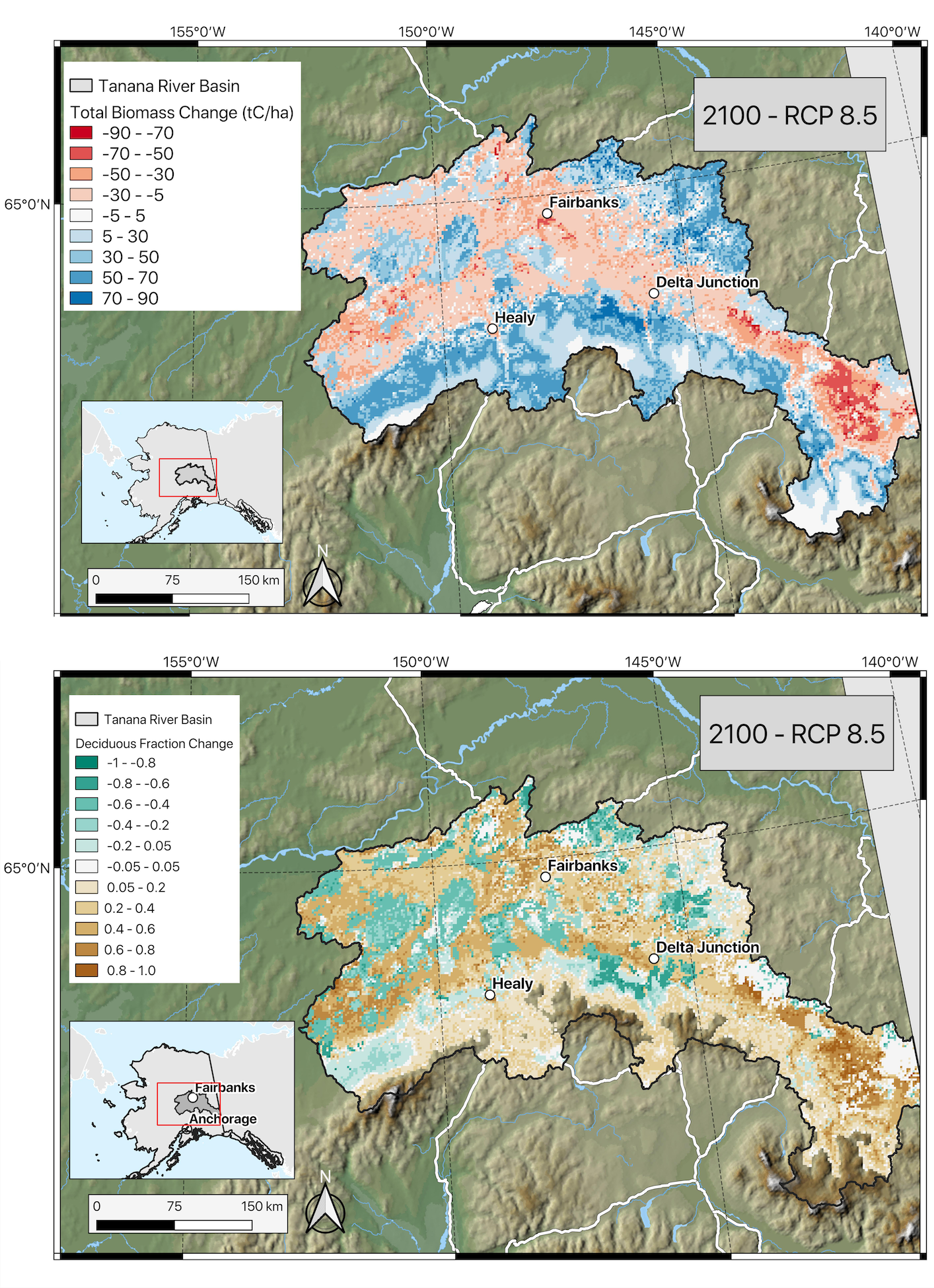
Scientists updated an individual tree-based forest model (University of Virginia Forest Model Enhanced - UVAFME) for better performance within the boreal zone. Specifically, the updates improved simulation of permafrost dynamics, litter and organic matter decay, and wildfire dynamics, and their interactions with vegetation and soil characteristics. Scientists tested these updates against 244 field observation sites across Alaska. They compared model output to observations of soil moisture, permafrost depth, forest biomass, species composition, and other biotic and abiotic characteristics. Results showed that the model could reliably produce these observations across a wide variety of site conditions. Next, the model was applied on a 2-kilometer (km) by 2-km grid across interior Alaska’s Tanana River Basin (~115,000 km2 area), equaling about 28,500 sites. The model was used to simulate forest dynamics under two climate change scenarios: Representative Concentration Pathway (RCP) 4.5—a more conservative climate change prediction—and RCP 8.5—a more extreme prediction.
Results and Impact
UVAFME predicted that decreasing biomass and increasing deciduous fraction is likely under those climate change scenarios. These changes have the capacity to feed back to climate through changes in forest structure, which impacts surface roughness, albedo (which in turn impacts energy fluxes), and evaporative flux. The model results increase understanding of the potential futures of the Alaskan boreal forests and demonstrate the importance of fine-scale interactions between trees and their environment. Importantly, accurate simulation of forest dynamics and characteristics was not possible until all model updates were finalized and all linkages between vegetation and soil characteristics were implemented. This finding demonstrates the importance of a fine-scale model like UVAFME for simulating future forest state.
Why HPC Matters
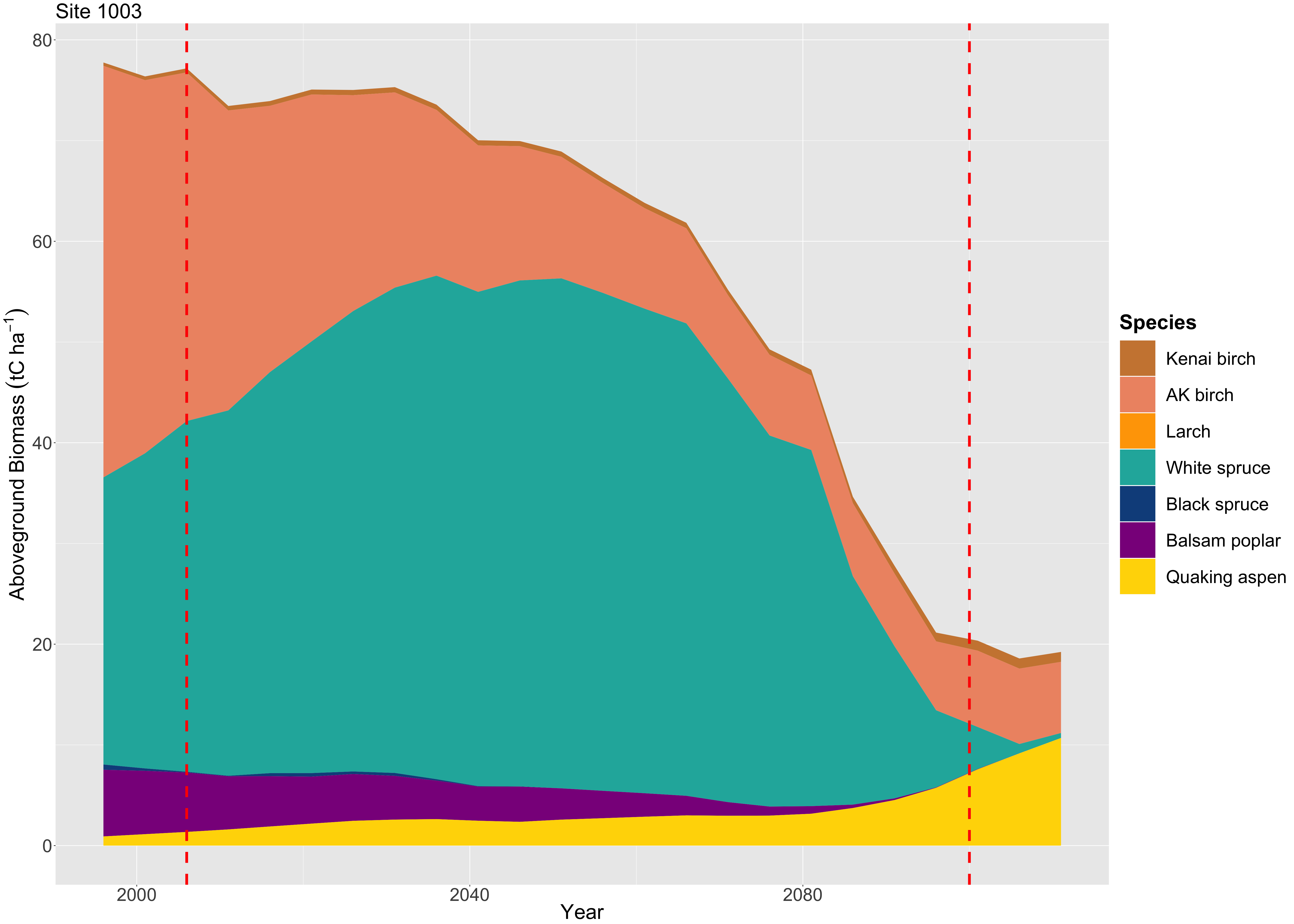
Scientists used the NASA Center for Climate Simulation’s ADAPT Science Cloud to conduct code refinements and testing as well as the model simulations for this work. They tested the model on ADAPT’s Arctic-Boreal Vulnerability Experiment (ABoVE) nodes, running jobs interactively. Once ready to run the large simulation across the Tanana, they used a SLURM script to submit batches of jobs to 10 nodes at a time. Each job consisted of ~2,850 sites to simulate and only used 1 core and minimal RAM. The major sink for this type of simulation is time. It takes about 40 seconds to run one site. If run in sequence on a personal computer, running all of the Tanana would take 1,140,000 seconds (i.e., 317 hours)! However, distributing the job across 10 nodes reduces runtime to only about 32 hours. Thus, ADAPT was an invaluable resource for timely testing and production of this work.
What's Next
In the future, UVAFME will be applied across the entire North American boreal region, providing further estimates of future vegetation trajectories across a much larger region. Additional model updates will include the incorporation of insect disturbance.
More Information
- UVAFME Website
- Importance of Tree- and Species-Level Interactions with Wildfire, Climate, and Soils in Interior Alaska: Implications for Forest Change Under a Warming Climate
- See the poster for this demonstration (PDF, 699KB). As shown in the NASA booth at SC19.
adrianna.foster@nau.edu Scott Goetz, Northern Arizona University
scott.goetz@nau.edu