High Fidelity Navier-Stokes Simulation of Rotor Wakes
Overview
Helicopters and rotorcraft provide many useful civil and military functions without the need for airports and runways. However, accurately predicting aeromechanic performance and noise production for these vehicles is very challenging and requires a multi-disciplinary approach to account for rotor blade aerodynamics, blade flexibility, and blade motion for trimmed flight. Moreover, rotor blades encounter the tip vortices of other rotor blades, resulting in very complex blade-vortex interactions and vortex wake structures.

NASA's Subsonic Rotary Wing Project is developing physics-based computational tools to more accurately predict these flowfields. To accomplish this, the OVERFLOW 2 Navier-Stokes computational fluid dynamics (CFD) code is loosely coupled with the CAMRAD II comprehensive code.
Project Details
Traditional comprehensive codes integrate the multi-disciplinary analyses of aerodynamics, structural response, and blade motion needed for rotorcraft simulations. However, these codes utilize a simplified, inviscid, linear aerodynamics model. CFD codes such as OVERFLOW, on the other hand, provide a higher-fidelity approach for predicting rotorcraft aerodynamics by solving the viscous, nonlinear Navier-Stokes equations. Loosely coupling the OVERFLOW 2 code with the CAMRAD II comprehensive code enables improved accuracy by replacing the linear aerodynamics model with the nonlinear Navier-Stokes equations.
The Navier-Stokes CFD approach is more accurate, but requires significantly more computational resources. Consequently, poor grid resolution, low-order spatial accuracy, and limitations of turbulence models often result in rotor vortex predictions that are weaker and more diffused than the actual physical flows. To address these challenges, several CFD improvements have been examined to improve the predictive accuracy of rotor aeromechanics. These improvements include the use of high-order spatial accuracy, adaptive mesh refinement (AMR) to efficiently improve the grid resolution of the rotor wake region, and more advanced turbulence models.
Results and Impact
For the first time, the figure of merit (a measure of rotor efficiency) for a hovering V-22 Osprey rotor was accurately predicted within experimental error over a range of collective blade pitch angles. This was accomplished by using finer grids on the blade surfaces, high-order spatial accuracy in the numerical algorithm, and an improvement to the Spalart-Allmaras turbulence model based on the detached eddy simulation method.
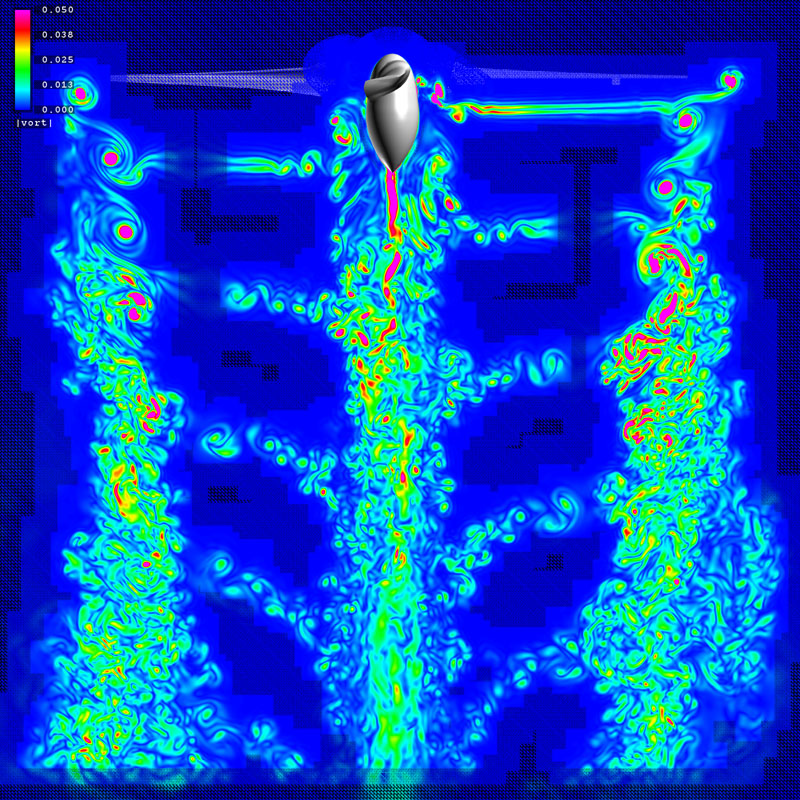
Use of AMR in the rotor wake region revealed complex turbulent structures and interactions that were previously unknown. CFD simulations of the UH-60 Blackhawk helicopter rotor in forward flight provided a 50% improvement in the prediction of rotor normal forces and pitching moments. These improvements advance the state-of-the art in engineering prediction accuracy and provide new insight into rotor wakes.
Role of High-End Computing Resources
These studies used 1,536 cores on NASA's Pleiades supercomputer, which enabled the completion of baseline grid solutions in less than a day and completion of AMR solutions in one week. These advancements would not have been possible without access to such high-end supercomputing resources.
Neal Chaderjian, NASA Ames Research Centerneal.chaderjian@nasa.gov