Simulation of Jet Plumes for Orion Launch Abort
Overview
Computational fluid dynamics (CFD) simulations support the design and analysis of NASA's Orion Multi-Purpose Crew Vehicle (MPCV). A range of CFD analyses are conducted to assess key aspects of vehicle performance during launch aborts.

Project Details
During ascent, the Launch Abort Vehicle—comprised of the crew capsule and abort rocket tower—must remain controllable at all times and speeds. CFD simulations and wind tunnel experiments are used to help system engineers determine whether a particular design is viable. Our CFD simulation efforts have supported the NASA Engineering and Safety Center's (NESC's) independent assessment of the validity of a phenomenon observed in jet interaction simulations.
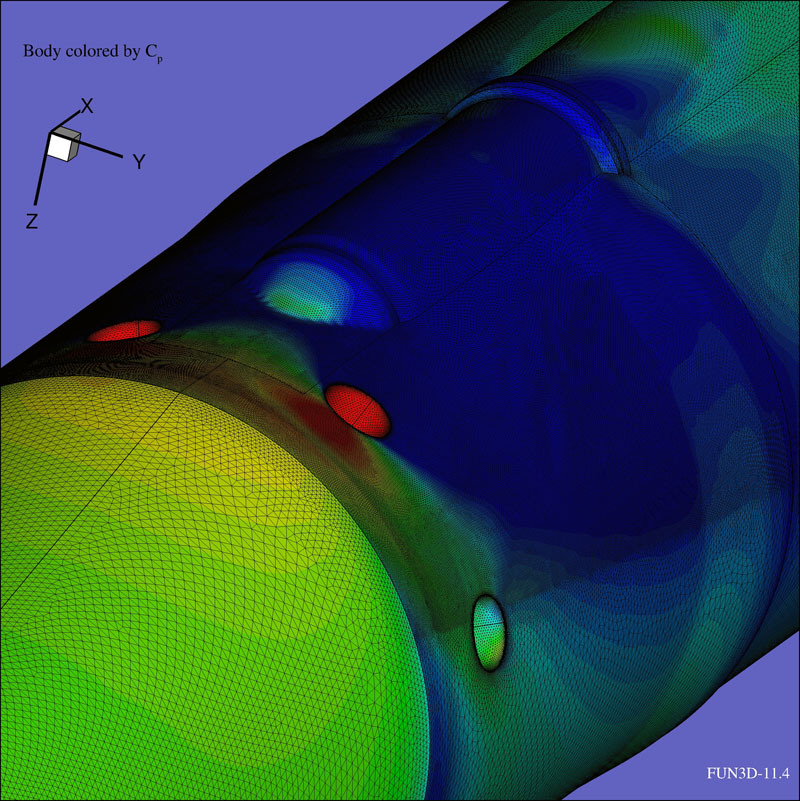
One particular issue is simulating the interaction of the rocket tower control motor plumes with the abort motor plumes. Our work investigates the simulation physics of this jet interaction.
Analyses of the stability and control of the Launch Abort Vehicle include complex interactions between the vehicle hardware, the attitude control jet motor plumes, and the abort jet motor plumes. We also evaluate turbulence models and time-accurate flow simulations to predict control jet motor plume development and subsequent downstream interaction with the abort jet motors.
Results and Impact
Our computations indicate that high physical model fidelity is required to accurately capture jet interaction phenomena. Large-scale structures of the jets must be simulated with time-accurate calculations to model aspects of this type of flow interaction. Simulations such as these enable NESC to evaluate the design tools and methodologies used by NASA projects.
Role of High-End Computing Resources
NASA supercomputing resources enable the computation of large, complex simulations, the generation of larger numerical design fields, and the use of sophisticated physics-based numerical models. Our simulations are extremely computationally demanding, and can only be solved using high-end computing resources.
Jan Carlson, NASA-Langley Research Centerjan-renee.carlson@nasa.gov