Aerothermal Entry Environments for the Multi-Purpose Crew Vehicle
Overview
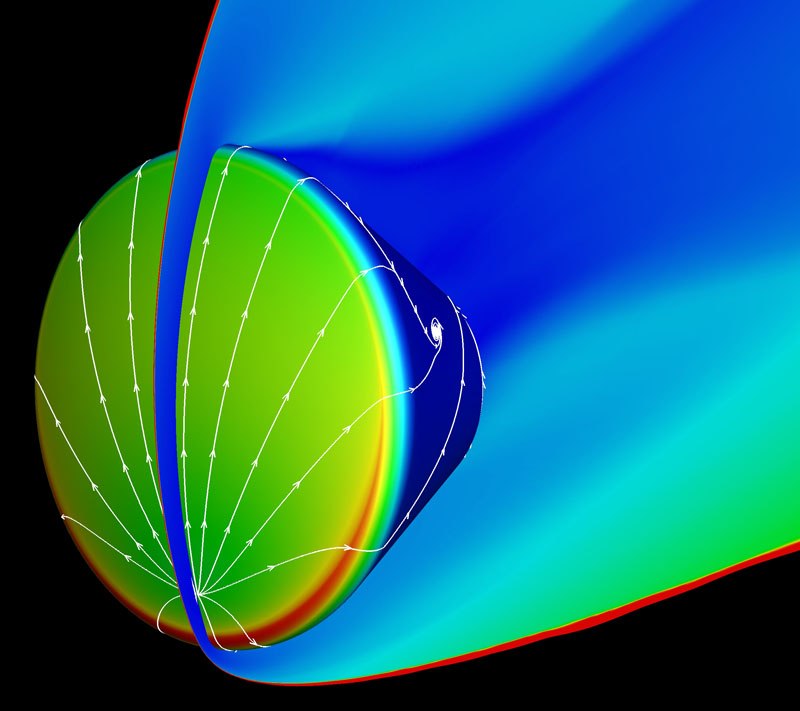
Computational fluid dynamics (CFD) simulations of atmospheric entry environments are being used to support thermal protection system (TPS) design and material selection for the Orion Multi-Purpose Crew Vehicle (MPCV). A variety of CFD simulations are used to generate a database characterizing the aerothermal conditions of the entry environment, and also to provide specific analyses needed for model development.
Project Details
Our CFD simulations of the Orion MPCV provide a comprehensive database of flow quantities, covering around 400 flight conditions occurring throughout atmospheric entry. Similar simulations of experimental tests in a variety of ground-based facilities are used to validate the CFD flight database.
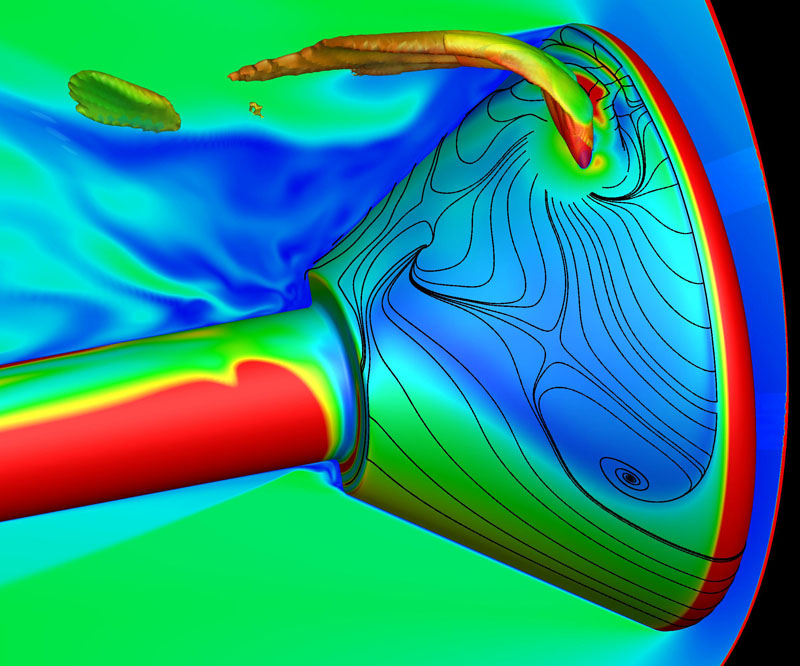
Flow quantities from the CFD database are then used as inputs to models of detailed design features. Detailed simulations of geometric complexities and flow phenomena support feature-specific model development. These simulations include parametric analyses of jet plume interactions to determine the relationship between characteristic parameters and heat transfer on the TPS surface, as well as analyses to scale empirically based cavity models to full-size flight conditions.
These CFD simulations are also critical to modeling phenomena that are difficult or impossible to test, such as the interaction of chemically reacting flowfields with various surface materials.
Results and Impact
The aerothermal environments generated by these simulations have been used to select and size materials for Orion's TPS. The extensive CFD database allows engineers to quickly assess the impact of design changes on vehicle heating during entry. Currently, CFD simulations are being used to plan the sensor layout for the first MPCV flight test, which will validate the TPS design for future crewed missions. The archive of CFD data from this project is not only useful for the MPCV, but can also be mined for the design of other space exploration vehicles in the future.
Role of High-End Computing Resources
NASA's Pleiades and Columbia supercomputers have enabled us to generate a dense database of roughly 400 aerothermal CFD solutions, each of which required 6,000 processor-hours to compute. CFD simulations that would have required weeks of computing time only a few years ago can now be computed in just 20 hours. Detailed simulations of the entire vehicle with all surface features (modeled with 80 million grid points) are now possible, reducing the cost and time required for experimental testing. The NASA Advanced Supercomputing facility also provides the data storage space needed for a constantly growing archive of CFD data.
Andrew Hyatt, NASA Ames Research Centerandrew.j.hyatt@nasa.gov