Large-Eddy Simulation of an Oblique Shock/Turbulent Boundary Layer Interaction
Overview
In high-speed aerodynamics, shock wave/turbulent boundary layer interactions (STBLIs) can create intense thermal and pressure loads that endanger aerospace vehicles or limit their designs. Heating rates generated by STBLIs in the bipod area between the Space Shuttle and its external tank, for instance, were partly responsible for the Columbia disaster.
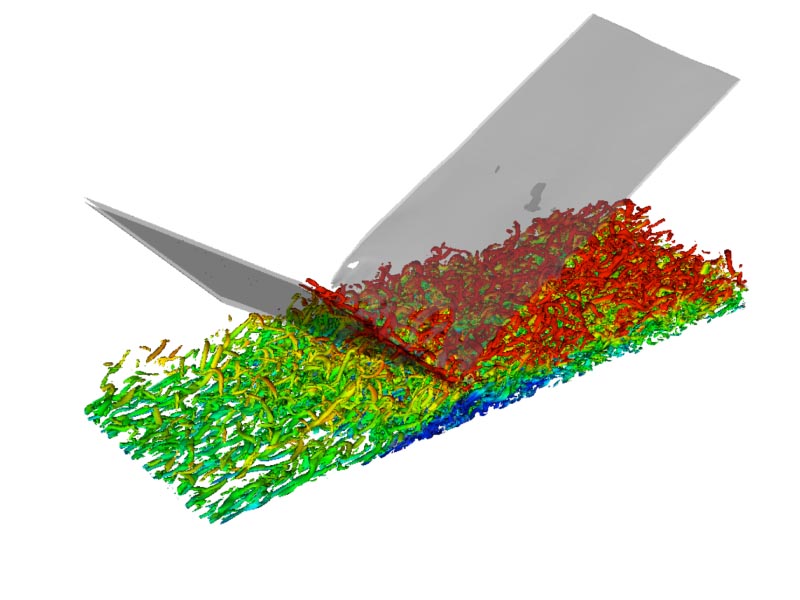
Since the Reynolds-Averaged Navier-Stokes (RANS) flow solvers typically used in aerodynamic simulations have difficulty predicting the unsteady nature of the strongly separated flows involved in STBLIs, it is important to establish high-fidelity baseline solutions to guide improvement and uncertainty quantification in RANS models.
Project Details
Large-eddy simulations of an oblique shock impinging on a supersonic, turbulent boundary layer are carried out using a high-order, compact differencing scheme with localized artificial diffusivity.
Simulations are carried out using a range of parameters to investigate the sensitivity of the solution to computational mesh resolution, domain size, Reynolds number, and wedge angle.
Results and Impact
Simulation results have shown that the predicted size of the separation bubble—the region of reversed flow created by strong, adverse pressure gradients—is smaller than experimental values, but does not appear to be significantly affected by the range of Reynolds numbers used in the simulations. This indicates that a commonly observed discrepancy between simulation results and experimental measurements may be due to some three-dimensional effect in the experiments, rather than to a difference in Reynolds number as previously thought.
Additionally, analysis of the spectral content of the wall pressure signal in the separation bubble has shown evidence of the expected low-frequency “breathing” mode. The time scale at which this low-frequency motion occurs is found to increase for stronger interactions.
Finally, analysis of low-pass filtered data fields has shown evidence of a correlation between the low-frequency motion and periodic mass entrainment and release in the separation bubble.
Role of High-End Computing Resources
NASA supercomputing resources have enabled 19 cases to be computed using a range of simulation parameters. These calculations required approximately 3.3 million processor hours and would not have been possible without access to high-performance supercomputers such as Columbia and Pleiades.
Brandon Morgan, Stanford Universitybmorgan1@stanford.edu Nagi Mansour, NASA Ames Research Center
nagi.n.mansour@nasa.gov