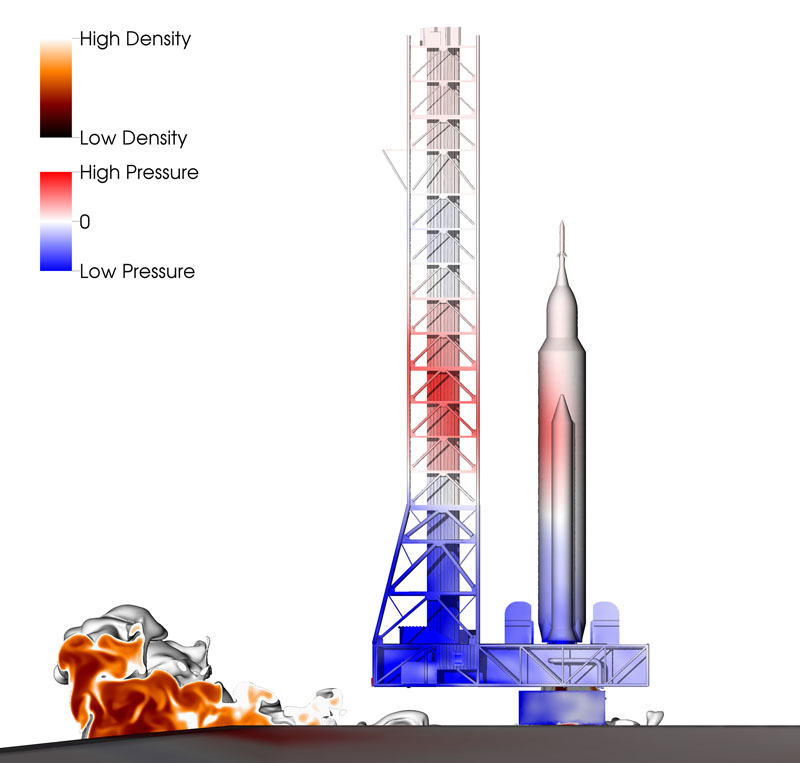
Simulations to Support Next-Generation Launch Pads
Overview
NASA is currently developing a heavy-lift launch vehicle, the Space Launch System (SLS), to carry large payloads for future human exploration missions beyond low Earth orbit. Because heavy-lift launch vehicles will require much higher thrust than current vehicles, high-fidelity computational fluid dynamics (CFD) simulations are being performed to assess the feasibility of launching the SLS from NASA Kennedy Space Center.

Project Details
Due to the greater thrust of heavy-lift vehicles, analyses must be performed to ensure vehicle stability, payload safety, and durability of the launch pad where the exhaust jets impinge. High-fidelity CFD simulations of ignition overpressure (IOP) and acoustic phenomena during ignition and liftoff have been performed using the existing launch pad configuration and a preliminary heavy-lift vehicle design. Results from these analyses will be used to help reconfigure the launch pad to reduce the strength of IOP and sound pressure levels for the SLS.
During ignition of the solid rocket boosters, an IOP wave is generated and travels between the mobile launch platform, the main deflector, and the vehicle. The IOP wave occurs during the first second of launch and may affect the stability of the vehicle. After that, the vehicle lifts off and its exhaust plumes impinge on the pad, generating potentially damaging sound pressure levels near the payload.
CFD analyses will provide launch pad design teams with estimates of unsteady pressure signatures on the surface of the launch pad and vehicle. These estimates will be used to guide modifications to the plume deflectors, which are located directly beneath the vehicle and serve to direct exhaust away from the pad. CFD simulations will be performed for a wide range of deflector and vehicle configurations to estimate the resulting loads on the launch tower and vehicle, as well as sound pressure levels near the payload.
Results and Impact
Ongoing CFD simulations will be used to support the redesign of the launch pad for the SLS. Obtaining launch environment data using traditional, scaled-model experiments is extremely challenging, and full-scale tests are expensive and dangerous. CFD simulations, however, are efficient, cost effective, and can provide results for a large number of pad configurations within a quick turnaround time.
Role of High-End Computing Resources
These simulations are very computationally demanding, each requiring 1,000 processor cores running for a week to accurately resolve the physics involved. These intensive computations can only be completed on supercomputers such as the Pleiades system at the NASA Advanced Supercomputing (NAS) facility. NAS's hyperwall-2 visualization system is also a valuable resource for this work, enabling researchers to effectively visualize and interpret their simulation results.
Cetin Kiris, NASA Ames Research Centercetin.c.kiris@nasa.gov Michael Barad, NASA Ames Research Center
michael.f.barad@nasa.gov