Hypersonic Turbulence and the Birth of Stars
Overview
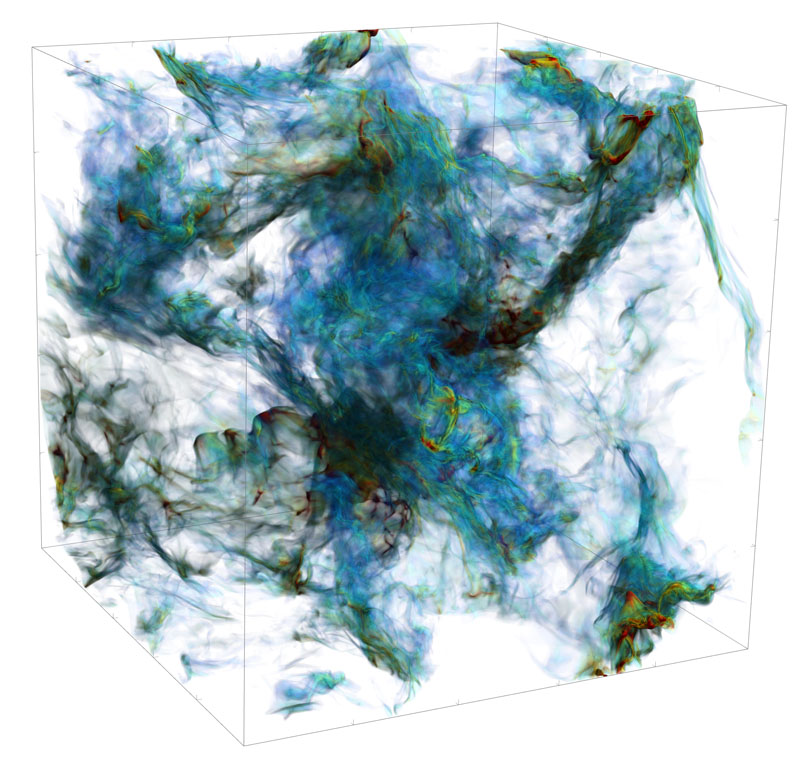
Knowledge of the star formation process is key to understanding how galaxies form and evolve. Stars are born in clouds of cold interstellar gas, where hypersonic turbulence dissipates in a complex network of intersecting shocks, which generates very dense filaments and cores. The densest cores, where gravity becomes the dominant force, collapse into new stellar systems.
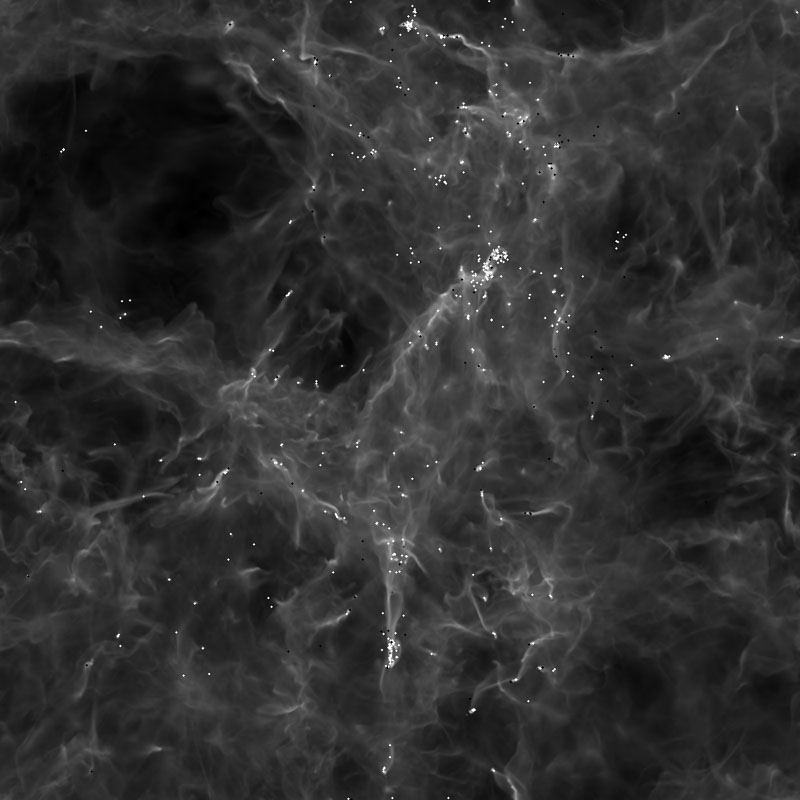
Due to the complexity of magnetized hypersonic turbulence and its interaction with gravity, extremely large numerical computations are an essential tool to investigate the birth of stars.
Project Details
The main goal of our project is to understand how stars are formed, by performing two types of numerical computations:
- Idealized hypersonic turbulence flow experiments to capture universal statistics that will be implemented in our theory of star formation.
- Realistic astrophysical simulations to test and further guide the theory development.
In the turbulence experiments, we run uniform grid simulations of more than 8.5 billion computational zones, solving the equations of magnetohydrodynamics in a highly supersonic regime, and investigate the statistical properties of such flows after they have relaxed for several dynamical times.
In the more realistic astrophysical simulations, we also include the force of gravity and follow the collapse of each individual protostellar core. To achieve this, we developed adaptive mesh refinement (AMR) methods that allow us to zoom in on the collapsing cores with increasing spatial and temporal resolution. These AMR simulations-the largest in the world to date-can resolve the most important flow structures (such as collapsing regions) at resolutions a thousand times higher than uniform grid runs.
Results and Impact
Our star-formation simulations have resulted in the first systematic computation of the rate at which stars form in turbulent clouds, as a function of physical cloud properties such as the relative strengths of turbulence, magnetic fields, and gravity. This result is key to modeling the life cycle of the interstellar medium, and to developing subgrid models that will be implemented in cosmological simulations of galaxy formation and evolution.
We have also generated synthetic observations of star-forming clouds by computing the radiation emitted by gas and dust that are assumed to follow the density, velocity, and magnetic field distribution of our turbulence simulations. These synthetic observations have been successfully compared with observations of star-forming clouds from ground- and space-based observatories.
Role of High-End Computing Resources
The ambitious scope of this project requires development of the largest hypersonic turbulence simulations in the world. These simulations would be impossible to run without NASA's powerful and efficient high-end computing resources, particularly the Pleiades supercomputer.
Paolo Padoan, Catalan Institution for Research and Advanced Studies, Institute of Cosmos Sciences (ICREA & ICC), University of Barcelonappadoan@icc.ub.edu