Design of Ultra-Durable Materials for Future Aerospace Vehicles
Overview
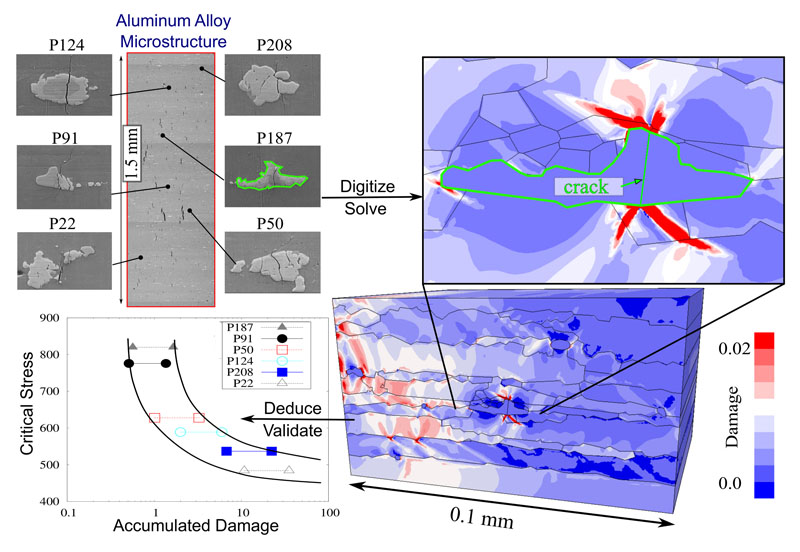
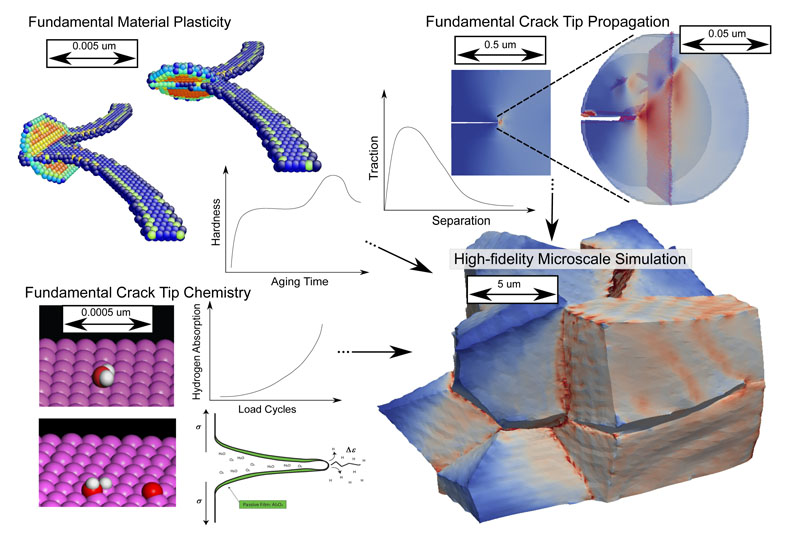
The extreme structural requirements of future aerospace vehicles motivate the development of new, ultra-durable materials and game-changing methodologies for material certification and sustainment. We are developing computational simulations spanning many orders of magnitude in length and time scales—from the nanoscale of underlying damage processes to the larger scales of continuum cracks—to support these requirements. Simulation results are used to deduce key aspects of material response to loads and environments.
Project Details
Simulations at the atomic scale provide fundamental information about the physics of plasticity, oxidation, and cracking. Results from these atomic-scale simulations are used to inform micro-scale simulations with important physical values. In turn, simulations at the micro-scale bridge the gap between fundamental physical laws and engineering design.
We also perform series of simulations to study the effects of key parameter variations. Each metallic microstructure is unique due to inherent variations in characteristic parameters, such as grain shape, lattice orientation, and chemical composition. The effect of each microstructural parameter on metal fatigue behavior is simulated to determine the complex interplay of the many parameters.
The simulations to date have been performed in collaboration with Cornell University, Brown University, George Mason University, and the University of Virginia.
Results and Impact
These simulations, both individually and as an integrated paradigm, are providing new insights into the physics and mechanics of metal fatigue damage. When closely linked with experiments, the simulations provide additional information with which new hypotheses can be formed and existing hypotheses can be validated. These simulations will be used to guide the design of new structural materials with exceptional properties, and to develop new methodologies for model-based material certification and sustainment.
Role of High-End Computing Resources
The high-fidelity atomic-scale and micro-scale simulations required for this work are computationally demanding and would be impossible to obtain without the use of supercomputing resources such as Pleiades. Each individual simulation requires between 100–4,000 processors with 1–2 gigabytes of RAM each, and runs for upwards of 4 days. NASA's high-end computing resources also make it possible to run the large number of these intensive simulations that are needed to study the effects of variations in key material parameters.
Jacob Hochhalter, NASA Langley Research Centerjacob.d.hochhalter@nasa.gov Edward Glaessgen, NASA Langley Research Center
e.h.glaessgen@nasa.gov