Visualizing Simulations of Cosmology and Galaxy Formation
Overview
According to the now-standard Lambda Cold Dark Matter (ΛCDM) "double dark" theory, most of the universe is made up of invisible dark matter and dark energy. Our project attempts to understand how the galaxies and larger structures in today's universe formed within the ΛCDM framework, and to test our theories against observational evidence.
Project Details
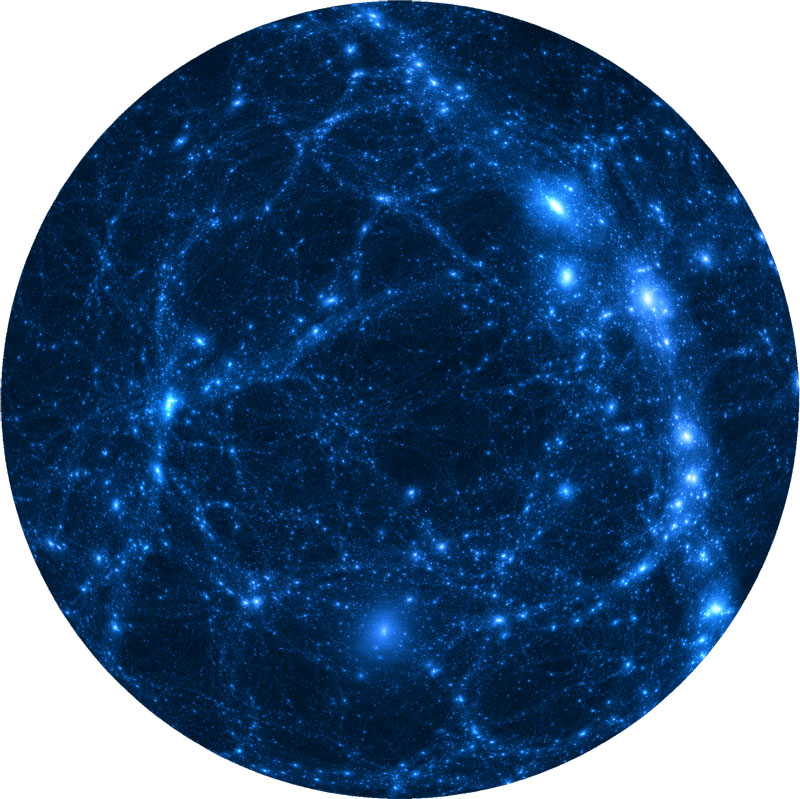
Based on the current cosmological parameters, our Bolshoi simulation is the most accurate and highest resolution large cosmological simulation available today. Comparison with the large-scale distribution of galaxies reveals strong correlations between predicted and observed statistics. Using the same cosmology, our BigBolshoi/MultiDark simulation is predicting the properties and distribution of very large structures (such as galaxy clusters), while our miniBolshoi simulation will resolve the merger history and structure of thousands of Milky Way-mass and smaller halos.
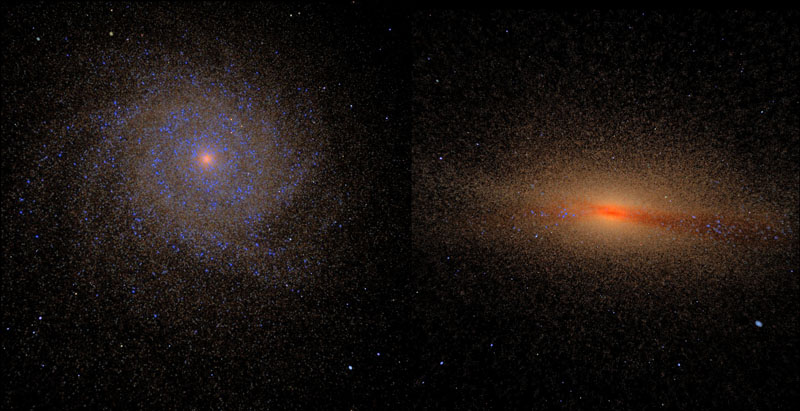
Our large library of high-resolution cosmological simulations of galaxies forming in the standard ΛCDM cosmology, in different environments and with different degrees of interaction, will provide an accurate sample of the observable universe. Using our radiative-transfer code, Sunrise, we are able to make realistic images of the simulated galaxies in many wavebands at many times during each simulation, including images of the effects of stellar evolution and dust.
Results and Impact
The Bolshoi and BigBolshoi/MultiDark simulations and their data are being made publicly available to astrophysical researchers worldwide. These data will allow astronomers to model the evolution of the large-scale structure of the universe, including the evolution and distribution of galaxies and clusters, with unprecedented accuracy.
Our simulations of galaxies forming in the standard ΛCDM cosmology are providing theoretical support for the interpretation of data gathered from NASA's Hubble Space Telescope (HST) and other observatories, especially in connection with two large HST studies: Cosmic Assembly Near-IR Deep Extragalactic Legacy Survey (CANDELS) and ACS Nearby Galaxy Survey Treasury (ANGST).
Role of High-End Computing Resources
The Columbia and Pleiades supercomputers at the NASA Advanced Supercomputing (NAS) facility have been extremely valuable in running dissipationless simulations of large-scale structure evolution, including hundreds of the highest resolution (15-70 parsecs) hydrodynamic galaxy simulations and Sunrise image "observations." Collaboration with NAS visualization experts has been crucial to viewing and interpreting the results of these simulations, and in generating materials for public outreach.
Joel Primack, University of California, Santa Cruz/UC-High-Performance AstroComputing Centerjoel@ucsc.edu
http://hipacc.ucsc.edu/Bolshoi/