Ultraviolet Spectra of Air Molecules
Overview
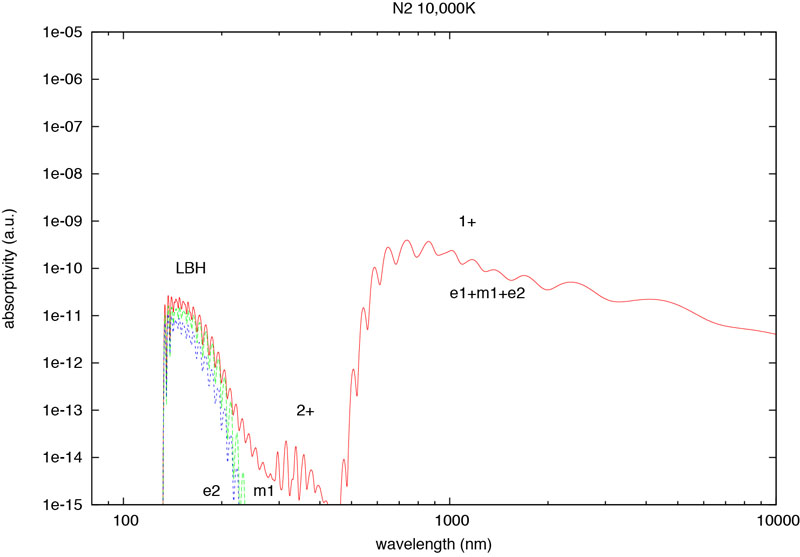
Heatshield development for spacecraft entering the Earth's atmosphere requires accurate spectra of air molecules at high temperatures—up to 10,000 Kelvin for lunar return. This data can only be determined by means of high-level quantum mechanical calculations. First-principle computational chemistry techniques are used to supply accurate molecular opacity data, which is needed to calculate heat loads for spacecraft entering atmospheres.
Project Details
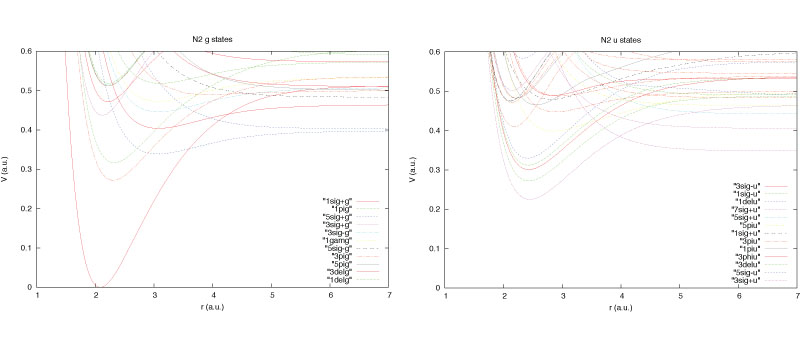
Extensive ab initio quantum chemistry calculations are carried out for key air molecules, including N2, O2, N2+, NO, CN, CO, C2, and CO+ molecules. A multitude of electronic states are considered for each molecule, covering each possible spin and space symmetry state and including Rydberg states where appropriate.
Full spin-orbit and non-adiabatic couplings are used to compute rotation-vibration-spin electronic wave functions and energy levels for each air molecule. These results are in turn used to compute probabilities for electric dipole, electric quadrapole, and magnetic dipole transitions. Bound-bound and bound-free transitions are included.
Results and Impact
The spectra generated by these quantum chemistry computations are being used with the NASA's new radiative code, HyperRad, to reduce the uncertainty in heating predictions for entry vehicles.
Role of High-End Computing Resources
The large number of electronic structure calculations and nuclear dynamics calculations required for this work could not have been carried out without the large number of processors available on the Pleiades supercomputer. The calculations would have required approximately 25 years to run if a single processor had been used.
David W. Schwenke, NASA Ames Research Centerdavid.w.schwenke@nasa.gov