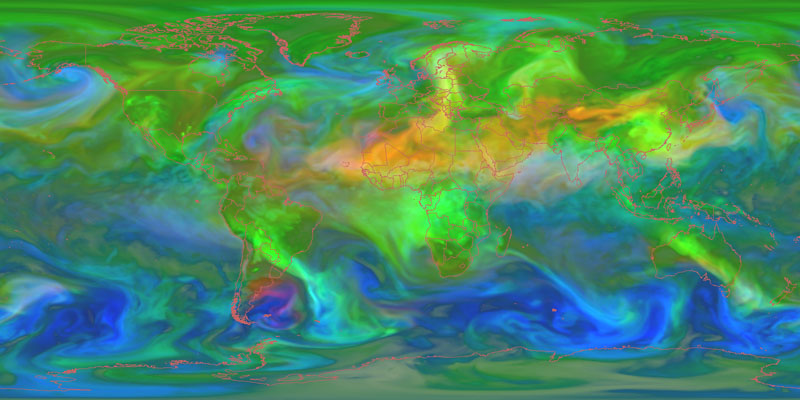
NASA Climate Simulations Inform the IPCC Fifth Assessment Report
Overview
NASA is making important contributions to the Coupled Model Intercomparison Project Phase 5 (CMIP5), a set of coordinated near- and long-term climate simulation experiments. CMIP5 results are used to evaluate climate models' ability to simulate the recent past and generate future climate projections. Simulations include scenarios with and without anthropogenic (human-influenced) changes in greenhouse gases, aerosols, and land use. CMIP5 is particularly relevant to the Intergovernmental Panel on Climate Change Fifth Assessment Report (IPCC AR5) being published in 2013.
Project Details
CMIP5 simulation experiments provide a framework for increasing our understanding of climate models' ability to simulate the climate. Thorough analysis of CMIP5 results will expand our knowledge of the complex physical processes and feedbacks involved in climate change.
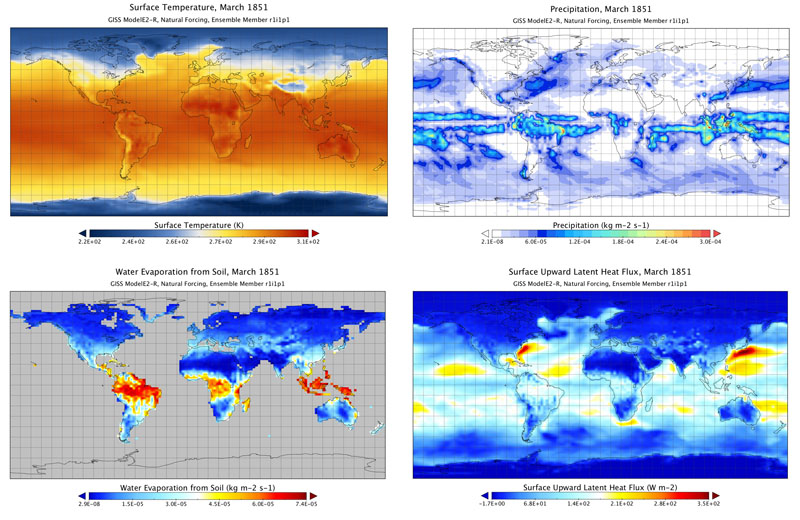
The Goddard Institute for Space Studies (GISS) is using its ModelE General Circulation Model (GCM) to produce suites of long-term simulations from the year 1850 through 2100 and beyond. The historical simulations demonstrate the model's accuracy in reproducing past climate change, providing valuable information for researchers evaluating future projections.
The Global Modeling and Assimilation Office (GMAO) is running near-term decadal simulations using its Goddard Earth Observing System 5 (GEOS-5) Atmosphere-Ocean GCM. Beginning with 1960, the decadal simulations encompass both early periods, when initial observations and the El Niño-Southern Oscillation (ENSO) exert the strongest influence on predictions, and later periods when longer-timescale ocean variations and changes from anthropogenic sources (e.g., human produced greenhouse gases) and natural sources (e.g., volcanoes) are increasingly important.
Researchers can access the results of climate simulations by NASA and other groups via the CMIP5 Earth System Grid gateway.
Results and Impact
Analysis of these simulations significantly improves our understanding of climate models. The resulting range of future climate change estimates are of great value for IPCC AR5 investigators, other scientists, and policymakers considering possible consequences.
Role of High-End Computing Resources
To meet IPCC AR5 investigators' demanding timeline, the NASA Center for Climate Simulation's Discover supercomputer is providing resources for the thousands of simulation-years required for CMIP5. Together, GISS and GMAO typically run more than 100 concurrent jobs and 10,000 cores on Discover to simulate the breadth of CMIP5 scenarios for greenhouse gas, aerosol, and land use changes.
Ellen Salmon, NASA Goddard Space Flight Centerellen.salmon@nasa.gov