Transition to Turbulence During Mars Entry
Overview
Next-generation Mars missions will rely on large atmospheric entry systems to land large payloads and exploration vehicles. Development of these systems requires improved understanding of how aerodynamic flows around the vehicle transition to turbulence during atmospheric entry, and the resulting increases in surface heat transfer. To gain insight into these complex transitions and improve the accuracy of aerodynamic heating predictions, we are performing high-fidelity simulations of hypersonic, chemically reacting entry flows.
Project Details
Inaccurate prediction of aerodynamic heating may lead to mission failures. For instance, vortices in turbulent boundary layers might cause uneven ablation of thermal protection materials, which would affect vehicle aerodynamics. Since turbulent heat transfer rates can be higher than laminar heating rates, reductions in the weight of thermal protection systems can be achieved with an improved understanding of the physics behind transitions from laminar to turbulent flow.
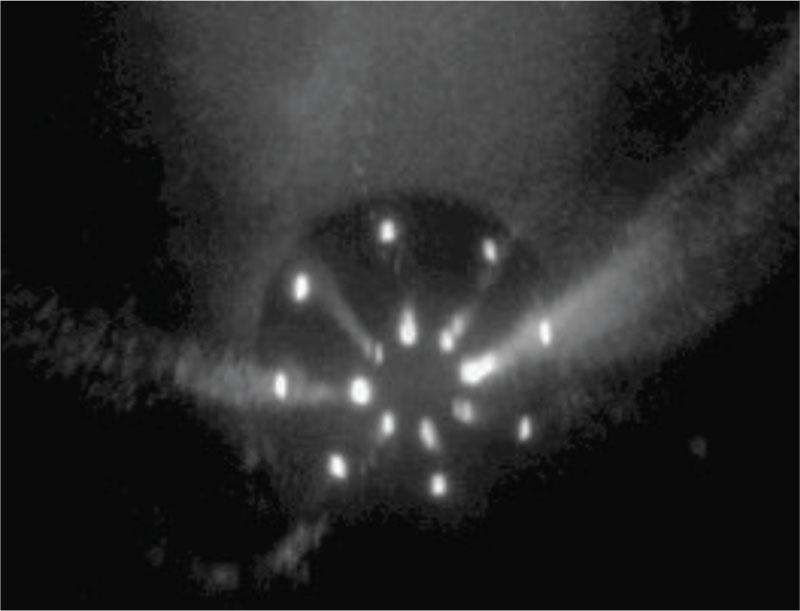
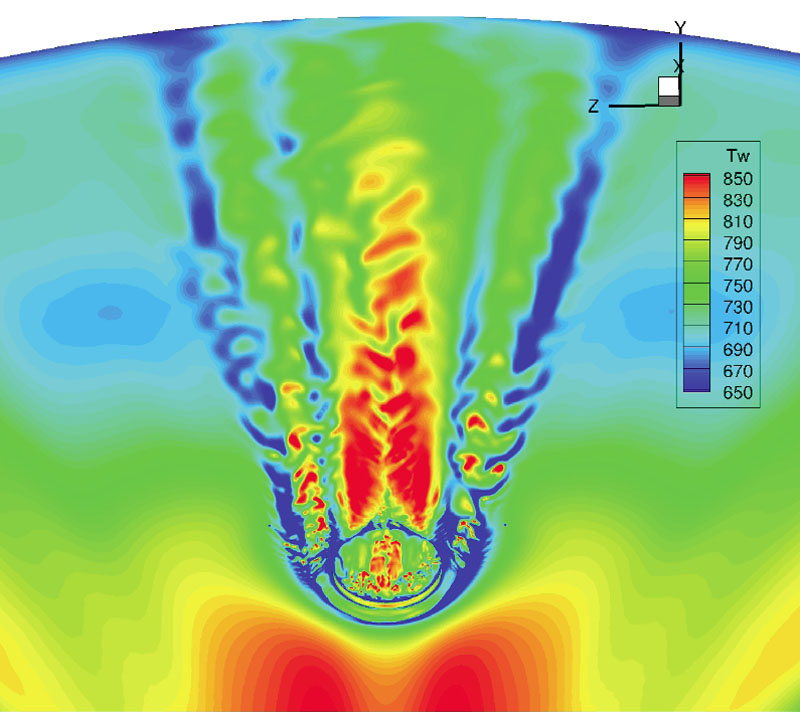
To validate and improve the accuracy of aerodynamic heating predictions for Mars atmospheric entry, direct numerical simulations of transition experiments in the Hypersonic Ballistic Range at NASA Ames Research Center have been performed. These phenomena must be modeled in the context of a hypersonic, chemically reacting flow environment. The effects of non-equilibrium chemical reactions on roughness-induced transition in Mars-like CO2 gas have been investigated by simulating high-enthalpy flows over a hemisphere with an isolated roughness element at Mach 15.
Results and Impact
Thermal protection system materials that are designed to affect boundary layer transition phenomena have the potential to significantly enhance future mission performance. Successful prediction of roughness-induced transition to turbulence in hypersonic, reacting flow environments will enable the design of safe and efficient thermal protection systems for next-generation planetary exploration spacecraft.
Role of High-End Computing Resources
Direct numerical simulations require computational models with large numbers of grid points in order to resolve the small turbulent scales in the boundary layer. Computing aerodynamic flow physics at such fine grid resolutions requires large computational resources, such as NASA's Pleiades supercomputer.
Steven Yoon, NASA Ames Research Centers.yoon@nasa.gov