Supersonic Retropropulsion for Mars Entry
Overview
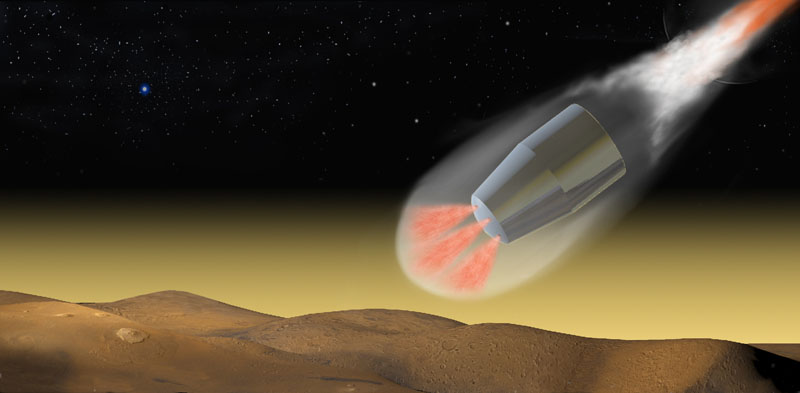
Large-mass missions to Mars (carrying tens of metric tons) require an alternative to parachutes as a means of decelerating a spacecraft and landing it safely on the surface of Mars. Supersonic retropropulsion (SRP) has been identified as a possible candidate. Because flight and ground tests are costly, computational fluid dynamics (CFD) simulations will play a large role in advancing the technology of supersonic retropropulsion.
Project Details
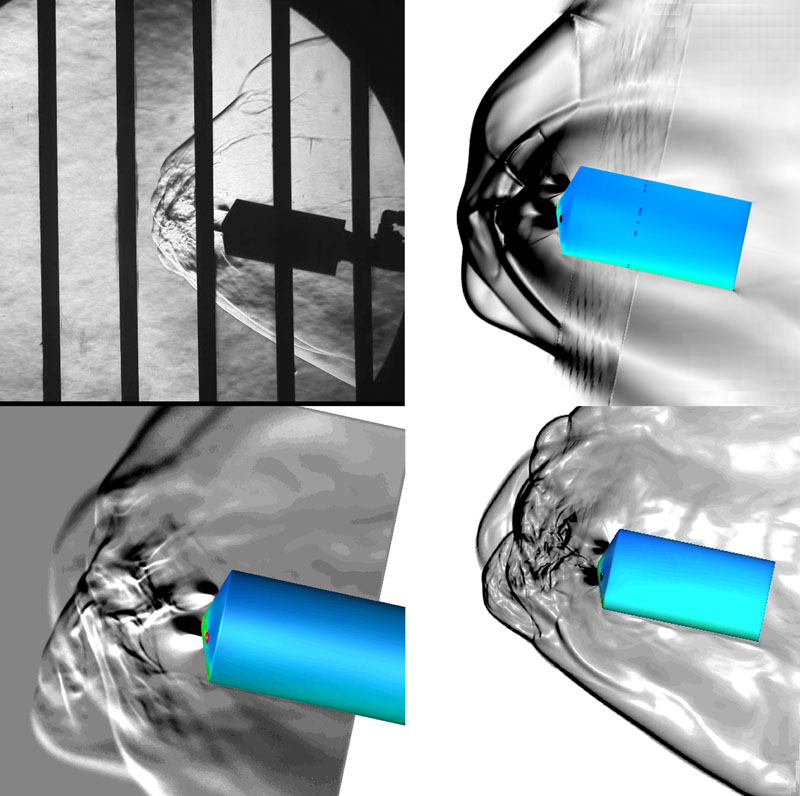
CFD analyses of SRP aerodynamics are performed to predict the stability and control of the vehicle as it decelerates toward the Martian surface. These CFD analyses are key to studying the unsteady nature of plume interactions and shear layers within the flowfield, and to predicting regions enveloped in subsonic flow—both of which are important factors in understanding SRP aerodynamics.
Two SRP wind tunnel tests have also been performed to provide high-quality experimental data. These experimental results will be used to validate CFD simulations of SRP flowfields, and to gain a deeper understanding of SRP aerodynamic behavior.
Results and Impact
Ongoing CFD simulations are providing key performance predictions for conditions that are difficult or impossible to obtain using ground or flight testing. The data from these simulations will support assessment and development of SRP as a potential technology for safely landing future missions on Mars.
Role of High-End Computing Resources
NASA supercomputing resources enable the intensive CFD simulations needed to model the complex flow physics involved in SRP. These intensive simulations are run across 900 processors for 48 hours, totaling 43,200 processor-hours each. These analyses provide efficient predictions of SRP aerodynamic performance and allow less reliance on experiments, which are much more costly and time consuming.
Kerry Trumble, NASA Ames Research Centerkerry.a.trumble@nasa.gov