The Sun in a Box
Overview
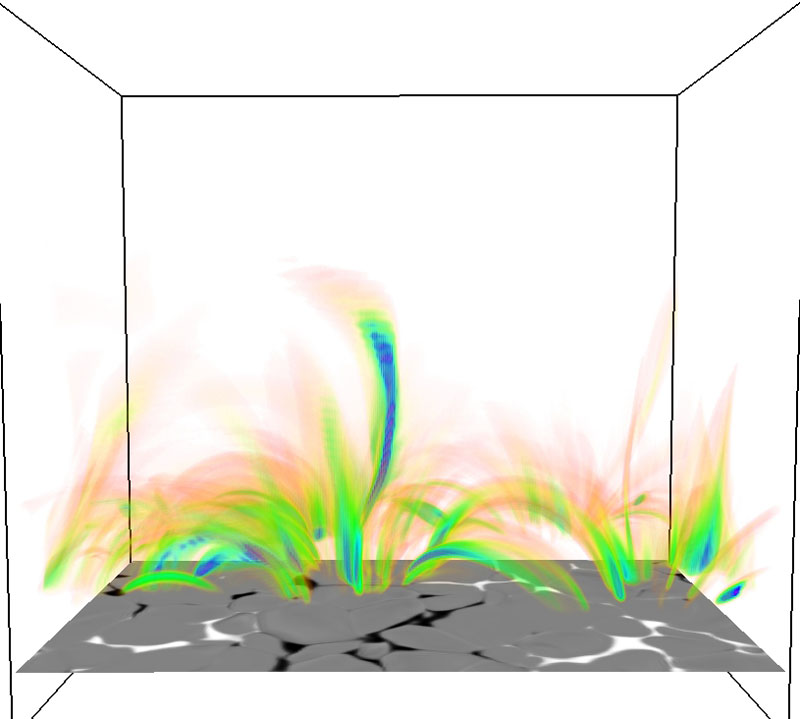
The Sun is the closest star to the Earth. It impacts us in a variety of ways, many of which are not well understood. For example, the Sun's radiation plays a role in the Earth's climate, while violent plasma storms on the Sun directly impact the space environment around Earth, which can lead to significant disruptions of GPS reception, power grid stability, and other key components of our highly technology-dependent society. To understand how the Sun's atmosphere is shaped and heated, and how it impacts Earth, we simulate a small piece of the Sun in a computational box six times the size of the Earth.
Project Details
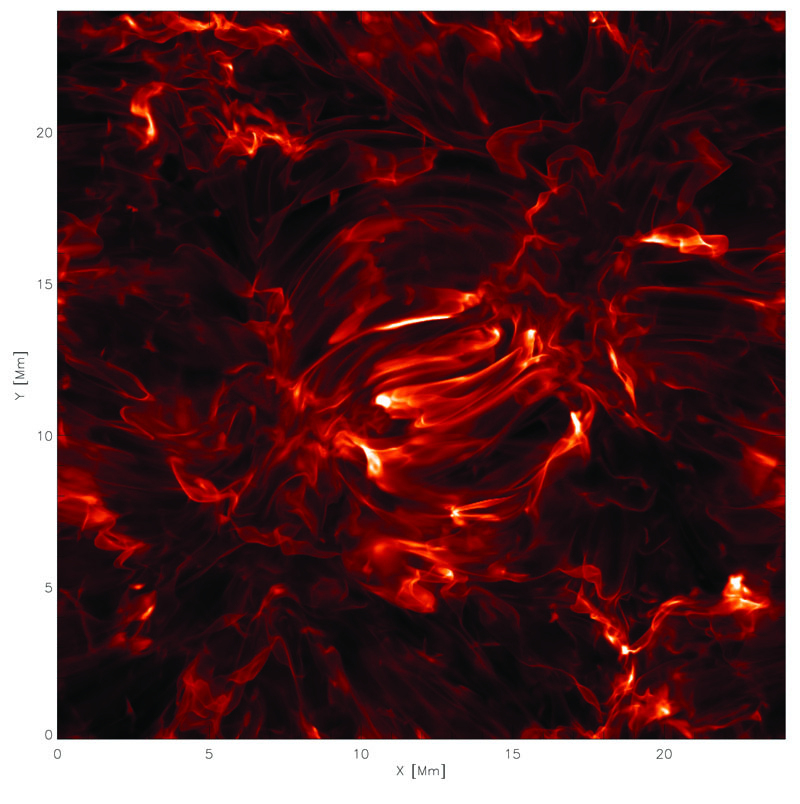
We use advanced, multi-dimensional, radiative magnetohydrodynamic simulations to take into account the complex physical processes that power the Sun's atmosphere. Our simulations of the solar atmosphere are focused on revealing:
- How the outer solar atmosphere is heated to temperatures much higher than those at the Sun's surface through the dissipation of magnetic field energy
- How the complex interactions of magnetic fields, hydrodynamics, and radiation fields shape the Sun's atmosphere
Results and Impact
We have compared images of the Sun from NASA missions with our simulations and have found magnetic heating present at much lower heights in the Sun's atmosphere than previously thought. The simulations have helped reveal how small-scale magnetic fields impact the low solar atmosphere, or chromosphere, and how magnetic waves help power the solar wind.
Our simulations are crucial to interpreting images of the solar atmosphere obtained from current NASA missions, such as the Solar Dynamics Observatory and NASA's Interface Region Imaging Spectrograph small explorer, due for launch in December 2012.
Role of High-End Computing Resources
Numerical modeling of the Sun's complex radiative transfer and physical processes, combined with the enormous contrasts of densities, temperatures, and magnetic fields within the solar atmosphere, demands supercomputing resources. The simulations exploit the massively parallel capabilities of NASA's Pleiades supercomputer. Approximately 2 million processor-hours (48 days on 1,728 CPUs) are required to compute one hour of solar time.
Bart De Pontieu, Lockheed-Martin Solar and Astrophysics Laboratorybdp@lmsal.com Mats Carlsson, University of Oslo
mats.carlsson@astro.uio.no